
15 min read ·
How to Visit Cloud Gate Without Making It Your Only Downtown Stop
Visitors can circle the sculpture, approach its reflective surface and pass through the arch beneath it, subject to current on-site restrictions.
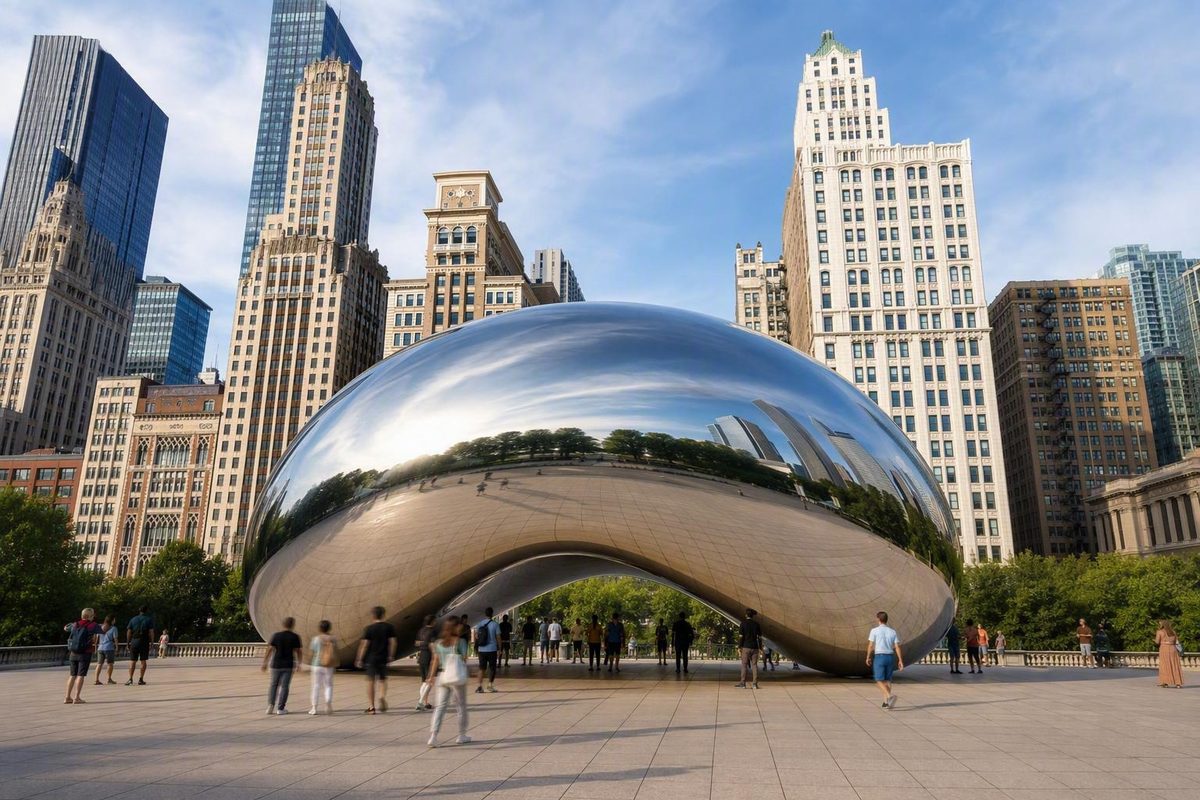
The short answer: What is The Bean?
The Bean is the popular nickname for Cloud Gate, Anish Kapoor’s monumental public sculpture in Chicago’s Millennium Park. Made from highly polished stainless steel, its curved exterior captures the skyline, clouds, greenery, and people, then stretches or compresses those reflections as visitors move around it.
This is not an artwork that must be viewed from behind a rope or from one preferred angle. Visitors can circle the sculpture, approach its reflective surface, and pass through the arch beneath it, subject to current on-site restrictions. From a distance, Cloud Gate resembles a single fluid mass. Up close, it becomes an interactive field of changing reflections.
The exterior offers broad views of the city and sky. The underside creates a more enclosed experience, multiplying faces and bodies overhead. That difference is why one front-facing selfie captures only a small part of the work.
Cloud Gate at a glance
- Official name: Cloud Gate
- Common nickname: The Bean
- Artist: Anish Kapoor
- Material: Polished stainless steel
- Approximate size: 66 feet long, 42 feet wide, and 33 feet high
- Weight: About 110 tons
- Arch height: 12 feet
- Admission: Free
The dimensions and weight are documented in the Choose Chicago guide to Cloud Gate; the City of Chicago describes the 12-foot walk-through arch.
What distinguishes Cloud Gate is visible in the work itself. It turns Chicago into part of the sculpture, places viewers inside the reflection, and changes with light, weather, movement, and viewing position. Its enormous weight contrasts with a surface that appears fluid and almost weightless.
Where The Bean is—and how to recognize the correct location
The official address for Millennium Park is:
201 E. Randolph St. Chicago, IL 60601
The City of Chicago’s Cloud Gate page lists 201 E. Randolph St., Chicago, IL 60602 City of Chicago :: Cloud Gate in Millennium Park. Millennium Park is in the downtown Loop near Michigan Avenue, within the area bordered by Michigan Avenue, Columbus Drive, Randolph Street, and Monroe Street. The official City of Chicago Millennium Park page provides the address and current visitor information.
Cloud Gate’s present setting is Grainger Plaza. Older maps, articles, and visitor reviews may call the same space AT&T Plaza, its former name. The current and former names refer to the same setting, not to two different Bean locations, as summarized in the historical overview of Cloud Gate.
You may also encounter references to McCormick Tribune Plaza. Do not use that as the sculpture’s current official location. For present-day wayfinding, look for Cloud Gate, Grainger Plaza, or Millennium Park.
The distinction matters because “The Bean” is a nickname. A transit map, park sign, event notice, or official webpage may use only the title Cloud Gate. If you enter Millennium Park and do not immediately see a sign saying “The Bean,” you are not necessarily in the wrong place.
A simple arrival strategy is:
- Navigate to Millennium Park at 201 E. Randolph Street.
- Enter from the side most convenient to the rest of your route.
- Follow signs for Cloud Gate or Grainger Plaza.
- Treat older references to AT&T Plaza as references to the same destination.
Check the City’s Millennium Park visitor information shortly before departure. Hours, event layouts, entrances, and temporary access notices are more likely to change than the sculpture’s permanent location.
Admission, park hours, transportation, and accessibility
Admission to Millennium Park is free. The City publishes park hours of 6 a.m. to 11 p.m. daily, but these are park-wide hours, not a guarantee that every feature will remain continuously accessible. The Welcome Center follows a separate schedule, with seasonal variations and possible extended hours on event nights. The City also identifies nearby CTA service, municipal garages, and general accessibility information on its official Millennium Park visitor page.
Temporary closures, maintenance, event preparations, or other restrictions can affect Cloud Gate or the surrounding plaza while the wider park remains open. If seeing the sculpture is the main reason for your trip, check current notices on the day you intend to visit.
Getting there by CTA
Millennium Park is served by nearby CTA trains and buses. Washington/Wabash, Monroe, and Adams/Wabash are among the rail stations identified by visitor guidance as nearby orientation points, but the most practical choice depends on your starting location, current service, elevator availability, and the park entrance you intend to use. Verify live routes and alerts before leaving rather than treating one station as universally best, especially if you require step-free access. These station examples are listed in a Millennium Park visitor guide, while current service conditions should be confirmed through CTA tools.
If you are building a walking day, the geographically shortest transit approach is not always the most efficient. Choose an arrival point that supports the direction in which you plan to continue after Cloud Gate.
Driving and parking
The City identifies four nearby municipal parking facilities:
- Millennium Park Garage
- Millennium Lakeside Garage
- Grant Park North Garage
- Grant Park South Garage
These are options, not guarantees of space, price, or convenient entry at a particular time. Downtown events can affect traffic and availability. If you drive, choose a garage based on the rest of your route rather than proximity to The Bean alone. Parking toward the direction of your next major stop can prevent an unnecessary return across the park.
Accessibility planning
The City describes Millennium Park’s features as accessible to everyone, but that broad statement does not document every sculpture-specific approach, surface condition, entrance, or interaction a visitor may need.
If you use a mobility device or require a particular entrance, elevator, drop-off point, or low-gradient approach, confirm current routing with the City before arrival. Event layouts and temporary barriers can change the most convenient path even when the park itself remains open.
The practical rule is simple: treat the artwork’s dimensions, materials, and location as stable facts, but treat operating hours, transit, parking, entrances, and access conditions as live information.
What to do when you reach Cloud Gate
Begin by resisting the urge to walk directly to the nearest reflective panel. Cloud Gate makes more sense when you first see its complete form.
Stand far enough away to take in the outline and the opening beneath it. Notice how the sculpture appears to rest on relatively narrow points while expanding into a broad arch. Because the polished shell reflects so much of its setting, its edges can seem to dissolve into the plaza.
Then use this five-step observation sequence:
- View the entire sculpture from a distance.
- Circle the convex exterior.
- Walk beneath the arch.
- Look upward inside the omphalos.
- Step back and compare the exterior and underside reflections.
Circle the exterior
Walk one complete circuit rather than taking several photographs from the first open spot. The convex surface bends the skyline differently at every point. A tower may appear tall and narrow from one side, then flatten or curve as you continue. Clouds stretch across the upper surface, while trees, paving, and people collect closer to the lower edges.
The image also changes as other visitors move. Someone crossing behind you can appear beside, above, or unexpectedly distant from you in the reflection. A stationary group may become an elongated band of repeated figures.
Visitors have ordinarily been able to approach and touch the polished surface. Follow posted instructions if barriers or temporary restrictions are present rather than assuming normal interaction is available.
Walk beneath the arch
Cloud Gate’s arch is approximately 12 feet high and leads into the concave mirrored underside. Visitors can normally pass beneath it and approach the reflective surface, according to an approved Cloud Gate visitor account.
The central chamber is called the omphalos. In plain language, it is where the reflections become much more complicated. Instead of the broad skyline views visible outside, the underside folds images inward. Look up and you may see yourself repeated, inverted, compressed, or apparently suspended overhead.
Move slowly and observe what happens when you take only a few steps. A small change in position can reorganize the entire image. When the plaza is busy, the underside becomes a dense pattern of faces, coats, shoes, phones, and gestures. Crowds can obstruct a conventional portrait, but they can also become part of the work’s visual effect.
Compare the two visual experiences
The exterior is expansive. It gathers the sky, buildings, trees, and a broad sweep of plaza activity.
The omphalos is concentrated. It bends visitors back toward the center and creates tighter, repeating imagery. Experiencing both areas makes Cloud Gate feel less like a mirrored object and more like an environment.
A focused visit may take less than an hour if you want a complete circuit, a walk beneath the arch, and several photographs. Allow longer if you are waiting for changing light, experimenting with compositions, traveling with a group, or continuing through the wider park.
Casual photography being common does not establish that climbing, drones, tripods, lighting equipment, or organized commercial shoots are permitted. Check posted rules or contact the City in advance if your plans involve specialized equipment.
Why it is called Cloud Gate—and why everyone calls it The Bean
Cloud Gate is the artwork’s official title. The Bean is its public nickname. They are not separate sculptures, competing installations, or different locations within Millennium Park.
The nickname refers to the work’s smooth, curved, oblong shape. It arose after the public saw renderings while the sculpture was still being developed. From the side, the resemblance to a bean is easy to recognize, and the informal name endured.
Wikipedia’s historical overview reports that Kapoor initially disliked the nickname but later accepted it. Because this is a tertiary account rather than a direct statement from the artist, it is best understood as reported biographical history rather than a definitive account in Kapoor’s own words.
The official title becomes more intelligible when you look at the work. The form was inspired by liquid mercury, while the polished surface draws the reflected sky down across the sculpture. The arch can appear visually like an opening into that reflected sky, although that is an interpretation of the viewing experience rather than a documented statement of the artist’s intent.
Visitors may likewise see Cloud Gate as blending city, park, weather, and viewer. That reading fits the observable effect of the sculpture, but broad claims about community, civic identity, or symbolism should not automatically be attributed to Kapoor without a direct source.
Myth versus fact
Myth: The Bean is the sculpture’s official title. Fact: Its official title is Cloud Gate; The Bean is the familiar nickname.
Myth: Cloud Gate and The Bean are different works. Fact: Both names refer to the same Anish Kapoor sculpture.
Myth: Grainger Plaza and AT&T Plaza are different Bean locations. Fact: Grainger Plaza is the current name; AT&T Plaza is the former name of the same setting.
Myth: Any page using another plaza name must describe a different sculpture. Fact: Older and third-party pages sometimes retain former or inconsistent location terminology.
For practical purposes, use “Cloud Gate” when reading official information and “The Bean” in ordinary conversation. Both names refer to the same work.
How 168 steel plates became a seamless mirror
Cloud Gate looks as though it were formed from one enormous piece of liquid metal. It was not. Its exterior consists of 168 stainless-steel plates fitted together and welded.
The finishing process created the illusion of a continuous skin. The welded exterior seams were ground and polished until they disappeared from ordinary view. That seamless appearance is fundamental to the experience: visible panel lines would interrupt the skyline and divide each reflection into a grid.
At approximately 66 feet long, 42 feet wide, and 33 feet high, and weighing about 110 tons, the sculpture requires much more than a polished shell. Its internal structure uses two large metal rings connected by a truss framework. Flexible connections allow the exterior to respond to expansion and contraction as temperature and weather conditions change. These construction details are documented in the Choose Chicago account of Cloud Gate’s design.
The separation between shell and support solves several problems at once. The internal framework carries the load while the exterior preserves its fluid form.
Those engineering choices directly shape the visitor experience:
- With no visible seams, clouds and buildings appear to flow across the surface.
- With the support concealed inside, the exterior retains its liquid appearance.
- With an open arch, visitors can enter the work instead of only circling it.
Cloud Gate was Kapoor’s first permanent public outdoor work in the United States. The more meaningful comparison is not an unsupported world ranking, but the contrast between the sculpture’s enormous physical weight and its apparently fluid, floating surface.
The 2004–2006 timeline explained
Was The Bean unveiled in 2004 or completed in 2006? Both dates belong to the same construction story.
Cloud Gate was publicly shown in an incomplete state during Millennium Park’s 2004 grand opening. It was then concealed again while construction and surface finishing continued. The work was completed and formally dedicated on May 15, 2006, according to the documented Cloud Gate timeline.
The sequence is clearer when separated into stages:
- 2004: The public saw the sculpture in an unfinished state.
- After the initial showing: Fabrication and surface finishing continued.
- 2006: Cloud Gate was completed and formally dedicated.
The final polishing was not a minor cosmetic task. Without it, plate boundaries and welded joints would have remained visible. The seamless mirror recognized today is therefore associated with the completed work, even though the public had already seen its emerging form.
It is imprecise to say only that Cloud Gate “opened in 2004,” because that implies the finished sculpture was permanently ready then. It is equally misleading to suggest that the work first appeared in 2006. The clearest wording is that it was shown incomplete in 2004, then completed and formally dedicated in 2006.
Crowd-aware photography and a compact Millennium Park walk
Recent visitor reviews commonly recommend early morning as a chance to encounter lighter crowds, but that advice is anecdotal rather than a guarantee. Events, maintenance, school groups, weather, weekends, and seasonal travel can all change conditions. The review-based estimate that a focused visit may take less than an hour is similarly a planning aid, not a fixed duration, as shown on the Tripadvisor Cloud Gate listing.
If a relatively clear composition matters, consider arriving near the beginning of the park’s published day and allow time to wait or change position. More importantly, decide whether you truly need an empty image. Cloud Gate is interactive public art, and a crowd-filled frame can show how people become part of the work.
Better photo ideas than one standard selfie
Try several approaches:
- Reflected clouds flowing over the upper surface
- Skyscrapers bent around the sculpture’s sides
- The complete form photographed from farther across the plaza
- Symmetry beneath the arch
- Repeated figures inside the omphalos
- Trees and greenery curved along the lower exterior
- A person positioned deliberately against a distorted building
- A composition that uses the crowd as a pattern
- A close view in which the sculpture’s physical edge disappears
- Contrasting reflections from two sides of the exterior
Changing position often matters more than specialized equipment. Take a few steps left or right, lower the camera, move farther away, or pass beneath the arch. Each adjustment changes the relationship among the buildings, sky, sculpture, and people.
There is no single correct lighting condition. Bright skies may produce strong architectural reflections, clouds can add movement to the upper surface, and overcast light may reduce harsh contrast. If surfaces are wet, icy, or otherwise difficult to navigate, follow current park guidance and use caution.
Turn The Bean into the start of a continuous walk
Do not arrive, photograph Cloud Gate, leave the park, and then make separate returns for nearby features. A compact sequence is more efficient:
- Cloud Gate
- Crown Fountain
- Jay Pritzker Pavilion area
- Lurie Garden
This is a flexible planning framework, not a verified timed or fully accessible route. Reverse or modify it around closures, events, crowd flow, and the entrance you use. The principle is continuity: move through the park in one direction instead of treating each feature as a separate outing. That approach reflects Chicago Know’s focus on practical walking plans rather than disconnected stops.
Crown Fountain contrasts with Cloud Gate by using faces, light, and water rather than a seamless reflective form. The Jay Pritzker Pavilion area shifts the emphasis toward architecture and performance space. Lurie Garden introduces a quieter, planted environment when access is available.
Check same-day official information for park restrictions, event schedules, garden access, and transportation changes. Do not rely on an undated event or closure notice without confirming whether it still applies.
Choose one extension
After the core park sequence, choose a direction based on the rest of your day:
- Toward Maggie Daley Park: useful if you want to continue east or connect toward the lakefront.
- Toward the Art Institute of Chicago: logical if the museum or the southern side of the park is your next priority.
- Toward downtown or the lakefront: suitable for a longer architecture-and-water itinerary.
Avoid adding every nearby attraction merely because the map makes them look close. Select the extension that supports your next major stop. If your day continues toward the water, a one-way strategy can help you combine downtown and the lakefront without unnecessary backtracking.
Frequently asked questions
Is The Bean in Millennium Park free to visit?
Yes. Admission to Millennium Park is free, and no separate ticket is normally required to view Cloud Gate. Free admission does not guarantee uninterrupted access to the sculpture if the surrounding plaza is affected by maintenance, an event, or another temporary restriction.
What are the official name and current plaza name of The Bean?
The sculpture’s official name is Cloud Gate, while The Bean is its nickname. Its current setting is Grainger Plaza in Millennium Park. Older references to AT&T Plaza describe the same plaza under its former name.
Can visitors walk under and touch Cloud Gate?
Visitors can normally walk beneath Cloud Gate and enter the concave mirrored chamber known as the omphalos. Close approach and touch have also ordinarily been part of the experience. Follow posted instructions if temporary barriers or restrictions are present.
How much time should I allow for The Bean and Millennium Park?
A focused Cloud Gate visit may take less than an hour. That can allow time for a complete exterior circuit, a walk beneath the arch, and several photographs without imposing a fixed pace.
Allow additional time for Crown Fountain, the Jay Pritzker Pavilion area, Lurie Garden, rest stops, event activity, and changing access conditions. Visitors interested in photography or architecture may spend longer because the reflections change with position and light.
What is the best time to visit The Bean with fewer crowds?
Early morning may improve the chance of lighter crowds, but it does not guarantee an empty plaza. Weather, maintenance, events, school groups, weekends, and seasonal visitor patterns can all affect conditions.
If photography is your priority, arrive early, remain flexible, and circle the sculpture before deciding that the crowd has blocked your shot. A small change in position may create a cleaner reflection, while the people already present can become an intentional part of the composition.
Make Cloud Gate the beginning of the route
Cloud Gate rewards more than a quick photograph. Circle the exterior, pass beneath the arch, look upward in the omphalos, and notice how the sculpture turns Chicago’s skyline, weather, and visitors into part of the artwork.
Then continue through Millennium Park in one connected direction. Treat The Bean as the beginning of a compact downtown walk rather than an isolated stop that requires a separate journey. Before setting out, check the City of Chicago’s current hours and access notices so the route reflects conditions on the day you visit.