
16 min read ·
Bishop’s Seat or Papal Honor? How to Read a Church’s Title
A cathedral is the bishop's diocesan seat, while a Catholic basilica has a papal title. St. Peter's is a basilica but not Rome's cathedral.
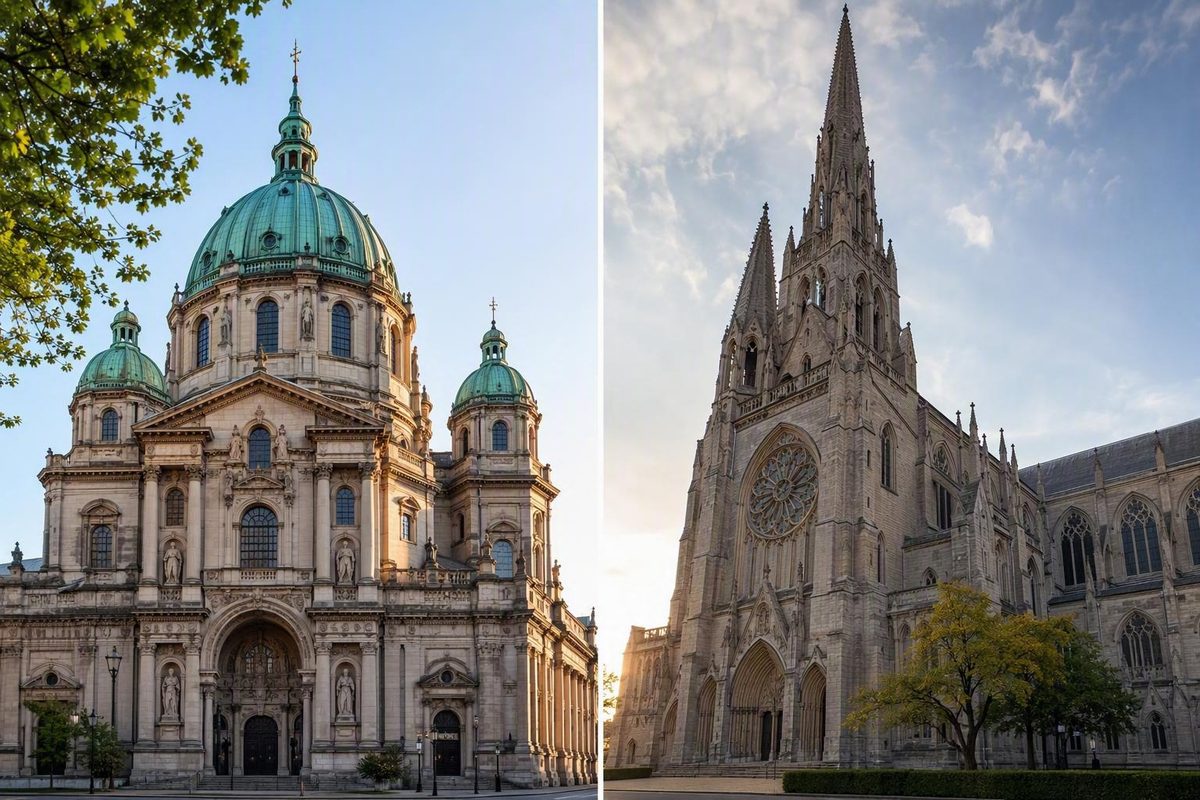
The short answer: diocesan function versus papal designation
A cathedral is the principal church of a diocese and the seat of its bishop. In current Roman Catholic usage, a basilica is a church granted a special title by the pope.
The memorable shorthand is:
- Cathedral = bishop’s seat
- Basilica = papal designation
These are not competing labels or successive steps in a single ranking system. “Cathedral” describes a church’s role in diocesan government and worship. “Basilica” describes a separate distinction conferred through papal authority.
A church can therefore be:
- A cathedral but not a basilica
- A basilica but not a cathedral
- Both a cathedral and a basilica
- Neither a cathedral nor a basilica
The distinction matters because appearance is an unreliable guide. The largest church in a city is not automatically its cathedral. A richly decorated pilgrimage church is not automatically a basilica. A modest or modern building can be a cathedral, while a world-famous basilica may not be the local bishop’s seat.
This guide uses basilica primarily in its current Roman Catholic sense. The word also has an older architectural meaning, discussed below. That Catholic definition should not be imposed on every Christian tradition.
| Point of comparison | Cathedral | Catholic basilica |
|---|---|---|
| Defining basis | Its function as the bishop’s diocesan church | A title granted by the pope |
| Connection to authority | Connected to the bishop and diocese | Connected to papal recognition |
| Primary role | Central church for diocesan governance and major worship | Church recognized for particular religious importance |
| Architectural requirements | No required size, age, period, or style | The title does not require a basilican floor plan |
| Can the titles overlap? | Yes | Yes |
The basic difference is therefore one of office versus distinction. A cathedral is tied to the office of a bishop; a basilica has received a papal distinction. Neither title necessarily means that the building is especially large or elaborate, as Britannica’s comparison of basilicas and cathedrals explains.
What makes a church a cathedral?
A cathedral is the principal or central church of a diocese, the territorial community overseen by a bishop. Its status comes from its association with the bishop’s official ceremonial seat—not from its dimensions, towers, façade, artwork, age, or prominence in a guidebook.
The word cathedral comes from the Latin cathedra, meaning “chair” or “throne.” In this context, the chair represents the bishop’s teaching and governing authority within the diocese. It is more than an impressive item of sanctuary furniture.
A cathedral consequently serves as a focal point for diocesan life. Important liturgies and gatherings may be held there, especially when the bishop presides. The building can also function as a parish church with its own regular worshipping community, even though its responsibilities extend beyond its immediate neighborhood.
A helpful comparison is a civic seat of government. A county seat is defined by its administrative function, not by whether its courthouse is the largest or most beautiful building in the county. In the same way, a cathedral is defined by its place in the structure of the diocese.
The bishop’s chair is the key
Visitors sometimes expect the bishop’s chair to be visually unmistakable. It may be prominent, but cathedral status does not depend on whether a casual observer notices it. The decisive point is that the church has been established as the bishop’s diocesan seat.
The cathedra expresses several related aspects of the cathedral’s role:
- The bishop presides over significant diocesan worship.
- The church serves as a visible center for the diocese.
- Services and gatherings may involve clergy and congregations from outside the cathedral parish.
A church does not become a cathedral simply because architects install a grand chair. It becomes a cathedral through its diocesan function, and the cathedra gives visible expression to that function.
A cathedral is not an architectural style
In popular imagination, cathedral often suggests pointed arches, stained glass, flying buttresses, high vaults, towers, and immense stone interiors.
A cathedral may be:
- Gothic, Romanesque, Baroque, Neoclassical, Modernist, or another style
- Ancient or comparatively recent
- Monumental or restrained
- Constructed from stone, brick, concrete, wood, or other materials
- Internationally famous or little known outside its region
Calling a church “cathedral-like” describes its atmosphere or appearance, not its official role. A vast Gothic Revival church without a bishop’s seat is not a cathedral merely because it resembles familiar cathedral buildings. Conversely, a modest church can be a cathedral if it serves as the diocesan bishop’s church.
What about co-cathedrals?
A diocese usually has a principal cathedral, but it may also have a co-cathedral. A co-cathedral shares cathedral status with another church in the same diocese.
This qualification prevents an overly rigid rule that every diocese invariably has exactly one building that may correctly bear a cathedral title. The underlying definition remains unchanged: both cathedral and co-cathedral status concern diocesan function and the office of the bishop, not architectural merit. A Catholic explanation of the distinction notes that a large diocese may have a co-cathedral in addition to its cathedral.
What makes a Catholic church a basilica?
In current Roman Catholic usage, a basilica is a church granted that title by the pope. The designation recognizes particular religious importance and expresses a special bond with the papacy.
These qualities should not be treated as a do-it-yourself checklist. Great age, famous artwork, relics, beauty, or pilgrimage traffic does not by itself turn a church into a basilica.
A church may possess several of those characteristics without holding the title. The central point is procedural and ecclesiastical: basilica status is granted, not inferred. A visitor cannot establish it merely by examining the building.
Papal recognition, privileges, and responsibilities
Basilica status reflects a special relationship with the pope. Within Catholic life, the designation may carry ceremonial privileges, recognized symbols, and liturgical responsibilities.
Those details do not change the basic comparison. Receiving basilica status does not make a church the diocesan bishop’s seat. If a basilica is not the bishop’s seat, it is not a cathedral—regardless of its fame, scale, decoration, or importance to pilgrims.
Nor does the title guarantee that every basilica will offer the same visitor experience. Basilicas differ in age, appearance, pastoral role, architectural plan, and public prominence. The designation communicates papal recognition, not a standard building type.
Major and minor basilicas
Catholic basilicas are classified as major or minor. The four major basilicas traditionally associated with Rome are:
- St. John Lateran
- St. Peter’s
- St. Mary Major
- St. Paul Outside the Walls
The Basilica of Sts. Peter and Paul’s institutional explanation identifies these four churches as the major or papal basilicas.
Other churches granted basilica status are generally classified as minor basilicas, whether located in Rome or elsewhere. “Minor” names a category; it does not dismiss the church’s importance to its community, history, or worshippers.
Minor basilicas may be recognized for qualities including antiquity, dignity, historical value, artistic or architectural worth, and significance as centers of worship. Active liturgical life and a special bond with the pope are also part of the designation. These considerations explain what the title may recognize, but they do not allow visitors to confer it informally.
The words major and minor should not be turned into a universal ranking of every church’s practical importance. A cathedral has a diocesan function that a minor basilica may not have. Within a diocese, the cathedral remains central because it is the bishop’s church.
How one church can hold both titles
A church can be both a basilica and a cathedral because the titles answer different questions:
- Cathedral status: What role does this church have within its diocese?
- Basilica status: Has this Catholic church received papal designation?
There is no contradiction when both answers apply. The church is a cathedral because it is the bishop’s diocesan seat, and it is a basilica because it has received the separate papal title.
| Classification | What it means |
|---|---|
| Cathedral but not basilica | The bishop’s diocesan church without basilica designation |
| Basilica but not cathedral | A church with the papal title that is not the diocesan bishop’s seat |
| Both | The bishop’s seat and a church with basilica designation |
| Neither | A church with neither the diocesan role nor the papal title |
St. John Lateran: both basilica and cathedral
St. John Lateran is the clearest example of overlapping status. It is a major basilica and the cathedral of the Diocese of Rome.
Its titles describe two aspects of its identity:
- As a cathedral, it is the seat associated with the Bishop of Rome.
- As a major basilica, it holds a separate papal distinction.
Neither title makes the other redundant. Both are accurate because each communicates a different kind of status.
St. Peter’s: basilica, but not Rome’s cathedral
St. Peter’s Basilica provides the contrasting example. It is a major papal basilica and is closely associated with the pope, but it is not the cathedral of Rome. The official St. Peter’s Basilica website confirms that St. Peter’s is a papal basilica while St. John Lateran is Rome’s cathedral.
That distinction can surprise visitors because St. Peter’s is internationally famous, visually imposing, and strongly associated with major papal ceremonies. Yet none of those characteristics determines cathedral status.
Cathedral status does not automatically go to the church that:
- Is most famous
- Appears most often in photographs
- Has the most prominent dome
- Accommodates large crowds
- Has the strongest popular association with the pope
- Seems most important to tourists
It belongs to the church that serves as the bishop’s diocesan seat. For the Diocese of Rome, that church is St. John Lateran.
The practical two-question test
When a guidebook, plaque, or itinerary uses either title, ask two independent questions:
-
Does this church serve as the diocesan bishop’s seat? If yes, it is a cathedral.
-
Has this Catholic church received basilica designation from the pope? If yes, it is a basilica.
If both answers are yes, both titles apply. This test is more dependable than judging the building by its appearance and avoids treating cathedral and basilica as rungs on a single ladder.
Basilica as a title versus basilica as an architectural form
The word basilica creates additional confusion because it has both an architectural history and an ecclesiastical use.
Before becoming a Catholic title, basilica referred to a type of Roman public building. At a high level, the form consisted of a long hall, commonly organized with a central nave and side aisles. The arrangement was later adapted for Christian worship.
In architectural writing, a historian may describe a building as basilican because of its longitudinal plan, nave, aisles, and related spatial organization. In that context, the word describes how the building is arranged—not an honor conferred by the pope.
The two meanings must be kept separate
The distinction can be summarized as follows:
- Architectural basilica: A building associated with a historical form or plan
- Catholic basilica: A church possessing a papally granted title
The two meanings can coincide, but they do not have to.
A Catholic basilica does not need to follow the ancient basilican plan. It may have a centralized design, a dome, transepts, extensive later additions, or a plan shaped by another architectural period.
Conversely, a church can have a central nave, side aisles, an apse, and other basilican features without holding the Catholic title. Architecture alone cannot confer ecclesiastical status.
The historical connection helps explain why one word carries both meanings. Roman public halls provided a useful model for early Christian assembly spaces, while the later Catholic title developed as a distinct ecclesiastical designation. A Catholic architectural overview traces the basilica form from Roman public buildings to Christian churches while distinguishing that history from papal recognition.
Why appearance remains an unreliable test
Travelers often try to decode church titles from visible clues. A long nave may look basilican. A great dome may make a church seem important enough to be a basilica. Towers or pointed arches may make another building seem cathedral-like.
Those impressions can be useful when discussing architecture, but they do not establish official status.
You cannot determine basilica designation solely from:
- The shape of the floor plan
- The presence of a dome
- The number or height of towers
- The age of the building
- The richness of its decoration
- The prominence of the façade
- The presence of an apse or side aisles
- The number of visitors
Context matters. In an architectural history, basilica may identify a building type. On a Catholic church’s official sign, it may identify the papal title. Sometimes both meanings apply, but neither should be assumed without checking.
Common misconceptions about basilicas and cathedrals
The safest approach is to separate what a church looks like from what it officially does or has been designated to be.
Myth: A cathedral is the largest church in a city
Fact: A cathedral is defined by its relationship to the diocesan bishop. It may be the city’s largest church, but size is not the criterion.
Another church nearby may be longer, taller, older, or able to accommodate more people. That does not transfer the bishop’s seat to it. A modest-looking building remains a cathedral if it serves as the bishop’s diocesan church.
A city may also contain cathedrals belonging to different episcopal Christian traditions. In that situation, “Which building is the city’s cathedral?” may be too vague. The more precise question is: cathedral of which diocese or church body?
Myth: A cathedral must be old, ornate, or Gothic
Fact: Cathedral is a function, not an architectural style.
That historical association has shaped popular imagination, but pointed arches, stained glass, and vaults neither create nor prove cathedral status.
A cathedral can be modern, restrained, or smaller than nearby churches. Its diocesan role is decisive.
Myth: Every famous pilgrimage church is a basilica
Fact: Pilgrimage, history, artwork, relics, and devotional importance do not automatically confer basilica status.
Those qualities may contribute to a church’s recognized significance, but the Catholic title requires papal designation. A church can be internationally important to pilgrims without being a basilica. Conversely, a basilica need not be globally famous.
Myth: Every basilica is architecturally basilican
Fact: The Catholic title does not certify that the church follows the historical Roman-derived floor plan.
Some titled basilicas have a longitudinal nave-and-aisles arrangement; others reflect different architectural traditions. An untitled church may still be accurately described as basilican in architectural terms.
Myth: Basilicas universally outrank cathedrals
Fact: The two labels describe different kinds of status.
A cathedral’s importance comes from its diocesan function. A basilica’s title reflects papal recognition. Asking which universally “ranks higher” confuses an administrative role with a distinction.
A minor basilica does not become the center of diocesan governance merely by receiving that title. If another church is the bishop’s seat, that other church is the cathedral.
Myth: An imposing basilica must also be a cathedral
Fact: A basilica is a cathedral only when it also serves as the diocesan bishop’s seat.
St. Peter’s illustrates the point. Its fame, scale, art, ceremonies, and association with the pope do not make it Rome’s cathedral. St. John Lateran holds that role.
Myth: A church can have only one special classification
Fact: Church titles can accumulate because they describe different attributes.
A church may be both a cathedral and a basilica. It may also be identified as a shrine, a distinct classification connected to sacred significance or devotion. Basilica, cathedral, and shrine are not synonyms, and one does not automatically imply another. An official Catholic basilica explanation notes that these classifications can occur in combination.
Shrine status falls outside the main comparison here, but it reinforces the larger principle: church names can contain several layers of information.
How to interpret the titles while visiting a church
For travelers, a church’s title is a compact piece of institutional and historical information. Read correctly, it can reveal something the exterior alone cannot.
When a sign or map says cathedral, understand it to mean:
This church has a central diocesan role and is associated with the bishop’s seat.
That may explain why important diocesan services take place there, why the bishop’s chair is prominent, or why the building has responsibilities extending beyond an ordinary parish.
When a Catholic church is called a basilica, understand it to mean:
This church has received special papal recognition.
That designation may invite questions about the church’s spiritual, liturgical, historical, artistic, architectural, or cultural significance. It does not promise a particular scale, age, layout, degree of decoration, admission policy, or visitor experience.
Check official wording instead of guessing
Consult the church’s official sign, website, visitor materials, or diocesan information. Look for precise wording such as:
- Cathedral
- Co-cathedral
- Major basilica
- Minor basilica
- Cathedral basilica
- Basilica and shrine
Do not promote a church to cathedral or basilica status because someone calls it “cathedral-like” or describes its interior as having “a basilica plan.” Those descriptions may be architecturally meaningful without identifying an official ecclesiastical title.
Likewise, do not assume that the most prominent church on the skyline must be the cathedral. The bishop’s seat may occupy a less conspicuous building, while a celebrated basilica may have no cathedral function.
Read the titles as different layers of the story
A cathedral title primarily conveys information about diocesan administration, episcopal authority, and worship. It locates the church within the organization of a diocese and identifies its relationship to the bishop.
A basilica title primarily conveys papal recognition and acknowledged religious importance. Understanding why a particular church received that distinction requires examining its own history and religious life.
When both words appear, retain both layers. “Cathedral basilica” is not needless repetition. It means the church is the bishop’s diocesan seat and also possesses basilica designation.
The word cathedral is not limited to Roman Catholicism. It is also used in Anglican, Lutheran, Eastern Orthodox, and other episcopal Christian traditions. The details of governance and terminology may differ, so the Roman Catholic framework should not simply be applied to all of them.
By contrast, this guide’s definition of basilica as a papally granted church title is specifically Roman Catholic. The architectural use of the word is broader and historical.
Frequently asked questions
Can the same church be both a basilica and a cathedral?
Yes. Cathedral status identifies the church as the diocesan bishop’s seat, while basilica status identifies a separate papal distinction. A church satisfying both conditions can accurately carry both titles.
St. John Lateran is the principal example: it is a major basilica and the cathedral of the Diocese of Rome.
Why is St. Peter’s Basilica not the cathedral of Rome?
St. Peter’s is not Rome’s cathedral because it is not the designated seat of the Bishop of Rome. That role belongs to St. John Lateran.
St. Peter’s fame, scale, visual prominence, ceremonies, and close association with the pope do not determine cathedral status. Diocesan function does.
Does a cathedral have to be large, old, or Gothic?
No. A cathedral is defined by its connection to the bishop’s seat, not by size, age, ornamentation, or architectural style.
It can be modern, modest, or built in any number of styles. Gothic architecture is associated with many famous European cathedrals, but it is neither a requirement nor proof of cathedral status.
What is the difference between a major basilica and a minor basilica?
The major category consists of St. John Lateran, St. Peter’s, St. Mary Major, and St. Paul Outside the Walls. Other Catholic churches granted basilica designation are generally classified as minor basilicas, as summarized in this Catholic explanation of major and minor basilicas.
“Minor” distinguishes the category from the major basilicas; it does not mean that the church lacks spiritual, historical, liturgical, artistic, architectural, or cultural importance.
Is basilica an architectural term as well as a Catholic title?
Yes. Historically, a basilica was a Roman public-building form later adapted for Christian worship. At a high level, it is associated with a longitudinal hall, central nave, and side aisles.
In current Roman Catholic usage, basilica can also mean a church granted that title by the pope. A titled basilica does not need a basilican floor plan, and a church can have basilican architectural features without possessing the papal title.
The final test to remember
Ask two questions:
- Is this the church of the diocesan bishop? If so, it is a cathedral.
- Has it received the Catholic title of basilica from the pope? If so, it is a basilica.
If both answers are yes, both titles legitimately apply.
St. John Lateran shows how the titles can overlap: it is a major basilica and Rome’s cathedral. St. Peter’s shows how they can remain separate: it is a major basilica but not Rome’s cathedral. Official function and designation—not fame, scale, age, or appearance—determine which description is correct.