
3 min read ·
Plan Buckingham Fountain Into a Grant Park and Lakefront Walking Day
See when Buckingham Fountain operates, how to reach it by CTA, and how to build it into a practical Grant Park and lakefront walking route.
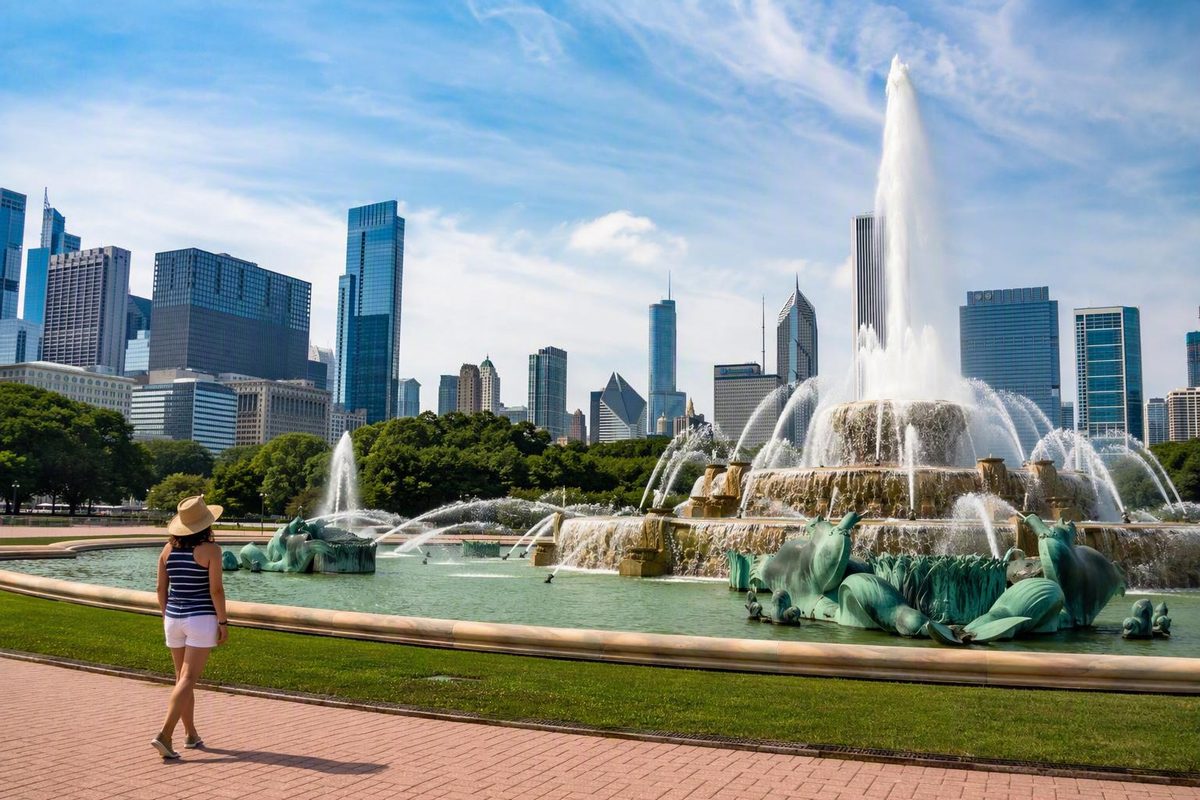
Buckingham Fountain works best as the middle of a Grant Park walking route, not as a separate out-and-back stop. Enter the park from the Loop, walk south to the fountain, turn toward the lake, then continue north to Millennium Park. Allow roughly two hours for the compact version, plus any time you spend watching a display or visiting nearby attractions.
Check whether the fountain is running
Buckingham Fountain is seasonal. The Chicago Park District describes its usual operating season as May through October, with water displays every 20 minutes and a light-and-water display from 9 to 10 p.m. Grant Park itself is listed as open from 6 a.m. to 11 p.m. (Chicago Park District).
For 2026 specifically, the season began with the fountain’s official switch-on at noon on May 9 (Switch on Summer). The published May-to-October range is general rather than a guarantee of operation on a particular day, so check the Park District page again before making an evening show the fixed point of your plan.
The fountain does not disappear outside its operating season: its broad basin, rococo “wedding cake” composition and skyline setting are still visible. The water display is the reason to time the stop carefully, however. The fountain was dedicated in 1927 as Kate Sturges Buckingham’s memorial to her brother Clarence; its four sculptural groups represent the four states bordering Lake Michigan (Choose Chicago).
Follow this one-way downtown route
1. Enter Grant Park from the Loop
Washington/Wabash and Jackson are useful rail arrival points for this route. CTA lists Washington/Wabash as accessible on the elevated lines and Jackson as accessible on both the Red and Blue lines (CTA accessibility). From either station, head east into Grant Park, then turn south rather than walking straight to Millennium Park. This puts Buckingham Fountain ahead of you and avoids returning over the same blocks later.
2. Make Buckingham Fountain the main pause
Approach from the west for the composition of fountain, open sky and lake beyond. Allow 20 to 30 minutes: enough to circle the basin, look back toward the Loop skyline and wait for the next display if the fountain is operating.
The park is generally flat, but it is crossed by large boulevards (Chicago Park District). Use marked crossings and expect the street crossings—not elevation—to be the main interruption.
3. Turn east, then walk north along the lakefront
After the fountain, continue toward the water using the signed park paths and crossings. Join the northbound lakefront route rather than returning west immediately. The Chicago Lakefront Trail runs through Grant Park as part of its 18-mile course, so the fountain can be folded into a genuine lakefront walk rather than treated as a downtown detour (Chicago Park District).
Keep this section short if sightseeing is the priority. Once you have had the open-water view, angle back into the northern part of Grant Park for Maggie Daley Park and Millennium Park. That produces a clean sequence: Loop architecture, formal park, fountain, lakefront and modern public art.
At Millennium Park, either finish at Cloud Gate or continue with the more detailed downtown and lakefront route. If the sculpture is your endpoint, the Cloud Gate visit guide explains what to look for as you move around it.
For alternatives beyond this walk, Choose Chicago’s citywide roundup collects iconic attractions and tours in one place.
Use the shorter version when time or mobility is limited
Skip the lakefront extension and walk directly north through Grant Park after the fountain. This retains the fountain-to-Millennium Park sequence while reducing crossings and exposure to lakefront wind.
All CTA bus routes use accessible buses, and CTA advises checking system status for elevator notices before travel (CTA accessibility). The park’s generally flat terrain helps, but temporary event fencing and boulevard crossings can still change the easiest path.
Best timing
- Daylight: Best for seeing the fountain’s sculpture, skyline and relationship to Lake Michigan.
- Around 9 p.m. in operating season: Best if the light-and-water display is the priority. Confirm same-day operation first.
- Outside May–October: Plan for the fountain as an architectural stop, not an active water show.
No separate fountain stop is needed if your day already includes Grant Park or Millennium Park. Put it between the Loop and the lake, keep moving north, and the landmark becomes part of the route instead of a detour.