
14 min read ·
Three Educational Institutions That Reveal a Lesser-Known Side of William Burn
Edinburgh Academy, John Watson's Institution and Madras College are the strongest starting points, though Madras is less well corroborated.
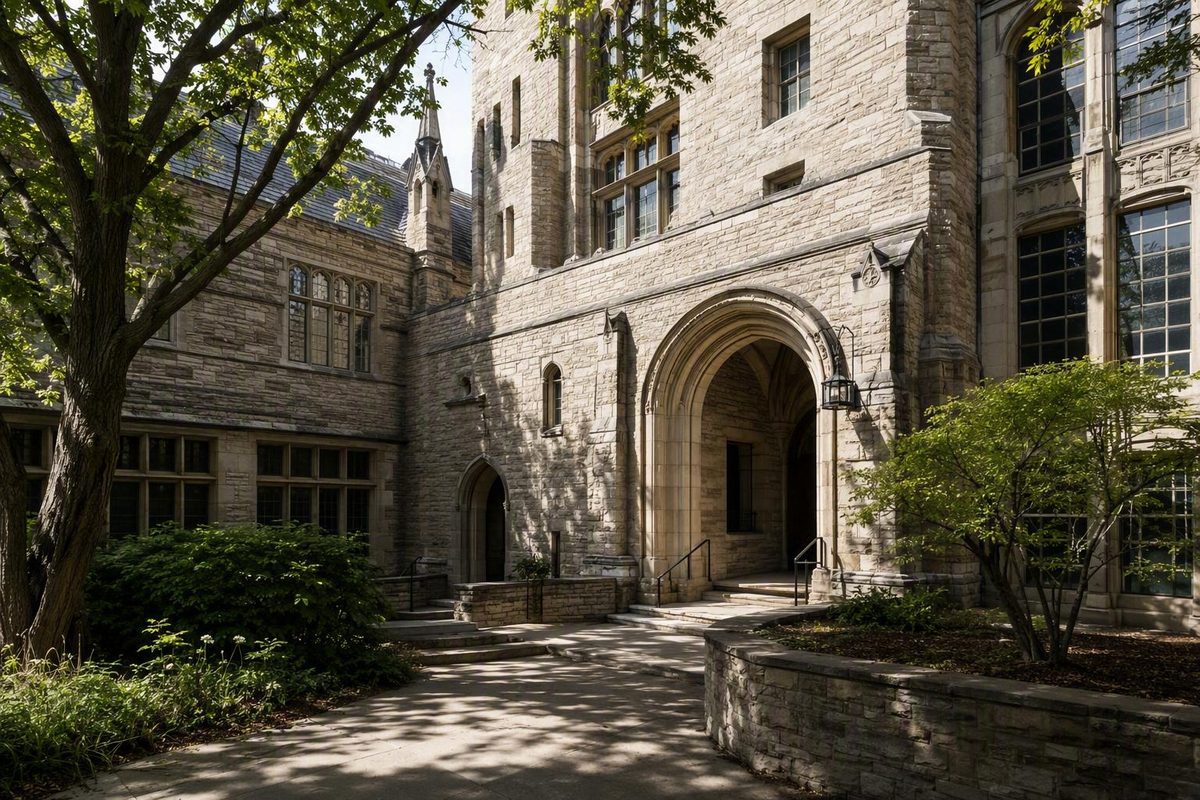
William Burn is remembered chiefly for country houses, churches, civic commissions, and his contribution to revivalist architecture in Scotland. A smaller group of education-related projects reveals a different part of his practice: buildings created for teaching, residential care, or institutions that combined the two.
The available evidence points to three examples: Edinburgh Academy, John Watson’s Institution in Edinburgh, and Madras College in St Andrews. They represent an academy, a residential educational charity, and a college. Their later histories also diverged: Edinburgh Academy remains a school, while John Watson’s Institution became an art gallery. The current use of the Burn-attributed building at Madras College is not established by the sources reviewed here.
This is a carefully bounded introduction, not a definitive catalogue. The online sources are selective and largely tertiary, and they do not establish complete construction chronologies, alteration histories, or the precise extent of surviving work by Burn. Madras College is especially provisional because its attribution, date, and stylistic description depend here on a single general works list.
William Burn’s educational buildings at a glance
The table summarizes the three education-related attributions supported by the available sources. Its dates and stylistic labels come from a non-exhaustive list of William Burn’s works.
| Building | Location | Source-reported year | Original institutional type | Source-reported style | Present use established here |
|---|---|---|---|---|---|
| Edinburgh Academy | Henderson Row, Edinburgh | 1824 | School or academy | Not specified | Still used as a school |
| John Watson’s Institution | Edinburgh | 1825 | Residential charity providing care and education | Neoclassical | Modern One, Scottish National Gallery of Modern Art |
| Madras College | St Andrews | 1832 | College | Jacobean | Not established |
The years should not be treated as confirmed opening or completion dates. A year in a general works list might mark a commission, design, construction campaign, opening, or another project milestone. The sources do not clarify what the dates mean consistently across the three entries.
The institutional categories also require care. Edinburgh Academy can straightforwardly be described as a school. Madras College is identified as a college, although the evidence considered here does not explain the commission or the extent of Burn’s contribution. John Watson’s Institution was more complex: it brought residence, welfare, care, and education together in one charitable establishment.
The style labels are similarly limited. The works list calls John Watson’s Institution Neoclassical and Madras College Jacobean, but it does not provide building-level analysis in support of either description. No corresponding style is supplied there for Edinburgh Academy.
These three buildings are therefore best understood as a selected, evidence-backed group. A comprehensive catalogue would need to distinguish complete new buildings from additions, alterations, joint projects, unsuccessful competition entries, and uncertain attributions.
Where education fits within William Burn’s wider career
William Burn was a Scottish architect who lived from 1789 to 1870. He attended Edinburgh’s Royal High School and trained in the London office of Robert Smirke before establishing his career in Scotland. The Victorian Web describes him as a versatile architect associated with Edinburgh neoclassicism, castellated and picturesque design, Gothic Revival details, and Scottish Baronial architecture within a long and varied practice.
Those career-wide associations should not be assigned automatically to every educational commission. An architect may work in several architectural modes, and a general reputation for Gothic Revival or Scottish Baronial design does not prove that a particular school or college belongs to either category.
Burn became especially prominent for country houses, but his output also encompassed churches and public buildings. Educational work was one strand within that broader practice rather than the category for which he is now best known. Even so, an academy, a residential children’s institution, and a college demonstrate that his commissions extended beyond private estates and conventional civic or ecclesiastical work.
The evidence does not support a detailed reconstruction of how Burn planned these institutions. It does not establish their original classroom arrangements, circulation systems, construction materials, costs, contractors, or complete sequences of alteration. Nor does it identify every surviving element that can confidently be assigned to Burn.
Online works lists must also be read according to their stated or apparent scope. A short biography may mention only a few country houses, churches, or public buildings without intending to reject other documented categories. Absence from a selective list is weak evidence against an attribution found elsewhere.
For that reason, the three examples do not carry equal evidentiary weight. Edinburgh Academy and John Watson’s Institution appear in a general works list and in a separate Edinburgh-focused account. Madras College appears only in the general list reviewed here. It can be included provisionally, but it should not be presented as equally corroborated.
Edinburgh Academy: a Burn-designed school still in educational use
The Edinburgh Academy building on Henderson Row is attributed to William Burn. The general works list places it under 1824, although it does not identify that year as the date of commission, construction, opening, or completion.
An Edinburgh architectural account independently names Burn as the designer and says that the Henderson Row building remains in use as a school. Continued educational use is the most significant fact established by the available evidence. It preserves a direct connection between the building and the institutional purpose for which it was created.
That continuity distinguishes Edinburgh Academy from John Watson’s Institution, whose original educational and charitable function ended before the building was adapted as an art gallery. Continued use does not, however, mean that the academy survives unchanged.
Historic schools commonly evolve as educational requirements and building services change, but the supplied evidence does not document what happened at this particular site. It would therefore be unsafe to identify the building’s present plan, façade, interiors, or additions as entirely Burn’s work.
The evidence also does not describe the original commission in detail. It offers no project-level account of the academy’s materials, classroom organization, construction phases, costs, contractors, or later architects. Visual resemblance to other Burn buildings would not by itself resolve those questions.
A definitive architectural history would require institutional records, original drawings and specifications, building accounts, listed-building documentation, and conservation reports capable of distinguishing Burn’s work from later phases. On the present evidence, the responsible conclusion is narrower: Burn is identified as the architect of the Henderson Row building, the works list associates it with 1824, and the building remains in school use.
John Watson’s Institution: education, residential care, and adaptive reuse
John Watson’s Institution was an Edinburgh commission attributed to Burn. The sources also use the name John Watson’s Hospital for the historic building. That variation should be acknowledged without assuming that the two forms were used interchangeably throughout the institution’s history.
This was not simply a conventional school. It was commissioned as a home providing care and education for fatherless children, bringing accommodation, welfare, and teaching together within one institution. Its residential and charitable purposes are essential to understanding the commission.
The Edinburgh account says Burn was commissioned in 1825, that the institution closed in 1975, and that National Galleries Scotland acquired the building in 1984. It now houses Modern One of the Scottish National Gallery of Modern Art, according to the same account of Burn’s Edinburgh buildings.
Those dates establish a broad institutional sequence, but not a construction chronology. The commission year does not necessarily identify when work began, when the building was completed, or when its first residents arrived.
The general works list describes the building as Neoclassical. That label is reported here as the source’s classification rather than as an independently demonstrated architectural analysis. The supplied material does not identify the compositional or decorative features on which the description rests.
The change from residential educational charity to art gallery creates the clearest contrast with Edinburgh Academy. Both buildings continue to serve public-facing institutions, but the purpose of John Watson’s building has changed fundamentally. Its present cultural role should not obscure its original social function.
At the same time, the sources do not document the physical conversion. They do not identify which original rooms or circulation routes survive, what structural interventions were required, or which architects directed the adaptation. Any account of those changes would need evidence beyond the present source set.
John Watson’s Institution also demonstrates the limitations of catalogues organized only by building name and date. A useful record must distinguish the historic institution from the building’s current occupant, describe its original mixed function, and note naming variations. Otherwise, it can be mistaken either for a conventional school or for an art gallery originally designed by Burn.
Madras College: the St Andrews example
Madras College extends the geographical scope of Burn’s identified educational work beyond Edinburgh. The available works list attributes the St Andrews project to him, places it under 1832, and describes it as Jacobean in the same project listing.
All three points require qualification because they come from one general tertiary source. No second source in the supplied material independently confirms the attribution, explains what the date represents, or identifies the features supporting the Jacobean label.
The date should consequently be treated as a project reference rather than a confirmed construction or completion year. The source also does not clarify whether Burn designed an entire complex, one principal building, or a particular phase in the institution’s development.
Likewise, “Jacobean” is a reported classification, not a conclusion demonstrated here through analysis of massing, roofline, openings, ornament, or historical precedent. Assigning such a label securely would require project-specific architectural documentation.
Madras College remains significant because it suggests that Burn’s education-related commissions were not confined to the Scottish capital. It places one identified project in St Andrews and indicates that this part of his practice had a wider geographical reach.
Beyond that limited finding, the profile must remain provisional. The supplied evidence does not establish the circumstances of the commission, construction sequence, relationship between Burn’s work and the wider campus, later additions, present ownership, current accessibility, or the extent of surviving original fabric.
Madras College therefore belongs in this introductory group as a singly sourced example awaiting stronger corroboration. It should not be described as being as well documented here as Edinburgh Academy or John Watson’s Institution.
Comparing three different institutional purposes
The most reliable comparison among these projects is functional rather than visual. The sources identify an academy, a residential educational charity, and a college. That range shows Burn working for institutions with different purposes and constituencies.
Edinburgh Academy is the clearest school commission. Its continued use preserves the relationship between the building and its original institutional category, although the available evidence does not establish how much of its present fabric belongs to Burn.
John Watson’s Institution combined education with accommodation and charitable care. Its residents did not simply arrive for lessons and leave at the end of the day. That residential and welfare dimension makes its original purpose more complex than the broad labels “school” or “college” would suggest.
Madras College supplies the college example and expands the geographical picture to St Andrews. Because its attribution is supported here by only one general list, it contributes less to a detailed architectural comparison than the two Edinburgh buildings.
Their later histories differ as well. Edinburgh Academy remains a school, while John Watson’s Institution now serves as an art gallery. The current use of Burn’s attributed work at Madras College is not established by the evidence, so a complete three-way comparison would be misleading.
The source-reported styles provide a more tentative contrast. John Watson’s Institution is called Neoclassical, whereas Madras College is called Jacobean. Those labels suggest that Burn did not apply a single stylistic formula to every educational commission, but the sources do not explain the architectural evidence underlying either classification.
Burn’s broader association with neoclassicism, Gothic Revival, castellated design, and Scottish Baronial architecture cannot fill that gap. Career-wide versatility is relevant context, not proof of the style or authorship of an individual feature.
The three buildings nevertheless demonstrate professional range. They connect Burn with three distinct forms of educational or education-adjacent institution. They do not establish a theory of his educational planning, summarize all his public architecture, or prove that these were his only commissions in the field.
Old College and Royal High School: two attribution traps
Two important Edinburgh educational buildings are connected with Burn for reasons that do not make them executed works by him.
The first is the University of Edinburgh’s Old College. Burn entered the 1816 competition to complete Robert Adam’s university project, but William Henry Playfair won. Burn’s involvement belongs under unrealized proposal, not completed building, as also recorded in a selected account of his Scottish career.
Competition entries remain relevant to architectural history because they show that an architect engaged with a particular programme and site. They do not, however, become executed works when another competitor receives the commission.
The supplied evidence does not describe Burn’s proposed design or confirm what submission material survives. It would therefore be inappropriate to reconstruct his scheme, compare it in detail with Playfair’s work, or attribute parts of the completed building to him.
The second trap is Edinburgh’s Royal High School. Burn attended the school before training under Robert Smirke in London, but attendance is a biographical connection rather than evidence of architectural authorship. A biographical account identifies both his schooling and training while presenting the Royal High School as part of Burn’s early life, not as one of his designs.
A practical classification rule helps prevent these errors:
- Executed works are buildings, additions, or documented phases attributed to Burn as architect.
- Unrealized proposals include competition entries and schemes that were not constructed from his design.
- Biographical associations include schools he attended and buildings connected with his life but not his architectural work.
- Uncertain or singly sourced attributions should remain qualified until project-level evidence corroborates them.
- Later work by partners, pupils, or other architects should not be absorbed automatically into Burn’s catalogue.
Researchers must also confirm that a reference to “William Burn” means the Scottish architect born in 1789 rather than another person or a similarly named practice. The architect’s identity, project, location, and role should be checked together.
What remains unverified about Burn’s educational architecture
The available material supports an introductory source review, not a definitive architectural catalogue. Edinburgh Academy, John Watson’s Institution, and Madras College emerge as the most relevant examples in the supplied evidence, but the support is uneven and comes mainly from general reference, tourism, and architecture-summary pages.
Chronology is the first unresolved issue. The listed years do not consistently reveal whether they mark appointment, design, construction, occupation, opening, or completion. Only John Watson’s Institution has a source that explicitly connects its year with Burn’s commission.
The second gap concerns the extent of Burn’s physical contribution. An institution may occupy several buildings or incorporate multiple campaigns by different architects. A building correctly attributed to Burn may also contain substantial later alterations. The reviewed sources do not map his contribution onto the surviving fabric of any of the three sites.
Other unresolved questions include:
- What original drawings, specifications, correspondence, and accounts survive?
- Were the buildings executed exactly as Burn designed them?
- Which contractors, assistants, or clerks of works participated?
- What additions or alterations followed the original campaigns?
- Which interiors and external features can be attributed securely to Burn?
- What project-level evidence supports the Neoclassical and Jacobean labels?
- Did Burn design other schools, colleges, or charitable educational institutions?
- Did he undertake additions that disappear from short building lists?
David Bryce is relevant to the history of Burn’s practice, but not automatically to these projects. Bryce became Burn’s pupil and later his partner; the supplied evidence does not show that he worked on Edinburgh Academy, John Watson’s Institution, or Madras College. A professional relationship cannot substitute for project-specific attribution.
Further research should begin with the Dictionary of Scottish Architects and continue through institutional archives, listed-building records, conservation plans, local authority material, historic photographs, measured drawings, and collections held by the relevant schools, galleries, and universities. National Galleries Scotland would be the appropriate institutional authority for investigating the later history of John Watson’s building.
Sources should be compared by independence and specificity rather than by the number of times a claim appears online. A short list that omits educational projects may simply be selective, while several websites may repeat information derived from the same underlying catalogue.
The bounded finding is straightforward. Edinburgh Academy, John Watson’s Institution, and Madras College provide the strongest available starting point for studying Burn’s educational architecture, but Madras College remains less well corroborated in this source set. Together they represent a school, a residential charity combining care with education, and a college outside Edinburgh.
Old College belongs in the discussion only as an unsuccessful proposal. The Royal High School belongs to Burn’s biography because he attended it, not because the evidence shows he designed it. Exact project dates, original fabric, alteration histories, and possible additional commissions require stronger archival and heritage research.
Which educational buildings did William Burn design?
The available sources attribute Edinburgh Academy on Henderson Row, John Watson’s Institution in Edinburgh, and Madras College in St Andrews to Burn.
This is a selected group rather than a complete catalogue. The two Edinburgh projects receive some independent corroboration within the supplied material, while Madras College depends on one general works list and should be treated more provisionally.
Did William Burn design the University of Edinburgh’s Old College?
Not as an executed building. Burn submitted an unsuccessful competition proposal to complete Robert Adam’s Old College project, but William Henry Playfair won the commission.
Old College should therefore be classified as an unrealized Burn proposal, not as a completed work by him.
What is John Watson’s Institution used for today?
The former John Watson’s Institution houses Modern One of the Scottish National Gallery of Modern Art.
That cultural use differs substantially from the building’s original purpose as a residential charitable institution providing both care and education for fatherless children.
Did William Burn design Edinburgh’s Royal High School?
The evidence reviewed here does not show that he did. Burn attended the Royal High School, but that is a biographical fact rather than proof of architectural authorship.
Unless separate project records establish a design role, the school should not be included among his executed works.
Are Edinburgh Academy, John Watson’s Institution, and Madras College a complete list of Burn’s educational works?
No. They are the most relevant examples identified in the supplied sources, not a proven inventory of all Burn’s educational commissions.
A comprehensive catalogue would need archival and heritage research, with separate categories for completed buildings, alterations, joint work, unsuccessful proposals, biographical associations, and uncertain attributions.