
22 min read ·
Why Historic Brick Streets Endure—and Why Cities Still Pave Them Over
A rough-looking street may still contain sound units that can be reused after its support structure is corrected. Deformation may occur below them.
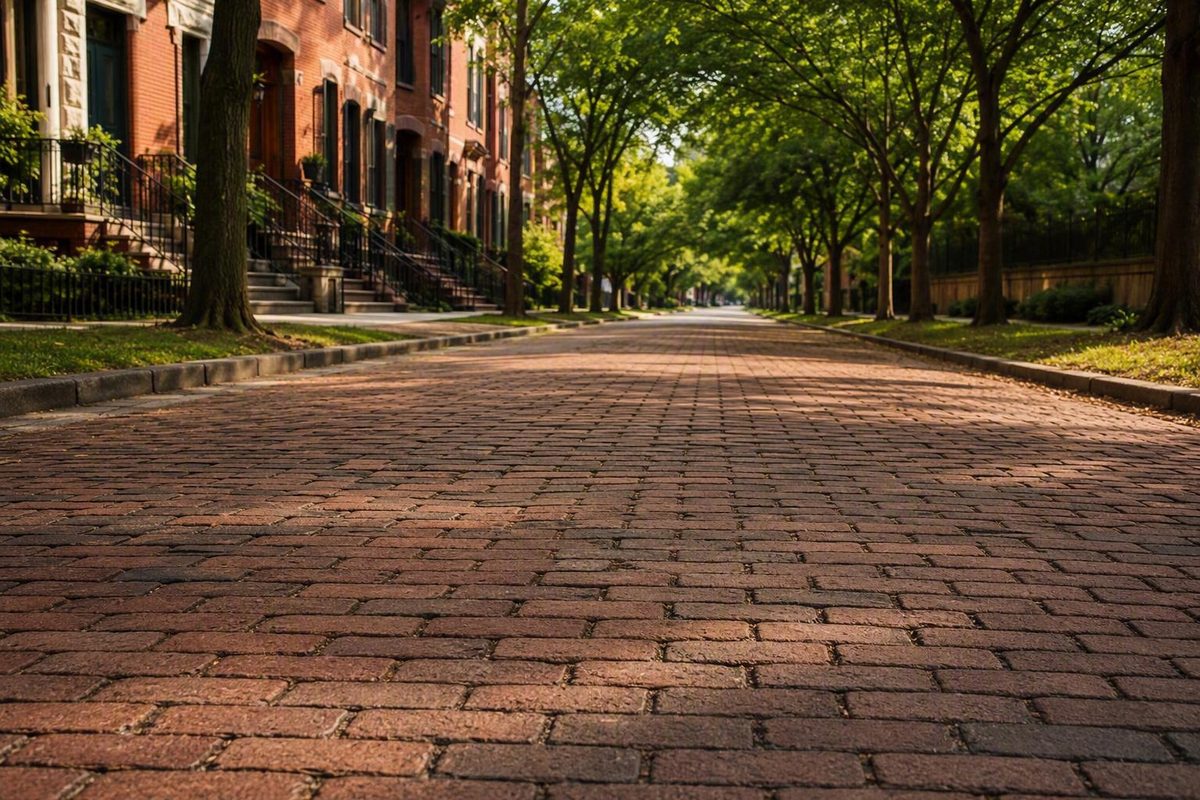
A surviving brick road can look like a simple layer of old rectangular units. In engineering terms, however, the visible bricks are only the wearing surface. Below them may be sand, gravel, crushed stone, asphaltic material, concrete, native soil, utility trenches, and drainage structures, along with the effects of decades of repairs.
That distinction explains an apparent contradiction. Some brick streets remain serviceable for many decades, while others become rutted, noisy, loose, or uncomfortable. The difference is not necessarily the quality of the bricks alone. It may lie in the base, drainage, joints, edge restraint, traffic, climate, workmanship, or maintenance history.
It also explains why preservation is not always the right answer—and why asphalt replacement is not automatically the economical one. Cities must evaluate the complete pavement system, compare equivalent project scopes, and account for historic value alongside safety, accessibility, traffic demands, and cost.
What Counts as a Brick Road?
A brick road is a pavement whose visible wearing surface consists of individually laid, fired-clay paving bricks. The definition matters because “brick,” “cobblestone,” “block,” and “paver” are often used loosely for surfaces that differ substantially in material, manufacture, installation, and performance.
Historic paving brick was made by forming clay into units and firing it at high temperatures. Vitrified paving brick—industrial clay brick fired to develop a dense, water-resistant body—became a prominent urban pavement material before synthetic sheet asphalt took over much of the market.
It is not the same as:
- Cobblestone: Naturally rounded or irregular stone, historically obtained from fields, river deposits, or ship ballast.
- Belgian block: Generally a hand-cut rectangular stone unit, commonly made from granite or sandstone. Its regular shape distinguishes it from rounded cobbles, but it remains a stone pavement rather than a clay-brick surface.
- Asphalt block: A manufactured paving block made with asphaltic material instead of fired clay.
- Modern concrete paver: A molded cement-based unit available in many shapes, colors, and finishes.
- Building brick: Fired-clay brick intended primarily for walls or structures rather than identified here as a purpose-made paving unit.
North American cities experimented with cobblestone, macadam, wood blocks, Belgian blocks, asphalt blocks, and vitrified brick, sometimes using several materials in different parts of the same city. Transport historian Robin B. Williams distinguishes hand-cut stone blocks from industrially molded and fired paving brick in his history of street pavement before asphalt.
The distinction is practical as well as historical. Stone blocks, clay paving bricks, and concrete pavers are different materials and may require different bedding, joints, repair methods, and acceptance criteria.
Even fired-clay brick streets do not share one construction method. Some historic streets placed brick on flexible layers of aggregate and sand. Others incorporated asphaltic cushions or filled joints. Modern reconstruction may place salvaged brick over concrete with an intermediate cushion. Some installations have tight, filled joints; others contain gaps where joint material has been lost.
The central principle is simple: a brick road is a pavement system, not merely a collection of bricks. The visible units matter, but their performance also depends on everything supporting, draining, separating, and restraining them.
Why Cities Turned to Brick Streets
Before modern asphalt became commonplace, North American streets could be dirt, gravel, macadam, wood block, cobblestone, Belgian block, asphalt block, fired-clay brick, or a combination of materials.
Unpaved streets created obvious problems. Rain could turn dirt into mud and wash gravel away from wheel paths. Dry weather produced dust. Ruts made travel uncomfortable and sometimes difficult. As cities grew and traffic increased, comparatively smooth pavement that remained usable in changing weather became increasingly valuable.
Vitrified paving brick emerged prominently in the early 1880s and spread during the late 19th and early 20th centuries. Historical accounts identify smoothness, durability, and resistance to water as important reasons for its adoption. Synthetic sheet asphalt then became dominant on streets and highways during the 1920s, although the transition varied by city and was not immediate everywhere, according to Williams’s historical account of paving materials and labor.
Changing transportation strengthened demand for smoother roads. Horse-drawn vehicles benefited, but so did bicyclists, who became influential advocates for better roads. Early automobiles added pressure for dependable, connected paved routes. Cities nevertheless selected materials according to local supplies, budgets, traffic, labor, and existing infrastructure.
Brick pavement was labor-intensive. Clay had to be extracted, formed, fired, sorted, shipped, and stacked. Street crews then prepared the foundation, handled thousands of units, established line and grade, compacted the pavement, treated joints, and maintained the surface. This labor could produce a comparatively regular road, but it became a disadvantage when less labor-intensive surfacing methods matured.
One frequently repeated early example comes from Charleston, West Virginia. A commercial historical account says Mordecai Levi, financed by Dr. Hale, began paving Summers Street with brick in 1870 and had completed a block by 1873. It describes a system involving a prepared roadbed, aggregate, an asphalt-like layer, sand, brick, and curbs. This is best treated as a reported early project—not proof that Levi invented brick paving in the United States or that no comparable method existed earlier. The dates and construction description come from a reclaimed-brick seller’s account of the Summers Street project, which should be read with that commercial context in mind.
Asphalt could be laid as a continuous surface without setting thousands of individual units. It also produced a smooth, comparatively quiet ride and could often be resurfaced without lifting and relaying an entire field of brick.
The transition was gradual rather than absolute. Some brick streets remained exposed; others were removed, reconstructed, or covered with asphalt. In some places, old brick survives as a buried pavement layer. Elsewhere, residents and preservation commissions continue to regard the visible surface as an important part of neighborhood character.
How a Brick Road Works as a Pavement System
From the bottom upward, a brick pavement may include:
- Prepared subgrade: Native soil or fill shaped and compacted to support the road.
- Structural base: Gravel, crushed stone, macadam, concrete, or another load-distributing material.
- Drainage provisions: Cross-slope, inlets, underdrains, or other measures intended to keep damaging water from accumulating.
- Cushion or bedding layer: Sand, sand-mastic, or another intermediate material used to seat the bricks evenly.
- Paving bricks: Fired-clay units forming the wearing surface.
- Joints and joint material: Spaces between units, potentially filled with sand, asphaltic filler, or another specified material.
- Crown or cross-slope: The roadway shape that directs surface water toward gutters or inlets.
- Curbs and edge restraint: Boundaries that resist sideways movement and help preserve alignment.
The subgrade supports the whole pavement. If it is weak, poorly compacted, or vulnerable to moisture-related movement, the upper layers may settle even when the bricks remain undamaged.
Drainage matters at several levels. Surface slope must direct water away instead of allowing it to pond. Joints, utility cuts, and edges may admit water into the pavement.
Curbs and edge restraints do more than define the street. Stable boundaries help keep the field of brick tightly assembled.
The construction method attributed to Levi illustrates an early layered concept: grade or fill the roadbed, place broken stone or similar material, add an asphalt-like layer, cover it with sand, set the bricks, and restrain the road with curbs. Whatever variations occurred in practice, the account shows that brick pavement depended on prepared support rather than simply placing bricks on untreated ground.
Another historical design was vertical-fiber brick pavement. Wire-cut bricks were oriented with their fiber or grain perpendicular to the roadway and with the wire-cut face upward. E. C. Minton’s historical engineering paper described installation over a prepared gravel, macadam, or concrete base, followed by a thin sand or sand-mastic cushion. The bricks were closely laid and rolled, their joints filled with heated asphaltic material, and the surface finished with sand. Those details document past practice; they are not modern specifications. Historical dimensions, application temperatures, equipment limits, and materials should not be adopted without current professional review and compliance with present safety and environmental requirements. The original method appears in Purdue’s archive of Minton’s paper on brick-road construction.
Historic flexible systems were intended to seat units firmly while permitting some adjustment within the pavement. Modern reconstruction may take a different approach. For heavily loaded downtown streets, Columbia, Missouri, proposed placing brick over a concrete base with an intermediate cushioning layer. The intent was to create a more uniform structural platform while avoiding direct, uneven contact between brick and concrete.
Neither arrangement is universally superior. A flexible aggregate base may work under suitable soil, drainage, traffic, and maintenance conditions. A concrete-supported system may provide greater uniformity but must still address joints, cushioning, water, utility access, and transitions at curbs and intersections. Design should follow the loads and subsurface conditions of the individual project.
Close placement, stable edges, consistent bedding, an evenly compacted base, and effective drainage all help keep each brick supported.
Why Brick Roads Become Bumpy, Rutted, or Loose
“Durable brick” does not mean “movement-proof road.” A fired-clay unit may remain hard and reusable while the sand, aggregate, fill, or soil beneath it settles, erodes, shifts, or loses density.
Deterioration therefore falls into two broad categories:
- Unit deterioration: Cracked, fractured, spalled, severely worn, or otherwise damaged bricks.
- System deterioration: Failed bedding, weak base, unstable subgrade, poor drainage, moving edges, utility disruption, or loss of joint support.
System deterioration frequently produces the familiar bumpy brick street. Wheel loads press on the surface, but the deformation may occur below the bricks rather than within them.
Several variables can interact:
- Water and poor drainage: Ponding, blocked outlets, leaking utilities, or water entering through joints can weaken support and move fine material.
- Subgrade movement: Compressible, poorly compacted, moisture-sensitive, or disturbed soils may move under seasonal changes and repeated loading.
- Weather: Temperature and moisture cycles can affect soil, base, bedding, joints, and edges.
-
Traffic volume and weight: Heavy vehicles impose larger repeated loads than many historic streets originally carried.
-
Installation quality: Uneven compaction, inconsistent bedding, wide joints, weak edges, or poor grade control can promote movement.
- Deteriorated foundations: A base that served earlier traffic may no longer distribute current loads evenly.
- Deferred maintenance: Rocking units, open joints, and drainage defects may spread if left uncorrected.
A surface inspection alone cannot establish the base condition. Bricks may look intact while concealed aggregate has moved. Conversely, a rough-looking street may contain many sound units that can be reused after the support structure is corrected. Columbia has attributed much of the rutting and unevenness in its downtown brick pavement to weak bases rather than distorted bricks, as explained in the city’s brick-street policy discussion.
Visible defects provide clues, although they are not definitive diagnoses:
| Visible defect | Possible underlying cause |
|---|---|
| Localized dip | Settlement, weak trench backfill, displaced bedding, or base failure |
| Long wheel-path rut | Repeated loading over inadequate or deteriorated support |
| Ponding water | Lost cross-slope, settlement, blocked drainage, or poor grading |
| Rocking bricks | Missing bedding support, wide joints, a broken unit, or an uneven base |
| Spreading joints | Weak edge restraint, lateral movement, turning loads, or lost joint material |
| Raised area | Subgrade movement, utility conflict, or displaced bedding |
| Repeated surface patch | Recurring underlying failure, material mismatch, or utility repair |
| Vegetation or ant activity in joints | Open joints, accumulated soil, moisture, or lost joint material |
Some paver installations contain ungrouted or open joints through which water can pass. Such gaps may also allow movement, vegetation, or ant activity when the base and joint system are not suited to the conditions. An asphalt contractor’s comparison of block paving and asphalt notes these possibilities, but its discussion focuses mainly on commercial and residential paving rather than historic municipal streets. The observation should not be generalized to every brick road: many historic pavements used tight or asphalt-filled joints and were not intended to function as permeable surfaces.
Several performance questions cannot be answered from appearance or age. These are project-specific engineering questions, not universal properties of brick roads.
How Historic Brick Streets Are Repaired and Rebuilt
Because brick pavement is modular, not every defect requires full reconstruction. The appropriate intervention depends on the size of the failed area and whether the underlying problem is local or widespread.
Isolated unit replacement is the smallest intervention. A cracked or severely worn brick can be removed and replaced with a compatible unit while leaving the surrounding pavement substantially intact. This approach is suitable only if the bedding and base remain stable.
Localized resetting addresses a limited depression, utility cut, or group of loose units. Crews lift the affected bricks, correct bedding or shallow base defects, and relay the surface to the proper line and grade.
Full reconstruction becomes relevant when settlement, rutting, drainage failure, or base deterioration is extensive. The bricks are removed across a large area or the full roadway, and the supporting pavement is rebuilt before suitable units are relaid.
A bounded restoration sequence may include:
- Document the existing street. Record patterns, dimensions, crown, gutters, curbs, utility covers, repairs, and transitions.
- Lift the bricks carefully. Removal should minimize breakage and preserve material for inspection.
- Investigate the failure. Examine bedding, base condition, subgrade, utility trenches, drainage paths, edges, and curbs.
- Sort and inspect the units. Separate sound paving bricks from fractured, severely worn, contaminated, or incompatible material.
- Correct drainage and utility problems. Rebuilding the surface without addressing unstable trenches or water pathways invites recurrence.
- Reconstruct the supporting layers. Use a project-specific design suited to the soil, loading, climate, utilities, and intended service.
- Restore stable edges. Curbs and restraints must hold the modular surface in alignment.
- Relay suitable brick. Establish consistent bedding, joint spacing, line, grade, crown, and transitions.
- Complete and inspect the joints. The joint system should match the pavement design rather than rely on improvised filling.
- Plan maintenance. Monitor settlement, drainage, loose units, utility cuts, and edge movement before defects spread.
If water continues to collect or trench backfill continues to settle, the depression may return.
Reuse offers two potential advantages. It retains historic material and the visual character associated with the original street, and it may reduce the number of new units required. Reuse is not automatic, however. Historic bricks must be inspected for condition and compatibility with the reconstructed pavement.
Current acceptance criteria should be established for each project by qualified professionals. The historical evidence used here does not establish a modern testing protocol for strength, absorption, wear, dimensions, freeze-thaw durability, or skid resistance. A city should neither assume that age proves fitness nor discard all old brick merely because the supporting base failed.
Material and labor availability can constrain reconstruction. Mt. Lebanon reported that subcontractors were having difficulty obtaining high-quality brick, illustrating how compatible materials and experienced installers can affect both quality and feasibility. Its municipal discussion also identifies base deterioration, cost, noise, and contextual safety concerns among the factors cities must weigh when considering brick-street reconstruction.
A successful local project demonstrates possibility rather than certainty. Columbia reports that South Glenwood Avenue was rehabilitated in the 1990s and was subsequently described as being in excellent condition. The city presents it as an example of how reusable units and corrected support can contribute to a successful brick-street rehabilitation.
The lesson is not that every brick street can or should be saved. It is that a rough surface does not, by itself, prove that the paving material has reached the end of its useful life.
Benefits and Drawbacks Beyond Appearance
Historic character is among the most visible arguments for preserving brick roads. Residents may value their color, pattern, sound, workmanship, and compatibility with older houses or commercial buildings. Those qualities can be meaningful community attributes without being converted into unsupported claims about tourism revenue, property values, or economic growth.
Brick’s modular form also offers practical advantages. A damaged unit can often be replaced without cutting a large continuous surface. During reconstruction, sound units may be lifted and reused, preserving visual continuity and reducing the number of replacement bricks required.
Surviving streets demonstrate that service lasting many decades is possible. They do not prove that every brick pavement will perform equally well. Longevity depends on the original units, base, drainage, traffic history, utility disruptions, weather, installation, and maintenance. A reconstructed street is not guaranteed to reproduce the performance of an unusually durable historic example.
The drawbacks are substantial enough to explain why municipalities choose asphalt:
- Labor-intensive reconstruction: Individual units must be lifted, handled, sorted, and relaid.
- High initial cost: The work may require pavement removal, drainage correction, utility coordination, base reconstruction, curb work, and traffic control.
- Uneven ride quality: Settlement, wide joints, poor alignment, or worn surfaces can affect road users.
- Traffic noise: Jointed or irregular surfaces may be noisier under higher traffic volumes.
- Contextual traction concerns: Some steep streets may present safety concerns under particular surface and weather conditions.
- Material scarcity: Compatible road-grade brick may be difficult to obtain.
- Specialized labor needs: Poor installation can reproduce bumps, open joints, and weak edges.
- Utility complications: Repeated excavation can disrupt carefully reconstructed layers.
Mt. Lebanon’s municipal account specifically identifies reconstruction expense, traffic noise, and the danger associated with some steep or slippery streets, while cautioning against treating every brick street alike. These are contextual concerns rather than universal defects of the material.
Accessibility also requires care. Level installation and tight, consistent joints may produce a smoother surface, but roadway treatment alone does not establish an accessible pedestrian route. Crossings, curb ramps, sidewalks, transitions, grades, and other pedestrian facilities require separate review under the requirements applicable to the project. Cities should also consider how surface irregularity affects people using wheelchairs, walkers, canes, strollers, or bicycles rather than evaluating ride quality only from a motor-vehicle perspective.
Suitability is contextual. A low-volume street in a historic residential district presents a different problem from a steep bus route, freight corridor, or downtown street repeatedly opened for utility work. Drainage, climate, road condition, adjacent land use, and maintenance capacity can all change the balance.
| Consideration | Brick pavement | Asphalt pavement | What remains project-specific |
|---|---|---|---|
| Local repairability | Individual units or small areas may be replaced | Commonly repaired with patches or resurfacing | Extent of hidden failure |
| Ride quality | Can be smooth when level and tightly laid; may become uneven | Generally provides a continuous surface | Settlement, patching, joints, maintenance |
| Noise | Jointed or uneven surfaces may be louder | Usually quieter when smooth | Speed, tires, traffic, surface condition |
| Accessibility | Careful alignment and tight joints may improve usability | Continuous surfacing may simplify smooth transitions | Crossings, ramps, grades, maintenance |
| Heavy-traffic suitability | Possible with a suitable structural design | Commonly used on high-volume roads | Loads, base, climate, turning movements |
| Historic value | May retain original fabric and streetscape character | May conceal or replace historic material | Local significance and policy |
| Material reuse | Sound bricks may be recovered and relaid | Not equivalent to visible reuse of original paving units | Condition and project specifications |
| Traction and winter performance | Cannot be generalized | Cannot be generalized | Testing, slope, weather, maintenance |
| Initial construction | Labor-intensive | Often less labor-intensive | Base, utilities, drainage, access |
| Service life | Can extend for many decades in favorable conditions | Depends on design, use, climate, and maintenance | Comparable local performance data |
The table does not select a winner. It separates broad characteristics from questions that require local evidence.
Brick Versus Asphalt and Concrete: Cost and Service Life
Cost debates often become confused because they compare different questions. Initial cost asks what a city must spend now. Life-cycle cost asks what it may spend over a defined period, accounting for maintenance, rehabilitation, replacement, timing, and residual value.
Brick installation and reconstruction commonly cost more upfront than asphalt. The work is labor-intensive, and a failing street may require excavation, drainage improvements, utility coordination, base reconstruction, curb work, and traffic control before a single brick is relaid.
Columbia’s 2011 pavement-only estimates illustrate the difference:
- $30 per square yard for asphalt milling and overlay
- $95 per square yard for Portland cement concrete
- $165 per square yard for modern pavers
- $190 per square yard for reconstruction with historic pavers
These were dated local estimates rather than current prices, and they excluded associated work such as sidewalk and utility replacement. Columbia’s life-cycle argument also assumed asphalt replacement at roughly 15-year intervals and brick service exceeding 100 years. Those figures and assumptions appear in the city’s brick-street cost discussion, but they should not be generalized without current local analysis.
Under Columbia’s assumptions, brick’s high initial cost could be offset over a long period. Change the service intervals, maintenance costs, reconstruction scope, discount rate, traffic, base design, or utility work, however, and the conclusion may change.
A Niles, Ohio, example points in the opposite direction on upfront cost. In 2018, a city engineer reportedly estimated that relaying one referenced street with brick would cost almost ten times as much as the asphalt alternative. The report’s wording leaves some ambiguity about the exact scope of the lower-cost treatment, and the estimate was project-specific rather than a universal ratio. It nevertheless illustrates the immediate budget barrier cities may face when residents ask for brick reconstruction instead of asphalt, as reported in WKBN’s coverage of northeastern Ohio brick roads.
Both examples can be valid in context. Columbia considered whether repeated future asphalt work might outweigh brick’s high starting cost. Niles focused on the near-term expense of relaying a particular street. Neither proves that brick is always economical or always unaffordable.
A credible modern comparison needs:
- Current competitive bids
- Equivalent street limits and pavement areas
- The same assumptions about excavation and base reconstruction
- Drainage and utility work
- Curbs, sidewalks, crossings, and accessibility improvements
- Traffic control and construction staging
- Maintenance schedules for each alternative
- Locally supported rehabilitation and replacement intervals
- A stated analysis period
- An explicit discount rate
- Expected utility cuts and repairs
- Material availability and labor rates
- Salvage, reuse, disposal, and residual-value assumptions
- Contingencies for concealed conditions
Comparisons must also distinguish overlay from reconstruction. Milling and overlaying asphalt on a supportable pavement is not equivalent to lifting brick, excavating a failed base, rebuilding drainage, and relaying units. If the underlying structure has failed, the fair comparison is between full-depth alternatives with the same utility, drainage, curb, accessibility, and traffic-control scope.
No fixed rule survives this scrutiny. Brick does not always last 100 years. It does not always cost three times or ten times as much as asphalt. Nor is it necessarily cheaper over its life. Results vary with climate, traffic, drainage, installation, maintenance, utility disruption, material availability, and project scope.
Preserve, Rebuild, Overlay, or Replace?
The choice should not be reduced to nostalgia versus the lowest bid. A defensible decision begins with condition, intended use, and a clear understanding of what each alternative includes.
Four broad options exist:
- Preserve and repair: Keep the existing system, replacing isolated units or resetting limited areas.
- Reconstruct: Lift the brick, correct structural and drainage failures, and relay suitable units.
- Overlay: Cover the brick or supporting pavement with another surface, usually asphalt.
- Replace: Remove or abandon the brick system and construct a different pavement.
The following scorecard is a nontechnical decision framework, not a substitute for project-specific engineering, accessibility, or safety review:
| Factor | Questions to ask | Favors preservation or reconstruction when… | May favor overlay or replacement when… |
|---|---|---|---|
| Surface condition | Are defects isolated or widespread? | Most bricks remain sound | Units are extensively fractured or worn |
| Hidden base | Is support stable and uniform? | Failure is limited or economically correctable | Structural failure is severe or pervasive |
| Drainage | Can water problems be corrected? | Grade, outlets, and subsurface drainage are repairable | Chronic water problems cannot be resolved within scope |
| Slope | Is the street steep? | Grade and measured traction are acceptable | Site-specific safety concerns are substantial |
| Traffic | What volumes, weights, and turning loads occur? | Loads suit the proposed system | Heavy or concentrated loads make it impractical |
| Safety | What do operating and condition data show? | Risks can be managed through design and maintenance | Documented risks outweigh preservation value |
| Accessibility | Can crossings and transitions be made usable? | Smooth installation and suitable facilities are feasible | Unresolved barriers remain |
| Historic significance | Is original material central to the streetscape? | Significance and integrity are high | Historic value is limited or fabric is heavily altered |
| Neighborhood context | Does brick support a coherent historic setting? | It contributes strongly to local character | That relationship is weak or no longer present |
| Materials | Are compatible bricks available? | Existing units and replacements can be sourced | Reuse yield is low and replacements are scarce |
| Labor | Are experienced crews available? | Qualified installers can perform the work | Labor scarcity threatens quality or feasibility |
| Full cost | Are equivalent scopes being compared? | Long-term value supports the investment | Budget constraints and competing needs dominate |
| Utilities | How often will the street be opened? | Work can be coordinated and reinstated properly | Repeated excavation is likely to disrupt the pavement |
Preservation is most plausible when defects are limited, the pavement system remains supportable, traffic and slope are appropriate, historic value is high, and compatible material and skilled labor are available.
Reconstruction deserves investigation when the bricks remain usable but the bedding, base, drainage, curbs, or edge restraints have failed. The road may be a strong material-reuse candidate even though superficial resetting would not address its problems.
Overlay or replacement may be favored where steep grades, documented safety concerns, heavy traffic, severe structural failure, material scarcity, repeated utility work, or constrained budgets outweigh preservation value. If brick is covered rather than removed, officials should document what remains beneath the new surface and how the altered elevation will affect curbs, drainage, driveways, and crossings.
Mt. Lebanon offers an example of condition-based prioritization. A PennDOT evaluation divided its brick streets into four categories: the better two were considered likely preservation candidates, the third warranted consideration, and the poorest was not recommended. The same municipality converted Castle Shannon Boulevard from brick to asphalt primarily for safety; the street was reported to carry about 5,000 vehicles per day. These examples show how condition, grade, traffic, engineering, and neighborhood value can be considered together rather than applying one rule to every street, as described in Mt. Lebanon’s municipal account of brick-street policy.
Public participation matters as well. Residents of N. Bentley Avenue in Niles opposed paving over their brick street and influenced the city’s decision to retain it, according to the 2018 local report on brick-road preservation debates. That was a meaningful preservation outcome, but public opposition alone does not resolve base condition, drainage, accessibility, safety, or funding.
The strongest municipal decision will document existing conditions, identify uncertainties, compare equivalent scopes, state life-cycle assumptions, and explain why historic value did or did not justify additional cost. Residents can then see what is being preserved, what risks remain, and what competing needs influenced the result.
How long can a brick road last?
A well-built and maintained brick road can remain in service for many decades, and surviving streets show that century-scale service is possible. That is not a universal expected life; even preservation-oriented life-cycle discussions acknowledge that performance depends on climate, substrate, material quality, traffic, and maintenance, as summarized in this review of brick-street longevity claims.
Why do brick roads become bumpy if the bricks are still intact?
The supporting material may have settled, moved, or washed away. Weak bases, displaced bedding, poor drainage, unstable subgrades, utility trenches, failed edges, and repeated loads can create dips and ruts without visibly deforming the bricks.
Are brick roads more expensive than asphalt?
They commonly cost more to install or reconstruct initially because individual units must be handled and the supporting system may require extensive work. Life-cycle cost is less certain and depends on service intervals, maintenance, traffic, utilities, discount rates, material reuse, and equivalent project scope.
What is the difference between a brick road, cobblestone, and Belgian block?
A brick road has a surface of manufactured, fired-clay paving bricks. Cobblestones are naturally rounded or irregular stones. Belgian blocks are generally hand-cut rectangular stone units, often granite or sandstone. All are unit pavements, but they are not interchangeable.
Why did asphalt replace so many brick streets?
Asphalt could be installed as a continuous surface with less unit-by-unit labor. It offered a smooth, comparatively quiet ride and often had a lower initial cost.
A century-old brick road is not proof that brick is always the best material. Just as importantly, a bumpy street is not proof that its bricks have failed. Sound decisions examine the full pavement system—the base, drainage, traffic, safety, accessibility, historic value, reusable material, labor, and complete project cost—before choosing repair, reconstruction, overlay, or replacement.