
16 min read ·
How Recognizable Figures Take Shape in Marble
Stylized or abstracted forms still qualify when the subject remains identifiable. That subject may be a person, animal, deity or mythological being.
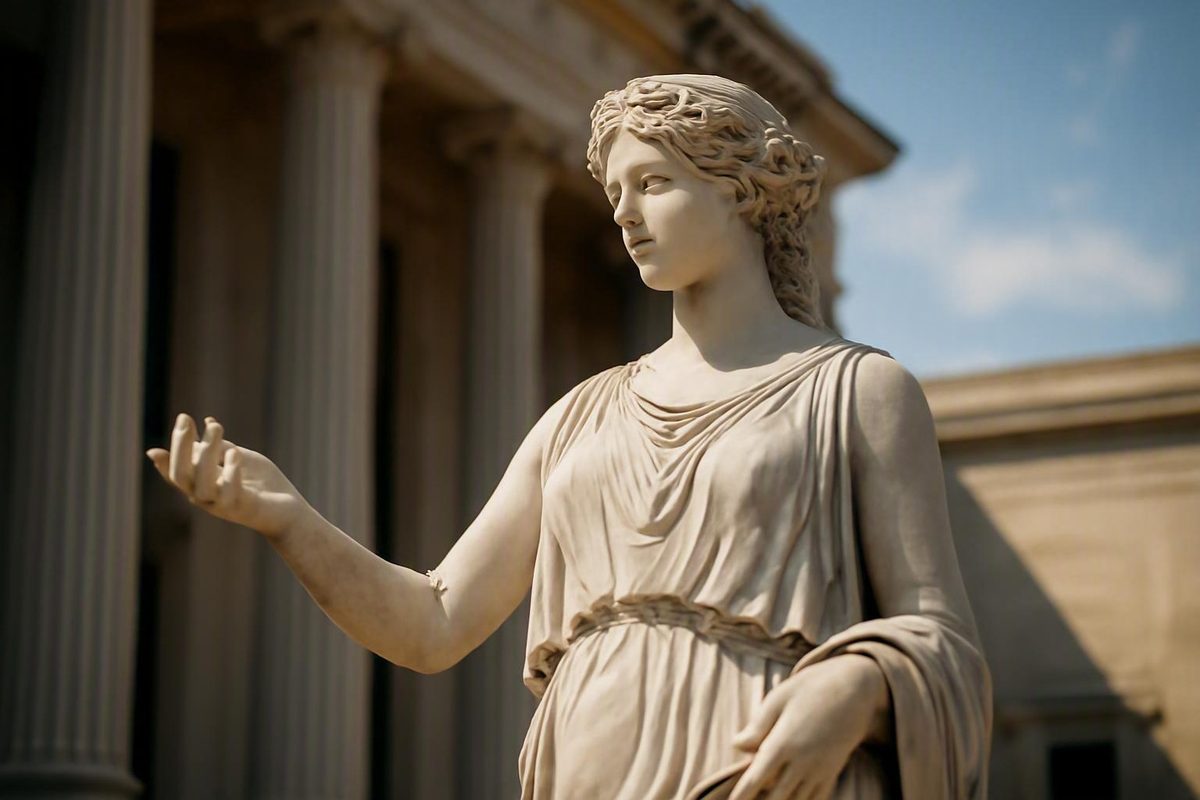
The plain definition of figurative marble sculpture
A figurative marble sculpture is a three-dimensional artwork carved from marble that represents a recognizable subject.
Each part of the phrase identifies a different feature:
- Figurative describes the subject matter: a viewer can identify a person, animal, deity, saint, mythological being, hybrid, or related figure.
- Marble identifies the stone from which the work is carved.
- Sculpture identifies a three-dimensional art form rather than a painting, drawing, or photograph.
The human body is the subject most commonly associated with figurative sculpture, but it is not the category’s only subject. A marble horse, eagle, deity, mythological creature, human-animal combination, portrait bust, or group of interacting figures can also qualify when the represented forms remain identifiable. Figurative art can depict subjects from belief, literature, and mythology as well as observable life.
Recognition—not beauty, age, prestige, monetary value, or perfect realism—is the central test. A recently carved, deliberately rough animal can be just as figurative as an old, highly polished portrait. Conversely, an elegant or valuable marble object is not necessarily figurative.
Architectural ornament, geometric carving, patterned panels, and nonrepresentational arrangements of stone masses may all be sculpture or sculptural carving without being figurative. Marble determines the material, but it does not determine the subject category.
This distinction is useful in museums and catalogs, where related terms overlap:
- Marble sculpture includes sculpture of any subject or style made from marble.
- Figurative sculpture includes recognizable figures made in any sculptural material.
- Figurative marble sculpture is where those categories meet: recognizable subject matter represented three-dimensionally in marble.
Figurative does not necessarily mean realistic
The word figurative is often treated as a synonym for lifelike, but the terms describe different qualities. Their precise meanings can vary across historical and scholarly contexts, especially where naturalism and realism overlap. For practical classification, however, four distinctions are useful:
- Figurative means that a figure or related subject remains identifiable.
- Representational means that a work refers to something in the observable or imagined world.
- Naturalistic suggests treatment resembling ordinary visual experience, such as plausible anatomy, posture, weight, or texture.
- Realistic generally implies close visual accuracy, although the term can also carry period-specific meanings.
A sculpture can therefore be figurative without being anatomically exact. An artist may lengthen a torso, enlarge the hands, compress a face, omit limbs, flatten the body, or reduce anatomy to a few rounded masses. If viewers can still identify the subject as a standing person, reclining animal, human torso, mother and child, or another figure, the work remains figurative.
Fragmentation does not automatically make a sculpture abstract. A detached head is still recognizable as a head, and a torso without arms may remain clearly human. A simplified body assembled from blocklike planes can likewise communicate a recognizable pose.
Fully abstract sculpture does not require an identifiable person, animal, or other represented subject. Its organizing elements may instead be volume, line, balance, void, rhythm, texture, geometry, or the physical character of the material. That does not mean abstract sculpture lacks meaning; it means that recognition of a depicted figure is not necessary to understand its category.
The boundary is not always sharp. Figurative and abstract are often more useful as positions on a spectrum than as mutually exclusive boxes. Abstract figurative sculpture transforms or reduces a recognizable figure without eliminating every reference to it. Near the boundary between abstraction and representation, classifications may differ according to context and viewer interpretation.
| Category | What the viewer can recognize | Is anatomical accuracy required? | Typical treatment |
|---|---|---|---|
| Figurative | A person, animal, deity, hybrid, or other identifiable figure | No | Realistic, naturalistic, stylized, or simplified |
| Abstract figurative | A recognizable figure transformed through distortion, fragmentation, or reduction | No | Elongated, geometric, partial, or strongly simplified |
| Fully abstract | No specific represented figure is required | No | Nonrepresentational masses, lines, planes, voids, or gestures |
The practical question is not “Does it look exactly alive?” but “Does an identifiable subject remain?” That recognition-based test accommodates classical naturalism, stylized carving, fragmented bodies, and contemporary figures that deliberately depart from ordinary proportions.
Common subjects and sculptural formats
Figurative marble sculpture is a category of subject and material, not a single physical format. It includes works intended to be seen from several sides, carvings attached to backgrounds, partial representations of the body, and compositions containing multiple figures.
It may depict a standing, seated, or reclining body; an animal; or a figure group. Its back and sides are physically articulated rather than absorbed into a flat background, although the artist may still emphasize one principal viewpoint.
A portrait bust generally concentrates on the head and upper torso or shoulders. It may commemorate a named individual, present an idealized type, or portray an imagined character. Because a bust represents only part of the body, it demonstrates why figurative does not mean full-length.
A relief is organized against a comparatively flat background. Its forms may project outward from that surface or be cut into it. Attachment to a background does not prevent a work from being sculpture; carving can produce figures, reliefs, ornamental forms, or abstraction, as the V&A’s overview of sculpture techniques explains.
Common subjects include:
- Portraits and commemorative figures
- Religious figures and narrative scenes
- Deities and mythological characters
- Allegorical figures representing ideas or activities
- Animals and recognizable natural forms
- Human-animal hybrids and imaginary beings
- Multi-figure compositions showing action or relationships
These themes are common rather than exhaustive. A contemporary sculptor might carve a stylized dog, an abstracted human torso, a fictional being, or an unfamiliar hybrid. The relevant question is whether the subject remains recognizable.
“Figurative marble sculpture” is broader: it can include statues, portrait busts, reliefs, figure groups, fragments, and partly abstracted figures.
Jean-Pierre-Antoine Tassaert’s Painting and Sculpture demonstrates that breadth. Dated 1774/1778, the freestanding marble composition contains two children together with a canvas, brushes, a palette, carving tools, and a portrait bust. The recognizable people and objects form one figurative composition rather than a single isolated statue, as documented by the National Gallery of Art.
Why marble can make a figure appear lifelike
Marble is a metamorphic carbonate rock formed when limestone or dolostone is transformed by heat, pressure, and recrystallization. Blocks vary in grain, color, veining, purity, inclusions, and crystalline structure, so two sculptures made from broadly similar marble may still look noticeably different.
Fine-grained marble can retain small carved details and gradual changes in form. A sculptor can use that capacity to define eyelids, lips, curls, fingernails, folds of cloth, and transitions across muscles or joints. Crisp ridges can suggest sharply folded drapery, while broad, gently changing planes can describe cheeks, shoulders, or the abdomen.
Some marble also permits light to penetrate slightly beneath the surface before returning to the viewer. This limited subsurface interaction can soften the stone’s appearance and contribute to the luminous effect often associated with carved skin. The result depends on the particular marble, its finish, the lighting, and the depth and shape of the carving; translucency is not uniform across every block. Marble’s geology, slight translucency, tools, and physical vulnerabilities are summarized in this reference overview of marble sculpture.
Surface treatment matters as much as the stone itself. Smooth polish reflects light differently from a toothed, scraped, abraded, or matte surface. These contrasts allow a sculptor to suggest different substances even when every part is carved from one block:
- Smooth, gradual surfaces may suggest skin.
- Fine grooves or broken ridges may suggest hair.
- Crisp edges and undercut folds can describe fabric.
- Rough tool marks can make a base or background recede visually.
- Alternating matte and reflective areas can clarify overlapping forms.
Color and veining also affect interpretation. A vein may cross a face, follow a fold, interrupt an even surface, or become part of the composition. Pale marble can emphasize shadow and contour, while colored or strongly veined stone introduces additional visual movement. None of these properties determines whether a work is figurative. A recognizable figure remains figurative whether the marble is white, gray, pink, greenish, veined, polished, matte, or deliberately stained.
Marble is not the only material capable of supporting convincing figures. Marble offers a particular combination of detail, surface variation, and luminosity, not universal superiority.
Those visual advantages come with physical constraints. Marble is heavy, inflexible, and brittle. Thin wrists, ankles, fingers, projecting arms, and unsupported drapery may fracture. The qualities that permit precise edges do not make those edges immune to impact or structural stress.
How a figure is carved from a marble block
Carving is a subtractive process: the sculptor creates form by removing material from a larger block. This differs from additive modeling in clay, where material can be pressed on, built up, shifted, or replaced.
Because removed stone cannot simply be restored, planning and sequencing matter. Methods vary across periods, workshops, technologies, and individual artists, but a practical process may include these stages:
- Develop the composition. The artist determines the subject, pose, scale, silhouette, viewing angles, and relationship between the figure, base, and any supports.
- Select a suitable block. Its dimensions, grain, color, veining, visible flaws, and orientation must accommodate the intended composition.
- Establish the large masses. Bulk stone is removed to locate the head, torso, limbs, groups, and principal negative spaces.
- Refine the forms. The sculptor develops anatomy, posture, drapery, attributes, facial structure, and transitions between masses.
- Add details and textures. Smaller tools define features, hair, folds, ornaments, edges, and differentiated surfaces.
- Smooth selectively. Rasps, rubbing stones, and abrasives reduce tool marks or establish matte areas.
- Apply the intended finish. The surface may remain visibly carved, receive selective polishing, or be brought to a more reflective finish.
Planning may begin with drawings, a small clay sketch or maquette, a more refined model, a full-scale plaster version, a digital model, or a combination of these. Other sculptors work through direct carving, responding to the block without transferring every contour from a finished model. Neither approach alone determines the quality or category of the result.
Traditional tools perform different tasks. A point chisel concentrates a mallet blow to remove bulk stone. Rasps grind and refine planes, while progressively finer abrasives reduce scratches and move a surface from rough to matte, smooth, or polished.
The process is not necessarily a steady march toward uniform smoothness. A sculptor may polish a cheek while leaving the hair visibly toothed, or refine the front while preserving rough quarry traces elsewhere. “Finished” describes an intentional endpoint, not the removal of every visible tool mark.
Antonio Canova provides a documented example of model-based studio production. He developed ideas through quick clay sketches, more resolved models, and full-scale plaster versions. Measurements and a pointing process helped transfer positions from the model into marble. Assistants could undertake basic transfer and rough carving while Canova monitored the work and completed important surfaces. The Art Institute of Chicago’s account of Canova’s progression from clay to polished marble explains this workflow through works including The Three Graces.
Canova’s practice illustrates one historical studio method, not a universal rule. It also complicates the popular image of a solitary artist improvising directly into stone.
Contemporary production can be equally varied. Sculptors may combine hand chisels with pneumatic hammers, diamond tools, grinders, digital scanning, CNC equipment, or robotic roughing. These technologies change the workflow and division of labor, but they do not by themselves determine whether the finished carving is figurative.
Supports, surfaces, and other details viewers often misread
A tree trunk beside a leg, a column beneath an arm, or a thick cascade of drapery may appear purely decorative. In marble sculpture, such forms can also help solve structural problems.
Because marble is heavy and brittle, a freely extended arm or slender ankle can be vulnerable during carving, transport, installation, and display.
Common supporting devices include:
- Tree trunks joined to a leg or hip
- Columns or posts beneath an arm
- Drapery connecting an arm to the torso
- Struts between limbs
- Objects placed beneath projecting forms
- Broad bases that distribute the figure’s weight
These additions can perform structural and visual roles simultaneously. A tree trunk may stabilize a leg while establishing an outdoor setting. Drapery may support an arm while adding movement. A column may help carry weight while identifying a figure or narrative.
Not every connecting piece was necessarily intended to remain visible. The V&A notes that supports used during stone carving could be intended for removal after installation but were not always removed. In other sculptures, supports were integrated deliberately into the final design. Individual examination is therefore more reliable than assuming that every strut is accidental, temporary, or permanent.
Viewers also sometimes treat rough passages as unfinished mistakes and polished passages as proof of greater quality. Surface contrast can be intentional. Carving, scraping, rubbing, abrasion, and polishing allow an artist to make the same stone suggest different materials. A matte garment can frame a reflective face; drill-cut shadows can deepen curls; rough ground can separate a figure from its base.
Canova’s finishing practices are especially informative. Carving, scraping, rubbing, cleaning, and polishing altered the marble’s reflectivity, translucence, opacity, and texture so that flesh, hair, and fabric appeared materially distinct. The underlying material remained hard stone, but controlled surface differences guided perception.
A highly polished finish is therefore an option, not a requirement. Figurative sculpture may deliberately include:
- Visible point- or tooth-chisel marks
- Matte abrasion
- Selectively polished skin
- Rough hair or fabric
- Staining or traces of applied color
- Contrasts between refined and raw areas
Myth versus fact: The familiar bare-white appearance of ancient marble in museums does not mean every classical sculpture was conceived as unpainted stone. Many ancient Greek and Roman marble sculptures originally carried color, although much of that decoration no longer survives. The V&A’s technical overview notes that classical Greek and Roman marbles were probably painted.
A uniformly pale surface may therefore differ from a work’s original appearance. Conversely, modern sculptors may intentionally choose bare marble, staining, mixed polishing, or visible tool marks. Color and finish are historical and artistic variables, not tests of whether a sculpture is figurative.
Selected examples and historical context
The following examples come primarily from European art history. They clarify the category but do not constitute a comprehensive global history of figurative stone sculpture. Other cultures and regions have their own traditions of carving recognizable figures in marble and related stones.
Recognizable marble figures were prominent in ancient Greek and Roman art, where sculptors represented deities, heroes, political figures, mythological narratives, and human bodies. Later European artists continued, revised, or challenged those traditions.
Several familiar works illustrate different formats:
- The Venus de Milo is an ancient marble representation of the human body. Its missing arms do not prevent the subject from remaining recognizable and figurative.
- Michelangelo’s David is a freestanding human figure—a familiar example of a body represented in the round.
- Michelangelo’s Pietà is a religious figure group rather than a single isolated statue, joining two recognizable bodies in a narrative relationship.
- Antonio Canova’s The Three Graces is a three-figure composition associated with a documented model-to-marble studio process and differentiated finishing.
- Jean-Pierre-Antoine Tassaert’s Painting and Sculpture combines children, a canvas, art-making tools, and a portrait bust in one freestanding allegorical composition.
A historical overview from Artsper identifies the Venus de Milo, David, and Pietà as marble sculptures while placing figurative marble within classical, medieval, Renaissance, and later European contexts. That sequence is useful as a limited European outline, not as a universal history.
Canova’s The Three Graces connects recognizable subject matter with documented clay sketches, refined models, plaster versions, pointing, workshop collaboration, and carefully varied marble surfaces. Tassaert’s Painting and Sculpture, meanwhile, shows that one figurative work can contain multiple people, objects, tools, and even a representation of another sculpture.
Famous works illustrate the category; they do not define its boundaries. Figurative marble sculpture need not be classical, monumental, white, European, or anatomically naturalistic. A contemporary stylized animal, an exaggerated or fragmented torso, and a shallow portrait relief can all satisfy the same recognition-based definition.
Marble’s limitations, display, and cautious care
Marble can endure for long periods, but it is not permanent or immune to damage. Its condition depends on the particular stone, the sculpture’s construction and base, previous repairs or treatments, handling history, environment, and exposure.
Relevant vulnerabilities include impact fractures, cracks around thin projections, instability at the base, staining, and stress at old repairs. Repeated touching can transfer skin oils and grime. Calcite-rich marble can also be etched by acidic substances, while outdoor exposure may contribute to surface loss or erosion.
In cold outdoor settings, water entering pores or cracks may freeze and expand, worsening existing weaknesses through repeated freeze-thaw cycles. The actual risk varies with the stone, condition, drainage, and exposure; commercial outdoor guidance specifically warns that water freezing in microfractures can damage marble.
There is no responsible universal rule that all marble belongs indoors or that every marble sculpture can remain outside safely. A protected work on a stable, well-drained base faces different conditions from one exposed to rain, irrigation, pollutants, deicing salts, and rapid temperature changes. A compact carving also presents a different risk profile from a cracked figure with thin limbs and old repairs.
Routine care should remain cautious and noninvasive:
- Avoid acidic or aggressive cleaners.
- Do not use abrasive pads, metal brushes, or scraping tools.
- Minimize unnecessary touching and handling.
- Keep the work stable on a base capable of supporting its weight.
- Watch for new cracks, movement, staining, powdering, or surface loss.
- Do not assume that a coating, sealant, stain remover, or other treatment is appropriate for every object.
Commercial care guidance supports avoiding acids and aggressive cleaners and recommends professional assessment for structural cracks, deep staining, or substantial biological growth; those recommendations are summarized in this marble-sculpture care discussion. Because treatments can alter appearance or interact with earlier repairs, valuable or historic objects should not be treated through a one-size-fits-all schedule.
A qualified objects conservator should assess valuable, historic, cracked, unstable, deeply stained, or biologically affected sculpture. Professional examination is particularly important before structural repair, stain extraction, coating removal, outdoor relocation, or any cleaning likely to alter an original surface.
Frequently asked questions
Does a figurative marble sculpture have to depict a person?
No. Human figures are the most common subjects, but the broader category can include recognizable animals, deities, saints, mythological beings, and human-animal hybrids. What matters is that the sculpture presents an identifiable figure or related subject. A marble horse can therefore be figurative, while an arrangement of entirely nonrepresentational geometric masses may not be.
Can a marble sculpture be both figurative and abstract?
Yes. An abstract figurative sculpture retains recognizable references to a figure while transforming them through simplification, distortion, fragmentation, exaggeration, or geometric reduction. A viewer might recognize a human torso even when its anatomy has been reduced to intersecting planes. As a practical distinction, a work moves toward full abstraction when identifying a represented figure is no longer necessary, although classifications near that boundary can vary by context and interpretation.
Does a marble relief count as figurative sculpture?
Yes, if the relief depicts recognizable figures. Relief is a sculptural format in which forms project from or are cut into a comparatively flat background. It does not need to stand freely in the round. A marble panel showing people, animals, saints, or mythological characters in a narrative scene can therefore be a figurative marble sculpture.
Why do marble statues sometimes include a tree trunk, column, or heavy drapery?
Such elements can stabilize vulnerable parts of a heavy, brittle stone figure. A trunk may connect a leg to the base, a column may support an arm, and drapery may bridge a narrow gap between a limb and the torso. These forms can also contribute to the subject, setting, or composition, so their structural and artistic functions often overlap.
Were ancient Greek and Roman marble sculptures originally white?
Many were not intended to remain uniformly white. Ancient Greek and Roman sculptors often added painted color to marble figures and architectural sculpture. Much of that color no longer survives, helping create the modern association between classical sculpture and bare white stone. Surviving traces and technical examination can sometimes provide evidence of earlier painted surfaces.
A figurative marble sculpture is ultimately defined by material and recognition. If a three-dimensional marble work retains an identifiable person, animal, deity, mythological being, hybrid, or related figure, it can be called figurative even when its proportions, surfaces, or forms are stylized or abstracted. The category does not require perfect realism, bare white stone, uniform polish, or a particular historical style. Marble’s capacity for detail and luminosity must also be understood alongside its weight, brittleness, and conservation needs.