
17 min read ·
A Practical Guide to Flat Natural Stone for Patios, Paths, and More
The label alone does not establish porosity, strength, stain resistance, weathering, maintenance needs or suitability for a particular load.
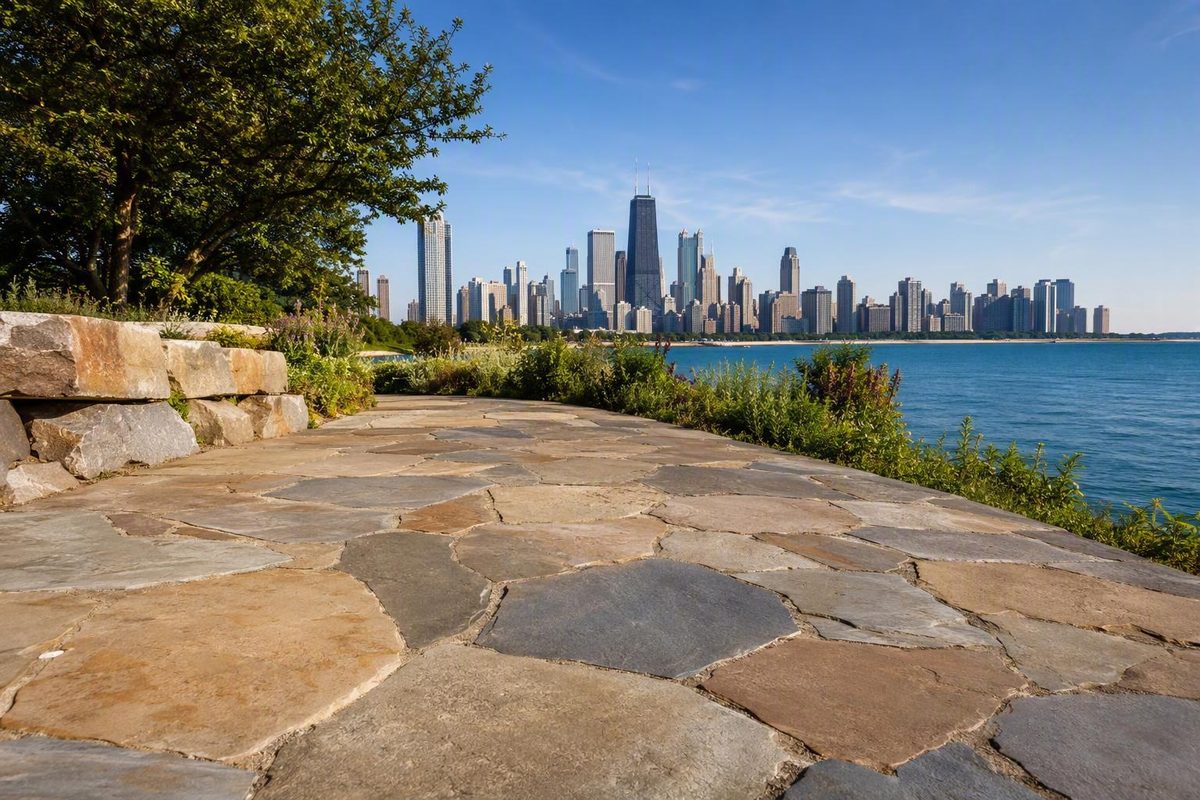
Flagstone is a category of relatively flat natural stone used for paving and construction—not one specific kind of rock. It is often sandstone, but limestone, slate, quartzite, bluestone, and other stones may also be supplied in flagstone form.
Its appearance and performance depend on the underlying stone, thickness, finish, installation, drainage, climate, and intended use. For that reason, choosing “flagstone” is only the beginning of the material-selection process.
Flagstone defined: a stone format, not one specific rock
Flagstone is a general term for relatively flat slabs or pieces of natural stone used in paving and construction. The label describes the stone’s form and common use more reliably than its geological composition.
A flagstone product might be sandstone, limestone, slate, quartzite, bluestone, or another natural stone supplied in slab-like pieces. Across the category, possible applications include paving, floors, steps, wall surfaces, facades, and roofing, but an individual product is not necessarily suitable for all of them. Suitability depends on its properties, dimensions, finish, support, and exposure.
Sandstone has the strongest traditional association with flagstone. Bedded sandstone can separate along natural planes, producing broad, relatively flat slabs with limited processing. Some definitions therefore use flagstone narrowly for layered sedimentary stone, often sandstone. Broader trade usage treats it as a product category. A general reference definition likewise describes flagstone as a generic flat stone that may be naturally irregular or cut into regular shapes.
That difference in usage explains why definitions sometimes appear contradictory:
- A traditional or geological description may emphasize sedimentary stone that splits along bedding planes.
- A seller may group several natural stones together because they are supplied as flat paving slabs.
It is therefore inaccurate to say that every flagstone is sedimentary rock. Slate, for example, is metamorphic but is commonly sold in flagstone form.
Visually, flagstone pieces are often flat, naturally varied, and fitted together in a puzzle-like layout. Uniformly cut squares, rectangles, and pattern sets are also available.
The word flagstone alone does not establish porosity, strength, stain resistance, weathering behavior, maintenance needs, or suitability for a particular load. Those qualities depend on the actual stone and the complete installation.
What flagstone is made from
Some flagstone materials naturally separate into broad layers along bedding or cleavage planes. Other products are quarried and then sawn, trimmed, or shaped into slabs.
Common materials sold in flagstone form include:
- Sandstone: The stone most closely associated with traditional flagstone. Its color, porosity, density, and weathering behavior vary by mineral composition and quarry.
- Limestone: A sedimentary stone supplied in different colors, textures, and finishes. It may be split or cut.
- Slate: A metamorphic stone that can separate into thin, flat layers. Its presence in the market demonstrates why flagstone is not exclusively a sedimentary-rock term.
- Quartzite: A hard metamorphic stone that may be sold as irregular slabs or dimensional paving.
- Bluestone: A commercial name used for certain blue-gray or multicolored paving stones. It can be supplied as flagstone but does not represent the entire category.
Commercial sellers commonly list sandstone, limestone, slate, bluestone, and quartzite as possible flagstone materials. This is a market classification, not a claim that the stones share the same geology or performance.
It helps to separate rock identity from product format:
- Sandstone, limestone, slate, and quartzite identify the material.
- Flagstone describes its relatively flat form and common building use.
- Irregular, pattern-cut, tumbled, and similar terms describe processing or presentation.
Bluestone causes particular confusion because it is sometimes discussed as if it were an alternative to flagstone. More precisely, bluestone is a stone name, while flagstone is the broader format. A seller may offer irregular bluestone flagstone, rectangular bluestone paving, or bluestone treads. Flagstone also includes products that are not bluestone.
The actual material influences:
- Color and mineral markings
- Surface texture
- Porosity and stain absorption
- Strength and resistance to flaking
- Weathering behavior
- Appropriate cleaning and sealing methods
Properties can vary between quarries and products carrying similar general names. Buyers should ask for:
- The actual rock type
- The quarry or regional source
- The product name and grade
- The nominal and actual thickness range
- The surface finish
- Recommended applications
- Installation guidance for the intended climate and exposure
“Natural flagstone” is not a complete specification. A useful proposal or invoice should identify the stone more precisely.
Shapes, sizes, colors, and product terminology
Flagstone does not have to be irregular. Naturally shaped pieces are common because they retain much of the stone’s split outline, but the material can also be cut into squares, rectangles, circles, curves, and coordinated pattern sets.
The two broad formats are:
- Irregular flagstone: Pieces have varied outlines and are individually selected, rotated, trimmed, and spaced to create a balanced layout.
- Pattern-cut or dimensional flagstone: Pieces are cut into planned geometric units, often squares and rectangles arranged in repeating combinations or a custom grid.
Natural variation remains a practical feature in either format. Pieces within one shipment may differ in:
- Shape and surface area
- Thickness
- Edge character
- Surface relief
- Mineral markings
- Color and tone
- Degree of natural texture
Documented colors include red, buff, blue, gray, brown, cream, gold, green, and related shades. Availability depends on the stone and quarry; a sample shows an example, not necessarily the full shipment.
One marketplace guide describes naturally irregular pieces as roughly one to two feet long and 0.75 to 3 inches thick, while emphasizing flagstone as a broad category. That range is a general description, not a specification for a patio, step, wall, or loaded surface. Product dimensions vary substantially by source and application, as shown in Thumbtack’s overview of flagstone formats and sizes.
Common supplier terms include:
- Irregular slabs: Naturally shaped or roughly processed pieces fitted together individually.
- Cut pavers: Stone cut into regular dimensions for organized layouts.
- Steppers: Individual pieces intended for spaced paths through lawn, gravel, or planting.
- Treads: Longer and often thicker units intended for the walking surface of a step.
- Veneer: Thin stone intended primarily as a facing.
- Tumbled pieces: Stone processed to soften edges and alter its surface character.
These products are not interchangeable.
Format also affects labor and appearance. Irregular pieces generally create wider or less uniform joints and require more fitting. Variable thickness means the bedding beneath each piece may need adjustment. Pattern-cut flagstone supports straighter joints and a more regular rhythm, although natural color, texture, and thickness variation may remain.
Cutting stone into regular shapes does not make it equivalent to a manufactured paver. It simply makes the natural material more geometrically consistent.
Where flagstone is commonly used
Flagstone is most strongly associated with horizontal outdoor paving. Common residential applications include:
- Patios
- Walkways
- Garden paths
- Individual stepping stones
- Pool surrounds
- Steps and landings
- Outdoor seating and entertaining areas
Its flat form allows relatively large pieces to create a walking surface while retaining natural variation. An irregular sandstone patio with gravel-filled joints is one familiar example; rectangular slate or limestone over a designed base provides a more formal interpretation.
Flagstone can also appear in vertical, decorative, and specialized applications, including:
- Wall facing and veneer
- Landscape edging
- Retaining-wall surfaces
- Water features
- Outdoor fireplaces
- Interior floors
- Building facades
- Fences and other construction details
- Roofing in some regional traditions
These uses require different products and assemblies. Paving must remain supported and stable under anticipated traffic. Veneer must be compatible with its backing and attachment system. A tread has different dimensional demands from a thin wall facing, while roofing requires an entirely different assembly from patio construction.
The label flagstone does not by itself establish suitability for a pool deck, structural step, retaining wall, roof, elevated surface, or vehicle load.
For a wet area or pool surround, evaluate:
- The actual stone’s porosity
- Surface finish and texture
- Performance when wet
- Shade and drying conditions
- Exposure to standing water
- Possible chlorine contact
- Maintenance requirements
- Locally proven performance in a comparable climate
Some sandstone can be damaged or discolored by moisture, freezing, standing water, irrigation, or chlorinated pool water, so these exposures should be assessed for the specific product rather than generalized to every flagstone.
Texture may improve grip, but flagstone is not universally slip-proof. Wetness, organic growth, finish, and sealing can change how a surface feels underfoot; some types can become slippery when wet, as noted in this comparison of outdoor paving surfaces.
Vehicle areas require project-specific evaluation. A pedestrian patio cannot be treated as a driveway merely because its surface stones appear substantial.
The same principle applies to structural steps and retaining walls: the visible stone is only one component.
Dry-laid versus mortared flagstone
Flagstone paving generally falls into two installation families: dry-laid and mortared construction. These terms describe systems, not universal specifications. Base depth, stone thickness, reinforcement, drainage, and joint design must be selected for the site.
Dry-laid flagstone is placed over a prepared, compacted aggregate foundation with a leveling or bedding layer. Depending on the design, joints may contain sand, gravel, crushed stone, decomposed granite, or low-growing plants.
A dry-laid assembly generally involves:
- Preparing and grading the site
- Building and compacting the foundation
- Adding a leveling layer
- Fitting and leveling each stone
- Filling or planting the joints
- Providing edge restraint where required
The word dry means the stones are not bonded into a continuous mortar assembly. It does not mean the surface can be placed without foundation preparation. The base must support the intended use and limit unwanted movement.
A practical advantage is access for repair. If an individual stone settles or rocks, it can often be lifted, the bedding adjusted, and the stone reset. Large pieces, tight joints, edging, and joint materials can still complicate the work.
Mortared flagstone is set in mortar, commonly over a rigid concrete base, with finished mortar or grout joints. Its appearance may be irregular and rustic or formal and geometric.
A mortared assembly may include:
- A prepared subgrade and foundation
- A specified concrete base
- A mortar setting bed
- The flagstone surface
- Finished joints
- Drainage, movement, and edge details suited to the project
This is a rigid assembly. A loose or cracked area may involve the stone, mortar, joints, concrete base, water conditions, or movement within the larger installation. Repair may therefore require more than resetting one piece.
A stone supplier’s comparison summarizes the basic distinction: dry-laid flagstone rests on a compacted base, while mortared flagstone is commonly installed over concrete. The exact layers and materials still vary by soil, climate, use, drainage, and local requirements.
Neither method is universally better. Dry-laid construction may suit informal patios, planted joints, and projects where individual reset capability is valuable. Mortared work may suit a continuous surface or tighter finished joints where a properly designed rigid base is appropriate.
Irregular stone adds labor in either system because pieces must be selected, fitted, and individually leveled. Pattern-cut stone simplifies layout but may still have natural thickness variation.
Drainage must be planned as part of either assembly. Paving next to a building should direct water away from the structure rather than trapping it against the foundation. There is no universal slope or base depth: elevations, thresholds, soils, rainfall, codes, and surrounding drainage all affect the design.
Flagstone compared with bluestone, slate, sandstone, and pavers
Confusion often arises because some terms identify a rock while others describe a product format.
| Term | What it identifies | Relationship to flagstone |
|---|---|---|
| Flagstone | Relatively flat natural stone used for paving or construction | The broad format |
| Sandstone | A sedimentary rock | Frequently supplied as flagstone |
| Slate | A metamorphic rock that separates into layers | Can be supplied as flagstone |
| Bluestone | A commercial stone name | May be sold in flagstone form |
| Limestone | A sedimentary rock | Can be cut or split into flagstone |
| Quartzite | A metamorphic rock | Sometimes supplied as flagstone |
| Concrete paver | A manufactured modular unit | An alternative to natural flagstone |
Sandstone and slate can both be flagstone when supplied in flat paving pieces. Neither word is interchangeable with flagstone: not every sandstone or slate product has that format, and not every flagstone is sandstone or slate.
Bluestone is also narrower than flagstone. Manufacturers may offer irregular bluestone flagging, dimensional bluestone paving, or bluestone treads. Commercial material comparisons accordingly describe bluestone as one stone option within the broader flagstone market. Its exact properties still depend on the product and source.
For many patios, the more practical comparison is natural flagstone versus manufactured concrete pavers.
Natural flagstone
Flagstone generally offers greater variation in shape, thickness, color, edge character, and texture. Irregular pieces can follow curves and planting areas, producing an organic layout. Pattern-cut stone provides cleaner geometry while retaining natural mineral and tonal variation.
That variation increases installation work. Irregular outlines must be fitted, and individual pieces may require height adjustments. Joints are often less regular than those in modular paving.
Manufactured concrete pavers
Concrete pavers are manufactured to more consistent dimensions. They support repeating patterns, controlled joint widths, and a more predictable installation sequence.
Consistency can simplify layout and leveling where straight lines or geometric designs are priorities. Replacement may also be more predictable if matching units remain available.
| Consideration | Irregular natural flagstone | Manufactured pavers |
|---|---|---|
| Appearance | Naturally varied and organic | More regular and repeatable |
| Fitting | Pieces are placed individually | Modular units follow a pattern |
| Leveling | Thickness variation often requires adjustment | Consistent dimensions improve predictability |
| Joints | Commonly wider or less uniform | Usually more regular |
| Design character | Suits informal or naturalistic layouts | Suits structured or geometric layouts |
Pattern-cut flagstone occupies the middle ground: natural color and texture in more regular shapes.
Price, lifespan, traction, weather resistance, and surface temperature should not be compared by category alone. Each depends on the actual product, finish, site, installation, and exposure.
Performance, maintenance, and common problems
Flagstone has no single maintenance profile. Performance varies by rock type, quarry, porosity, finish, thickness, climate, base, joints, drainage, use, and exposure.
Moisture, flaking, and discoloration
Some sandstone flagstone absorbs moisture. Persistent irrigation, standing water, freezing, chlorinated pool water, erosion, spills, and grilling residue can damage or discolor susceptible products. These documented risks for some sandstone paving should not be extended automatically to every stone.
Flaking may reflect a vulnerable material, damaging exposure, or both.
The first step is to identify the source. Applying sealer without correcting persistent moisture or drainage may leave the underlying cause unresolved.
Efflorescence
Mortared and other cement-associated installations may develop efflorescence: cosmetic white mineral streaks or deposits created when moisture moves through the assembly and carries soluble material to the surface. This differs from biological growth. A patio-surface overview explains the connection between moisture movement, cement-associated minerals, and efflorescence.
Recurring deposits justify examining moisture entry and drainage. Cleaning methods should be compatible with the actual stone and joint material.
Settlement and loose stones
A stone that rocks, sinks, or develops a raised edge may indicate loss of support or movement within the installation. Dry-laid pieces can often be lifted and reset. In mortared construction, movement may involve the stone, mortar, joints, or rigid base.
Repeated movement calls for investigation of the assembly rather than repeated surface-only repairs.
Weeds, moss, and joint maintenance
Open or aggregate-filled joints can collect windblown soil and organic matter. Weeds may germinate there, while moss or algae may develop in damp, shaded conditions. Commercial comparisons note that weeds or moss can occur between flagstones, although the amount depends on the site and joint system.
Loose aggregate may need replenishment after erosion or cleaning. Planted joints require horticultural care, while mortar joints need compatible repairs if they crack or deteriorate.
Traction and slipperiness
Texture can improve grip, but rough stone is not slip-proof. Wetness, algae, ice, wear, finish, slope, and sealers may affect the surface underfoot. Frequently wet walks, pool surrounds, and steps should be evaluated using the actual stone and finish.
Verify that a proposed product is compatible with both the stone and its intended exposure.
Sealing
Flagstone does not universally require sealing, and there is no fixed resealing schedule suitable for every installation. The decision depends on:
- The underlying stone and porosity
- Surface finish
- Stain exposure
- Moisture conditions
- Pool or chemical exposure
- Desired color and sheen
- Joint and setting materials
- Product-specific guidance
Test a product in an inconspicuous area because it may darken the stone or change its appearance.
Persistent standing water, flaking, loose pieces, movement, or recurring staining should be investigated before a coating is applied. Separate likely material issues, such as porosity and mineral staining, from installation issues, such as settlement, poor support, and inadequate drainage.
How to decide whether flagstone fits a project
Start with function rather than the appearance of a showroom sample. A successful patio, path, pool surround, step, or wall is a complete system in which the material, dimensions, support, drainage, joints, and exposure work together.
Define the application
Ask what the installation must do:
- Carry ordinary foot traffic?
- Form an informal garden path?
- Support tables and chairs without rocking?
- Provide a stable route for wheels or mobility devices?
- Withstand pool water or cooking spills?
- Form a tread, landing, facing, or elevated surface?
- Carry vehicles or equipment?
A spaced garden stepper is not necessarily appropriate for a continuous walking route. A patio slab is not automatically a structural tread.
Identify the material
Request the actual rock type, quarry or regional source, grade, and finish. Ask whether the sample represents the expected range of color, thickness, texture, and mineral markings.
Where possible, inspect older installations of the same product in comparable shade, moisture, and climate conditions. An indoor sample cannot show exactly how the stone will look when wet, weathered, or sealed.
Confirm dimensions and format
Review:
- Nominal and actual thickness
- Piece-size range
- Irregular or pattern-cut format
- Edge treatment
- Surface finish
- Expected joint style
- Tolerance for natural variation
Irregular pieces generally require more fitting and leveling than pattern-cut stone or consistent pavers. That labor should be reflected in the estimate and schedule.
Evaluate climate and water exposure
Consider:
- Freeze-thaw conditions
- Rainfall and snow
- Irrigation overspray
- Shade and drying time
- Standing-water risk
- Roof and downspout discharge
- Pool chemicals
- Soil drainage
- Water movement near buildings
Water management should be considered before choosing the stone. An attractive surface can still perform poorly if the assembly remains saturated or directs water toward a structure.
Compare installation systems
Evaluate dry-laid and mortared options according to:
- Desired appearance
- Joint style
- Existing foundation conditions
- Drainage
- Soil and climate
- Repairability
- Maintenance tolerance
- Threshold and elevation constraints
- Expected movement and loads
Dry-laid work may make individual stones easier to reset. Mortared construction creates a more continuous assembly but introduces rigid-base and mortar-joint considerations. Neither description replaces a site-specific design.
Compare complete costs
Total cost may be affected by:
- Paved area
- Stone variety and source
- Regional availability and transport
- Site access
- Demolition and excavation
- Foundation preparation
- Drainage work
- Irregular or cut format
- Fitting and leveling labor
- Edging and joint treatment
- Local labor rates
- Future maintenance
Do not assume flagstone is always more or less expensive than pavers. Compare written proposals for complete assemblies, not material prices alone.
Know when project-specific guidance is needed
Professional design, installation, engineering, or local code guidance may be appropriate for:
- Vehicle loads
- Structural steps
- Retaining walls
- Elevated surfaces
- Significant slopes
- Drainage near buildings
- Pool surrounds
- Routes with accessibility requirements
- Work requiring permits
The decision rule is straightforward: choose according to the actual stone and complete installation system, not the flagstone label alone.
Frequently asked questions
Is flagstone the same thing as sandstone?
No. Sandstone is a particular sedimentary rock, while flagstone is a category of relatively flat natural stone used in paving and construction.
Traditional flagstone is often sandstone because bedded sandstone can separate into practical slabs. Limestone, slate, quartzite, bluestone, and other stones may also be sold in flagstone form.
Is bluestone a type of flagstone?
Bluestone can be supplied as flagstone, but the terms are not synonymous. Bluestone is a commercial stone name, while flagstone describes the broader flat-stone format.
A seller may offer irregular bluestone flagstone, rectangular bluestone paving, or bluestone treads. Flagstone can also be made from stones that are not bluestone.
Does flagstone have to be irregularly shaped?
No. Puzzle-like pieces are common, but flagstone may also be cut into squares, rectangles, circles, curves, or coordinated patterns.
Irregular stone tends to require more fitting and produces less uniform joints. Pattern-cut flagstone creates a more regular layout while retaining natural color and texture variation.
Should flagstone be dry-laid or installed with mortar?
Either method may be appropriate. The choice depends on soil, climate, drainage, intended use, appearance, foundation conditions, and maintenance preferences.
Dry-laid stone rests on a prepared aggregate foundation and can often be lifted and reset. Mortared stone is commonly installed over a rigid concrete base and forms a more continuous assembly. Project-specific layer depths, stone dimensions, joints, and drainage details are still required.
Does flagstone need to be sealed?
Not always. Sealing depends on the actual stone, porosity, finish, installation, exposure, and supplier guidance.
A compatible sealer may help with certain staining concerns, but it can change color, sheen, absorption, or traction. It cannot correct loose stones, inadequate drainage, or persistent standing water.
Conclusion
Flagstone is best understood as a flat natural-stone format, not a single geological material. Its appearance, maintenance, and suitability depend on what the stone actually is and how the entire installation is designed.
Identify the rock type and source first. Then match its thickness, finish, shape, foundation, joints, and drainage to the intended use, local climate, moisture exposure, maintenance expectations, and budget.