
13 min read ·
That Honeyed Summer Scent May Be a Linden in Bloom
Sweet, honeyed and floral is the core scent. Confirm the source by checking for pale flower clusters, narrow bracts and asymmetrical heart-shaped leaves.
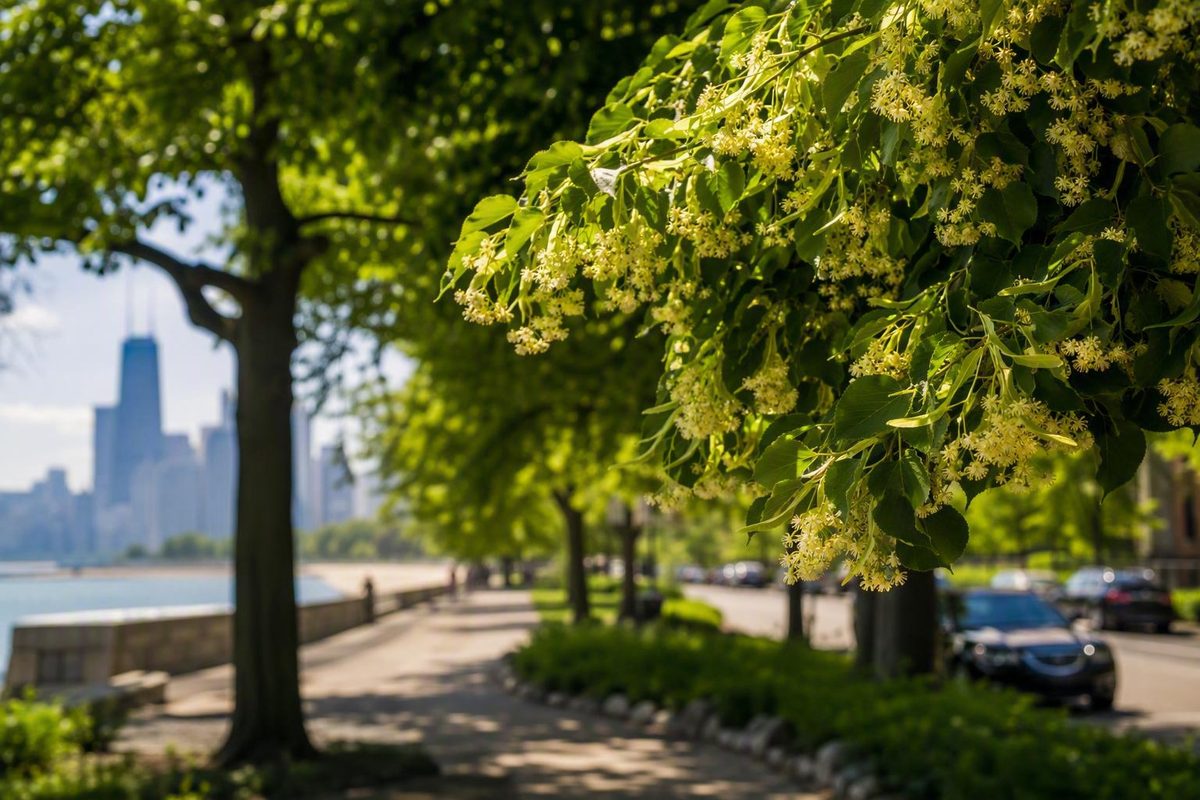
A distinctly sweet, honeyed floral fragrance drifting through a street or park in early summer may be the smell of a linden tree in bloom. The aroma often has a fresh green edge, and some people notice hints of lemon peel or citrus blossom.
You may smell the tree before you see it. Linden flowers are small, pale, and often tucked beneath leaves or held high above the sidewalk. Fragrance is therefore a useful first clue—but not a complete identification. To confirm a likely linden, look for hanging flower clusters with narrow, leaf-like bracts, then check for heart-shaped leaves with pointed tips, serrated edges, and often uneven bases. Bees and other flower visitors can provide another seasonal clue.
What a blooming linden smells like
The simplest description of linden blossom is sweet, honeyed, floral, and slightly green. Depending on the observer and tree, that central profile may be joined by a suggestion of lemon peel or citrus blossom. Kevin Lee Jacobs, writing about a silver linden on his property, described its scent as a blend of honey and lemon peel (a firsthand account of a fragrant silver linden).
Think of honey carried on a light floral breeze rather than the concentrated smell of honey in a jar. The green quality keeps the fragrance from seeming purely sugary and can recall the fresh vegetation surrounding the flowers.
Comparisons beyond that core profile are more personal. Some observers mention jasmine or honeysuckle. Others perceive almond, cucumber, or the warm floral atmosphere of a greenhouse. These descriptions may help communicate an individual impression, but they are not universal scent notes. A linden does not reliably smell like jasmine to everyone, and different trees need not present the same balance of sweetness, greenery, and floral warmth.
Emotional descriptions require the same caution. Words such as heady, soothing, intoxicating, nostalgic, and clean describe how the fragrance affects a person. They are not standardized botanical properties. One walker’s gentle, airy scent may be another walker’s overwhelming cloud of sweetness.
The fragrance is seasonal. It comes from the flowers and becomes conspicuous during bloom, not throughout the year. Outside that period, the same tree may remain recognizable by its leaves and other features without producing the familiar honeyed floral scent.
Why you may smell the tree before you see the flowers
The fragrance comes from linden flowers rather than the leaves or bark. Yet the leaves are much easier to notice from ground level: they form a broad green canopy, while the blossoms are comparatively small and visually quiet.
Linden flowers are generally creamy white to pale yellow and grow in hanging groups. Their color does not contrast sharply with sunlit foliage, and the clusters may be partly hidden beneath leaves or positioned high overhead. The Arnold Arboretum describes sidewalk conversations in which people notice the remarkable aroma but search unsuccessfully among surrounding shrubs because the small flowers are concealed in the canopy (the Arnold Arboretum’s account of linden’s “secret” scent).
This creates a familiar walking experience. You notice a sweet floral smell and initially inspect garden beds, shrubs, hanging baskets, or flowering vines. Nothing nearby seems strong enough to explain it. Only after stepping back and looking upward do you find pale blossoms spread through the canopy.
When searching, look beneath the outer branches rather than only at the upper surfaces of the leaves. Low branches may provide a closer view, but there is no need to pull flowers or foliage from the tree.
A blooming linden can perfume the surrounding air, so you may detect it before reaching the trunk. That does not provide a dependable measure of distance. Reports of fragrance traveling across properties or along streets are personal anecdotes, not standardized measurements. Wind, buildings, canopy size, the number of flowering trees, competing odors, and individual sensitivity all affect where the scent is noticeable.
Treat the fragrance as a prompt to survey nearby canopies. Once you find a likely tree, use flowers, bracts, and leaves to confirm that the scent is coming from a linden.
When linden trees are fragrant
Early to midsummer is the safest general answer. In many Northern Hemisphere locations, linden bloom falls sometime in June or July, but the schedule varies by species, location, weather, and the individual tree (a qualified overview of linden bloom and identification).
There is no single date that applies everywhere.
Different linden species do not necessarily flower at the same time. At the Arnold Arboretum, species within the collection flower in sequence over several weeks rather than all opening on one fixed date (observations of staggered linden flowering). In a park, botanical collection, or neighborhood planted with several kinds of Tilia, that variation can make the local linden season seem longer than the bloom on any one tree.
For a walker, the tree itself is a better guide than a date borrowed from another city. When the sweet smell first becomes noticeable:
- Look for pale flower clusters beneath the foliage.
- Check whether flowers are open and whether some buds remain.
- Notice whether the blossoms appear fresh or are beginning to brown and fall.
- Return later if you want to observe how the flowers and fragrance change.
The scent is tied to the period when the blossoms are open. As flowering ends, the honeyed floral signal fades. The leaves and bracts may still assist with identification, but the fragrant part of the seasonal display will be over.
Reports from Boston, Portland, Idaho, or another location should not be used as exact forecasts elsewhere. They describe particular trees under particular conditions. Begin watching likely lindens in early summer, then let the opening flowers establish the local timing.
A walking checklist for identifying a linden
Fragrance can lead you toward a linden, but smell alone cannot identify the tree reliably. Other plants produce sweet summer aromas, and moving air can make the source difficult to locate. A stronger identification combines several features.
Use this sequence during a street or park walk:
- Locate the likely canopy. Look upward rather than assuming that the nearest shrub or flower bed is responsible.
- Search beneath the foliage. Linden flowers are small, pale, and commonly held in hanging clusters.
- Find the bract. Look for a narrow, leaf-like structure associated with the stalk of each flower cluster.
- Inspect a low or fallen leaf. Avoid removing foliage when a naturally accessible example will do.
- Check the overall leaf shape. Linden leaves are generally heart-shaped and pointed at the tip.
- Examine the edge and base. The margin is typically serrated, while the two sides of the leaf base often meet the stalk unevenly.
- Notice insect activity. Bees and other flower visitors can support the conclusion that the canopy is actively blooming.
- Combine the evidence. Fragrance, flowers, bracts, leaves, and seasonal activity provide a better genus-level identification than any single clue.
The bract is especially useful. It is a pale-green, leaf-like structure attached to the stalk supporting the flowers. During and after bloom, the bract and cluster form a distinctive hanging arrangement. A tree-identification overview illustrates this combination of flower clusters, bracts, serrated heart-shaped leaves, and uneven leaf bases (visual features used in linden identification).
Do not interpret “heart-shaped” as perfectly symmetrical. A linden leaf often looks slightly lopsided where the blade joins the stalk, with one side extending lower than the other. Leaf size, color, and surface texture vary among species, so size alone is not enough.
Focus on the clustered arrangement and associated bract rather than demanding one exact shade.
Bee activity is supporting evidence, not a unique diagnostic feature. Many flowering trees attract insects. It becomes relevant when it accompanies the other linden clues: a honeyed floral scent, pale clustered blossoms, narrow bracts, and asymmetrical heart-shaped leaves.
Avoid handling flower clusters that insects are actively visiting. Observing without touching or shaking branches allows the insects to continue feeding and gives you all the information needed for a walking identification. If precise identification matters, compare the tree with an authoritative local field guide or consult a local botanical expert.
Linden, basswood, lime tree, and Tilia explained
Tilia is the botanical genus discussed throughout this article. Linden, basswood, and lime tree are common names used for trees in that genus, although regional preferences and species associations differ.
“Linden” is common in landscaping and general North American usage. “Basswood” is widely used in North America, particularly for native Tilia and in forestry or field-guide contexts. A nature-education account of American basswood explains that basswood and linden are common names applied to different species in the genus Tilia (basswood and linden naming explained).
In Britain and parts of Europe, members of the same genus are commonly called lime trees. A lime tree in this sense is not the citrus tree that produces lime fruit. The regional name can therefore be confusing in garden labels, travel writing, maps, and fragrance descriptions (an overview of linden’s regional common names).
Readers may encounter different wording depending on the source:
- A municipal tree map may say linden.
- A North American field guide may say basswood.
- A British garden label may say lime.
- A botanical collection may lead with a scientific name beginning with Tilia.
- A perfume description may say lime blossom while referring to linden rather than citrus.
These shared names should not erase differences within the genus. American basswood, littleleaf linden, silver linden, and other species or cultivated selections can differ in leaf size, surface color, growth habit, flowering time, and perceived fragrance.
For an ordinary walk, recognizing the tree as a likely member of Tilia may be enough. When a tree has a label, record the full scientific name rather than relying only on the common name.
Why the fragrance can seem gentle one day and heady the next
The strength of linden fragrance is not experienced uniformly. Two people beneath the same canopy may describe it differently, and one person may have contrasting impressions on separate visits.
Several factors can shape the experience:
- The observer: Scent sensitivity, attention, associations, and tolerance for sweet floral odors vary.
- The tree: Species, individual condition, canopy size, and number of flowers may influence the overall impression.
- Flowering stage: A tree with many fresh blossoms may not present the same aroma as one nearing the end of bloom.
- Distance: Standing beneath a low, flower-filled branch differs from detecting the scent farther down a path.
- Wind: Air movement can carry fragrance toward one location and away from another.
- Competing odors: Traffic, food, smoke, cut grass, mulch, wet pavement, and other flowers can mask or alter the experience.
- Local conditions: Warm, still, or humid weather commonly appears in personal accounts of especially noticeable linden fragrance, but those accounts do not establish exactly why the scent seemed stronger.
Jonathan Kauffman offered one useful but limited comparison from Portland: he perceived small-leaf linden as sweet and gentle, while silver linden seemed headier and more like a warm hothouse. He also noticed a green, cucumber-like quality in an informal blossom infusion. These are one writer’s sensory impressions, not a proven ranking of species (a firsthand comparison of Portland linden blossoms).
Another observer described noticing basswood at night during humid weather and searching among numerous trees before locating the source. That account illustrates how conspicuous and difficult to place the aroma can be, but it does not prove that humidity increases fragrance production (a nighttime encounter with blooming basswood).
The same restraint applies to claims about distance. Anecdotes about scent crossing a property or traveling along a street show that linden can perfume surrounding air. They do not establish a universal range.
There is also no basis in the supplied evidence for ranking linden as the strongest or sweetest-smelling tree. It is enough to say that a linden in full flower can be highly noticeable, even when its blossoms remain hidden overhead.
Why blooming lindens attract so many bees
A flowering linden may sound almost as noticeable as it smells. Honeybees, bumblebees, and other flower-visiting insects come to the blossoms for floral resources, including nectar. Lindens can provide midsummer forage after many earlier-flowering plants have finished.
Listen for activity distributed through the canopy rather than expecting one concentrated group of insects. On an accessible branch, visitors may be seen moving from one flower cluster to another.
Buzzing is corroborating evidence, not proof of identity. Bees visit many kinds of flowering trees. Their presence becomes more informative when combined with the characteristic linden features: pale clustered flowers, leaf-like bracts, uneven heart-shaped leaves, and a sweet floral scent.
There is also no need to touch blossoms or disturb branches in order to identify the tree. Observe from a comfortable position and allow feeding insects to continue moving among the flowers.
Fresh linden blossom versus perfume, tea, and other interpretations
The aroma beneath a living linden is multidimensional. Flowers mingle with green foliage, outdoor air, nearby plants, and changing concentrations of scent as you move toward or away from the canopy. Perfume and dried preparations isolate or reshape parts of that experience.
In perfumery, linden blossom is described as a bright yellow floral note with honeyed and green nuances. It appears as a named note in numerous compositions (the perfumery profile of lime or linden blossom). That description corresponds with the recurring outdoor profile, but a named perfume note does not prove that a fragrance contains natural linden extract.
A perfume note can be an artistic reconstruction. A perfumer may evoke linden by emphasizing sweetness, bright florals, greenery, or citrus-like freshness. One composition may feel transparent and airy, while another may magnify the honeyed aspect.
A bottle labeled “linden blossom” should therefore not be treated as a precise recording of a living tree. It may capture a recognizable facet while omitting the influence of leaves, shade, breeze, distance, and the fluctuating intensity experienced outdoors.
An infusion is another interpretation of the blossom rather than a substitute for encountering fresh flowers overhead.
One informal experiment preserved blossoms in vodka and produced a floral preparation with a perceived green, cucumber-like flavor. That personal observation does not establish a standard flavor profile, nor does it provide sufficient grounds for preparation instructions.
This article does not offer harvesting, tea-making, or alcohol-infusion directions. Its focus is the sensory experience and visual identification of a living tree, not the collection or consumption of plant material. Perfume, tea, and other preparations may echo parts of linden blossom, but each medium selectively changes the fresh-flower aroma.
Frequently asked questions about linden fragrance
Does the whole linden tree smell, or only its flowers?
The conspicuous sweet fragrance comes from the flowers. The leaves and bark are not the source of the familiar honeyed floral cloud associated with linden bloom.
That is why the tree is notably fragrant during flowering rather than throughout the year. If a strong smell appears near a linden outside bloom, look for another possible source.
How long does a linden tree stay fragrant?
A linden remains notably fragrant while its flowers are open. There is no universal duration because species, local climate, annual weather, flowering stage, and the individual tree all influence the event.
Several kinds of linden planted together can create a longer neighborhood season by flowering at different times. On one tree, fresh pale clusters indicate active bloom, while browning or falling flowers and weakening fragrance show that flowering is ending.
Can linden fragrance be smelled from far away?
It can perfume the surrounding air and may be noticed before the tree is visible, but there is no reliable fixed distance.
Use the aroma to locate a likely canopy, then confirm the source visually.
Is a basswood the same as a linden tree?
Basswood and linden are common names for trees in the genus Tilia. “Basswood” is particularly common in North America, while “linden” is frequent in landscaping and general use. “Lime tree” is another regional name, especially in Britain and Europe.
The terms do not mean that every Tilia species is identical. American basswood, littleleaf linden, silver linden, and other species may differ in leaves, growth, flowering time, and perceived fragrance.
Can smell alone identify a linden tree?
No. A honeyed summer fragrance is a useful first clue, but other flowering plants can smell sweet, and air movement can obscure the source.
Confirm a likely linden by looking for several features together: small pale flower clusters beneath the canopy, narrow leaf-like bracts, heart-shaped leaves with pointed tips and serrated edges, and a noticeably asymmetrical leaf base. Flower-visiting insects can add seasonal support.
On an early-summer walk, that sudden honeyed floral scent may lead to a linden whose blossoms have been hidden overhead all along. Look up, check beneath the branches, and let the flowers, bracts, leaves, and insect activity complete the identification. Timing and intensity vary by tree, species, place, weather, and observer, which is why the best conclusion relies on more than the nose alone.