
18 min read ·
Is a State Street Miyabe Maple Right for Your Landscape?
It is unsuitable where success depends on the tree remaining unusually small, enduring severe compaction indefinitely, or fitting beneath overhead wires.
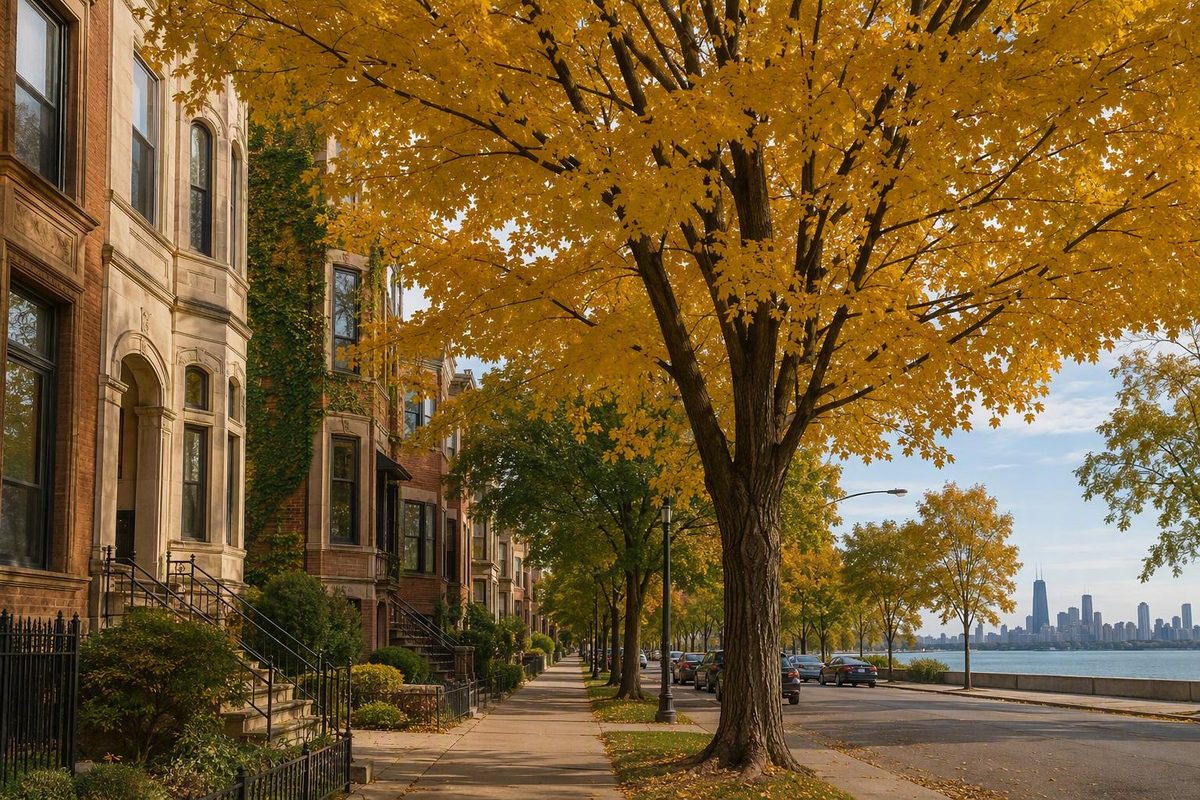
The State Street maple tree is a deciduous shade-tree cultivar valued for its dense crown, golden-yellow fall color, and corky mature bark. It can be a strong choice for a wide parkway, park, commercial property, allée, or spacious yard, but only where the site provides adequate canopy room, usable soil, drainage, and establishment water.
State Street maple quick facts
| Characteristic | Practical specification |
|---|---|
| Botanical name | Acer miyabei ‘Morton’ |
| Common names | State Street maple; State Street Miyabe maple |
| Tree type | Deciduous, non-native shade-tree cultivar |
| Species origin | Japan, including Hokkaido in cultivar histories |
| Practical mature size | Plan for approximately 40–50 feet tall and 30–40 feet wide |
| Crown form | Dense and upright oval to pyramidal when young; broader or rounder with age |
| Foliage | Opposite, simple, five-lobed, medium- to dark-green leaves |
| Fall color | Pale golden yellow to yellow-gold |
| Bark | Gray to gray-and-tan, becoming corky, ridged, furrowed, or fissured |
| Hardiness | Best-supported range: USDA zones 4–7; some sellers extend the listing to zone 8 |
| Light | Full sun to partial shade, with full sun the most consistent preference |
| Soil | Moist, adequately drained soil with sufficient rooting space |
| Water | Consistent irrigation during establishment; periodic drought tolerance once established |
| Common uses | Wide parkways, broad medians, parks, commercial landscapes, allées, and spacious residential properties |
Published dimensions vary. A wholesale grower lists the cultivar at 50 feet high and 35 feet wide, while other institutional and nursery profiles give somewhat smaller estimates. Designing for approximately 40–50 feet of height and 30–40 feet of spread is therefore more prudent than relying on the lowest available figure. J. Frank Schmidt & Son lists the 50-by-35-foot estimate.
USDA zones 4–7 are the strongest-supported hardiness range. A commercial listing extends the range through zone 8, but that broader claim is not as consistent across sources and should be confirmed locally. McKay Nursery lists zones 4–8.
The central suitability rule is simple: urban tolerance does not make this tree suitable for every urban planting space. State Street maple can tolerate several stresses associated with streets and developed landscapes, but it still needs adequate rooting space, appropriate planting depth, workable drainage, and regular water while establishing.
The most important source agreements and conflicts can be summarized this way:
| Topic | Best-supported conclusion |
|---|---|
| Mature size | Estimates differ; plan around the larger credible range rather than the smallest listing |
| Hardiness | Zones 4–7 have the strongest support; zone 8 requires local confirmation |
| Growth rate | Described variously as moderate, fast, or rapid; no universal annual rate is established |
| Compaction | Treat severe compaction as a limitation despite broad commercial urban-tolerance claims |
| Moisture | Moist, well-drained soil is the safest baseline; drought tolerance applies after establishment |
| Pruning | Avoid routine spring pruning; sources disagree between dormant-season and summer pruning |
Botanical identity and Morton Arboretum history
State Street maple is not a separate maple species. Its name has three parts:
- Acer miyabei is the species.
- ‘Morton’ is the cultivar name.
- State Street is the commercial name used for the cultivar.
The plant may appear in catalogs as State Street maple, State Street Miyabe maple, State Street Miyabe’s maple, or Acer miyabei ‘Morton’. Sources also vary in their use of ™ and ®. For gardeners, landscape planners, and municipal buyers, confirming the botanical name is more important than resolving that trademark styling.
The cultivar was selected through The Morton Arboretum and is associated with the Chicagoland Grows collection. Its reported history traces to a parent tree accessioned and planted at the Arboretum in 1929. The underlying species comes from Japan, with Hokkaido specifically identified in cultivar profiles, and the tree is therefore considered non-native to North America. Johnson’s Nursery describes the 1929 parent-tree history and Hokkaido origin.
Despite its name, State Street maple is not:
- A sugar maple, Acer saccharum
- A Japanese maple cultivar, Acer palmatum
- A general term for maples growing on a street named State Street
- A reference specifically to trees planted on Chicago’s State Street
That distinction matters because maple species and cultivars differ substantially in size, form, soil response, fall color, and care. Instructions written for a small Japanese maple or a sugar maple should not automatically be applied to Acer miyabei ‘Morton’.
The Arboretum history establishes the cultivar’s identity and gives it particular relevance to Midwestern landscapes. It does not guarantee identical performance in an arid western city, a warm zone 8 climate, or a site with heavily altered soil.
Appearance through the seasons
A young State Street maple generally forms a dense, orderly crown with ascending branches. Sources describe the form as upright oval, broad pyramidal, or pyramidal. These terms are compatible: a nursery tree may begin relatively narrow and upright, then develop a broader, more rounded crown with age.
Spring
The spring flowers are small and inconspicuous. They do not provide the display associated with crabapples, magnolias, or redbuds. The fruit consists of paired winged seeds called samaras—the familiar form often called maple “keys.”
Its principal spring appeal comes from the emerging foliage and the structure of its developing canopy, not from showy flowers.
Summer
The leaves are opposite, simple, five-lobed, and generally 3–5 inches long. The Morton Arboretum provides the leaf dimensions and foliage description.
These are conventionally lobed maple leaves, not finely cut or lacy foliage. Descriptions suggesting a laceleaf effect conflict with the stronger cultivar evidence and may reflect generic or copied retailer text. Visually, State Street maple reads as a substantial shade tree rather than a delicate ornamental maple.
Fall
Fall color is normally pale golden yellow, bright yellow, or yellow-gold. Anyone seeking consistently red, scarlet, or orange foliage should choose another tree. State Street maple offers a clear yellow canopy rather than a red-orange or multicolored display.
Yellow is the defensible expectation; unusually brilliant color in every year is not.
Winter
Mature bark is one of the cultivar’s most distinctive ornamental features. It is described as gray or gray-and-tan and becomes rough, corky, ridged, deeply furrowed, or fissured with age. These descriptions refer to the same general development: relatively plain young bark gains stronger texture as the tree matures.
After leaf fall, that bark and the tree’s structured branch architecture provide winter interest. Overall, the cultivar’s ornamental value comes from canopy form, dense summer shade, yellow autumn foliage, and mature bark—not a dramatic floral display.
How large does a State Street maple get?
Published size estimates do not agree. Municipal and horticultural profiles include heights of 30–40 feet, 40–45 feet, and approximately 50 feet, with reported spreads generally between 30 and 40 feet. The City of Fort Collins lists both height and spread at 30–40 feet, while The Morton Arboretum gives approximately 40–45 feet high and 30–35 feet wide. Fort Collins provides the lower municipal range, while The Morton Arboretum gives the intermediate estimate.
For design purposes, reserve space for a tree roughly 40–50 feet tall and 30–40 feet wide. This is not a guaranteed final dimension. It is a conservative planning envelope intended to reduce the risk of choosing the tree based on the smallest available estimate.
A cultivar profile reports an intermediate size of approximately 20–25 feet high and 15 feet wide after 15 years, followed by an eventual estimate of 40–50 feet high and 30–35 feet wide. Those figures illustrate why a tree that appears modest for many years can still require substantially more long-term space; they do not establish a guaranteed growth schedule. The Chicagoland Grows cultivar profile gives both the 15-year and mature estimates.
Ultimate size can vary with:
- Climate and length of the growing season
- Soil depth, structure, and fertility
- Rainfall and irrigation
- Available rooting volume
- Competition from turf and nearby trees
- Pruning history
- The number of years the tree remains in place
Growth rate is also inconsistently described. Some sources call the cultivar fast or rapid, while another calls it moderate. Without comparable measurements across sites, those labels should not be converted into a promised number of feet per year.
The upright form of a young nursery tree can make it look narrower than its eventual canopy. The relevant question is not whether the current branches fit but whether a broad mature crown can develop without recurring conflicts with buildings, traffic, neighboring trees, or utilities.
Do not plant State Street maple beneath overhead power lines. One nursery profile that lists the tree at about 40 feet tall and 30 feet wide explicitly discourages planting it under utility lines. Millcreek Gardens includes that overhead-clearance warning.
Where pavement, curbs, foundations, underground services, or other infrastructure are close, obtain a site-specific review. The available evidence does not establish that this cultivar’s roots are harmless, unusually aggressive, foundation-safe, or certain to lift sidewalks.
Site requirements and urban-condition tolerance
State Street maple is most often recommended for full sun to partial shade. Full sun is the clearest recurring preference and is the safest starting assumption, although partial shade may be acceptable where the climate and soil moisture remain suitable.
Moist, well-drained soil is the best baseline. This does not mean the soil must remain saturated. It means the root zone should absorb water, retain usable moisture, and drain well enough to avoid chronically airless conditions.
Institutional and horticultural profiles support tolerance of several difficult conditions, including:
- Summer heat
- Alkaline soil
- Clay
- Salt spray or road-salt exposure
- Dry sites and periodic drought
- Some variation between wetter and drier conditions
These traits make the cultivar worth considering in developed landscapes where more sensitive maples may struggle. The critical qualification is that drought tolerance applies principally after establishment. A recently transplanted tree has a restricted root system and still requires consistent irrigation.
Compaction is the most important source conflict. Some commercial descriptions portray the tree as tolerant of compacted urban soil. The Morton Arboretum, however, explicitly says it does not perform well in compacted soil. The conservative approach is to treat severe compaction as a limitation rather than relying on a broad sales claim.
A road-facing location may be suitable when it offers workable soil, sufficient rooting volume, and access to water. Tolerance of pollution, heat, or salt cannot compensate for:
- A buried root flare
- A very small or sealed planting opening
- Rubble-filled or severely compacted soil
- Persistent drainage failure
- Repeated drought during establishment
- Insufficient room for the mature crown
Hardiness zones also require context. Zones 4–7 are the evidence-backed range, while zone 8 appears mainly in commercial listings. At the warm edge of the claimed range, seek local confirmation from a municipal forestry department, extension office, botanic garden, or experienced arborist.
Alkaline-soil tolerance should not be read as immunity to nutrient problems. High-pH soils in the Intermountain West commonly contribute to iron chlorosis in maples, so local soil and climate should guide cultivar selection. Utah State University Extension explains the regional high-pH and iron-chlorosis concern.
This local verification is especially important outside the cultivar’s strongest Midwestern evidence base.
Where the tree fits—and where it does not
State Street maple is most promising where the landscape can accommodate both a substantial crown and a meaningful root zone. Plausible settings include:
- Wide residential parkways
- Broad street medians
- Parks
- Commercial landscapes
- Campuses
- Allées
- Large front or back yards
- Urban and suburban properties with generous open soil
The cultivar is particularly useful when the goal is an orderly young tree that can eventually produce dense shade. Repeated specimens may also work in a formal avenue or allée where adequate soil and spacing are available.
It is a questionable choice for a confined courtyard, undersized yard, narrow planting strip, or any location that works only if the tree remains at the smallest published dimensions. Suitability depends on usable space, not simply whether the trunk fits at planting.
One retailer recommends planting the tree at least 15 feet from buildings. That figure can be used as an initial screening benchmark, but it is not a universal setback or an engineering assurance concerning roots and foundations. Final placement should consider expected crown spread, building height, roof and gutter clearance, property boundaries, soil conditions, and local requirements. The 15-foot recommendation comes from the iTrees commercial listing.
Before selecting a site, evaluate seven factors:
- Overhead clearance: Are utility wires, lighting, signs, or building projections above the location?
- Future crown spread: Can the mature canopy develop without continual clearance cutting?
- Rooting area: Is there substantial open or soil-connected space beyond a small pavement opening?
- Drainage: Does water enter the soil without leaving the root zone chronically saturated?
- Compaction: Is the soil workable, or is it dense construction fill?
- Road exposure: Will the tree face salt spray, vehicle damage, or repeated disturbance?
- Establishment water: Can someone irrigate consistently during dry periods?
Young trees may begin with relatively low branches. A nursery listing gives typical initial canopy clearance at about 5 feet, while Fort Collins notes that young specimens require pruning to develop acceptable street-tree clearance. The Millcreek Gardens listing provides the 5-foot estimate.
Fort Collins includes State Street maple on its approved street-tree list, but that approval applies to its own program. Municipal rules elsewhere may specify approved species, permits, utility clearance, nursery-stock size, or who may plant in the public right-of-way. Seller availability is not the same as municipal authorization.
Candid fit assessment: This is a promising cultivar for a roomy, prepared urban or suburban site. It is unsuitable where success depends on the tree remaining unusually small, enduring severe compaction indefinitely, or fitting beneath overhead wires.
Planting and establishment care
Planting should be treated as the beginning of a multiyear process rather than a one-day event.
The following practices combine general maple guidance with cultivar-specific nursery and municipal observations. They are not guarantees of performance in every site.
Planting day
Before measuring the hole, locate the root flare—the point where the trunk widens into the major roots.
Dig the planting hole two to three times wider than the root ball. Set the tree so the root flare is at or slightly above the surrounding grade, not buried below it. Utah State University Extension also recommends removing turf for 2–4 feet around the trunk, applying 1–2 inches of mulch, and recognizing that establishment may take as long as three years depending on tree size and conditions. USU Extension provides these general maple planting specifications.
Keep mulch several inches away from the trunk so the flare remains visible. A broad, shallow mulch zone is preferable to a mound pressed against the bark.
Water after planting so moisture reaches the root ball and adjacent soil. Surface wetting alone is inadequate; the objective is to moisten the active root zone without leaving it continuously saturated.
First growing season
Consistent watering is the primary establishment task. Johnson’s Nursery recommends weekly watering during the first year, but that should be treated as a starting point rather than a universal schedule. The actual interval must respond to soil texture, rainfall, temperature, wind, drainage, and tree size. Its cultivar profile includes the weekly first-year recommendation.
Water slowly enough to penetrate the root zone rather than merely wetting the mulch.
These signs do not prove a particular diagnosis, but they justify closer inspection of moisture, planting depth, drainage, and physical damage.
Do not assume that the mature cultivar’s drought tolerance applies during this period.
Years two and three
Continue monitoring moisture during dry weather.
Refresh mulch as it decomposes, keeping the layer shallow and away from the trunk. Maintain a turf-free area where practical and check that settling soil or later landscape work has not buried the root flare.
Begin or continue formative pruning with long-term structure in mind. Priorities can include:
- Protecting a suitable dominant leader
- Addressing competing stems
- Removing damaged or crossing branches
- Correcting poor attachments while branches remain relatively small
- Developing pedestrian or vehicle clearance gradually
- Retaining enough live foliage to support establishment
Established-tree maintenance
Once established, State Street maple may tolerate periodic drought better than it did after transplanting, but prolonged dry conditions can still justify supplemental water. Continue inspecting mulch depth, root-flare visibility, trunk condition, branch structure, and infrastructure conflicts.
Routine spring pruning is best avoided because maples can bleed conspicuous sap. Sources disagree about the best alternative: Johnson’s Nursery recommends dormant-season winter pruning, while some nursery listings recommend pruning in summer after leaves have expanded. This conflict does not support one universal calendar for every region and pruning objective.
For significant live-branch pruning, competing leaders, or clearance work, consult a local certified arborist who can consider climate, tree condition, and the purpose of each cut.
Where deer pressure is common, Johnson’s Nursery recommends protecting the young trunk in winter.
Advantages, limitations, and final suitability checklist
State Street maple combines useful urban traits with substantial space and establishment requirements. Its value lies not in being indestructible, but in offering a practical combination of shade, structured form, cold hardiness, yellow fall color, and bark interest when planted in a suitable site.
Advantages
Supported advantages include:
- Dense shade: The full crown can provide substantial shade in parks, broad streetscapes, and spacious yards.
- Orderly young form: Young trees generally develop an upright oval or pyramidal shape with ascending branches.
- Broader mature canopy: The crown can become more rounded with age, increasing shade coverage.
- Yellow autumn color: Foliage normally turns pale golden yellow or yellow-gold.
- Winter texture: Corky, ridged, or fissured bark becomes more prominent with maturity.
- Cold hardiness: The strongest evidence supports USDA zones 4–7.
- Urban-stress tolerance: The tree shows tolerance of heat, alkaline soil, clay, salt spray, and periodic drought after establishment.
- Versatile large-site use: It can be considered for parks, parkways, broad medians, commercial properties, allées, and spacious residential landscapes.
Limitations
The principal limitations are equally important:
- Substantial mature size: It is a medium-to-large shade tree, not a compact ornamental.
- Compaction sensitivity: Strong institutional guidance says it does not perform well in compacted soil.
- Establishment-water needs: Newly planted trees require consistent irrigation even though established specimens tolerate dry periods.
- Non-native status: The cultivar derives from a Japanese species rather than a North American native maple.
- Uncertain regional transfer: Much of the detailed performance information is Midwestern, so warmer and arid regions require local confirmation.
- Variable availability: Some municipal and nursery profiles describe availability as limited.
- Training requirements: Young street trees may need formative pruning for structure and clearance.
- Incomplete health data: The available evidence does not justify calling the tree pest-free, disease-proof, or problem-free.
The City of Fort Collins lists “weak wood” as a consideration. That belongs in a comparison with other candidate trees, but the municipal entry provides no failure statistics and does not prove a high storm-failure rate.
Johnson’s Nursery identifies Verticillium wilt as a possible problem in stressed trees. This supports careful site selection and maintenance, not the conclusion that the cultivar will inevitably become diseased. Claims of disease immunity or pest-free performance should likewise be rejected.
Fort Collins also lists use by pollinators, invertebrates, and urban birds. That suggests some habitat value but does not establish ecological equivalence to a locally native shade tree, particularly in relation to specialist insects or regional food webs. The municipal profile lists both the wildlife uses and the weak-wood consideration.
Other promotional claims require similar caution. A commercial listing’s estimate of an 80-year or longer lifespan under ideal conditions does not establish a typical landscape lifespan. Universal noninvasiveness, exceptional pest resistance, harmless roots, and maintenance-free performance are also not demonstrated across regions.
Prices, inventory, installation packages, delivery schedules, and warranties are seller-specific and time-sensitive. Compare them at the time of purchase rather than treating them as characteristics of the cultivar.
Yes-or-no suitability checklist
Answer each question before choosing the tree:
- Space: Can the site accommodate the upper end of the credible mature-size estimates?
- Overhead clearance: Is the location free of permanent utility-wire and aerial conflicts?
- Rooting conditions: Is there meaningful usable soil rather than a tiny, sealed, or rubble-filled opening?
- Compaction: Can severe soil compaction be avoided or meaningfully addressed?
- Drainage: Is the root zone moist but adequately drained?
- Sunlight: Does the site receive full sun or suitable partial sun?
- Establishment water: Can someone provide slow, consistent irrigation during dry periods for as long as establishment requires?
- Structure: Is there a plan for gradual young-tree training and clearance pruning?
- Regional fit: Is the cultivar locally recommended for the climate and soil?
- Approval: If the site is in a public right-of-way, has the municipality approved the species and planting?
- Infrastructure: Have nearby pavement, foundations, and underground utilities received site-specific consideration?
Final verdict
Strong candidate: A roomy urban or suburban property with adequate light, workable and well-drained soil, no overhead-wire conflict, establishment irrigation, and space for the upper-end mature dimensions.
Conditional candidate: A location with high-pH soil, uncertain soil structure, unusual climate, heavy road exposure, or nearby infrastructure. Confirm the selection with municipal forestry staff, a local extension office, or a certified arborist.
Poor candidate: A confined courtyard, narrow planting strip, severely compacted site, location beneath utility lines, or any space that works only if the tree remains at the smallest published size.
Frequently asked questions
Is a State Street maple the same as a State Street Miyabe maple?
Yes. Both names refer to Acer miyabei ‘Morton’. “Miyabe maple” identifies the species connection, while “State Street” is the cultivar’s commercial name.
When comparing nursery stock or municipal planting lists, use the botanical name to confirm that the plants are the same cultivar. Trademark symbols may differ among sources without changing the botanical identity.
How fast does a State Street maple grow?
Published descriptions vary among moderate, fast, and rapid. No dependable evidence establishes a universal annual growth rate for the cultivar.
One profile reports an intermediate height of approximately 20–25 feet after 15 years and a substantially larger eventual size. That is an illustration, not a guaranteed schedule. Growth depends on climate, soil, moisture, rooting space, competition, and tree age, so site planning should be based on mature dimensions rather than a promised rate.
Can a State Street maple tolerate drought and road salt?
An established State Street maple can tolerate periodic drought and salt spray, making it a plausible candidate for some road-facing landscapes. Evidence also supports tolerance of heat, alkaline soil, and clay.
A recently planted tree still needs consistent irrigation.
When should a State Street maple be pruned?
Avoid routine spring pruning because maples can bleed conspicuous sap. Beyond that point, the supplied sources conflict: some recommend dormant-season pruning, while others recommend summer pruning after the leaves have expanded.
Young trees may need formative pruning to develop a sound structure and adequate clearance over sidewalks or streets. Because timing depends on regional climate, tree condition, and the purpose of the work, consult a local certified arborist before removing significant live branches.
Is a State Street maple suitable for a small yard or beneath power lines?
It should not be planted beneath overhead power lines because its expected mature height creates a foreseeable long-term conflict.
A yard is suitable only if it provides enough room for the mature canopy and an adequate root zone. Do not rely on the narrow appearance of a young nursery tree or the lowest published size estimate. Where the available space cannot accommodate the planning envelope without repeated clearance pruning, choose a genuinely smaller tree.
State Street maple can be an effective shade tree when its urban tolerances are matched with sound site design, establishment water, and gradual structural training. Those tolerances should never be mistaken for immunity to compaction, transplant drought, disease, infrastructure conflicts, or poor placement.