
4 min read ·
A clearer plan for the Forest Park Blue Line—but construction funding still matters
See which Forest Park Blue Line track segments are complete, planned for 2027, or awaiting construction funding, plus separate station rebuilding targets.
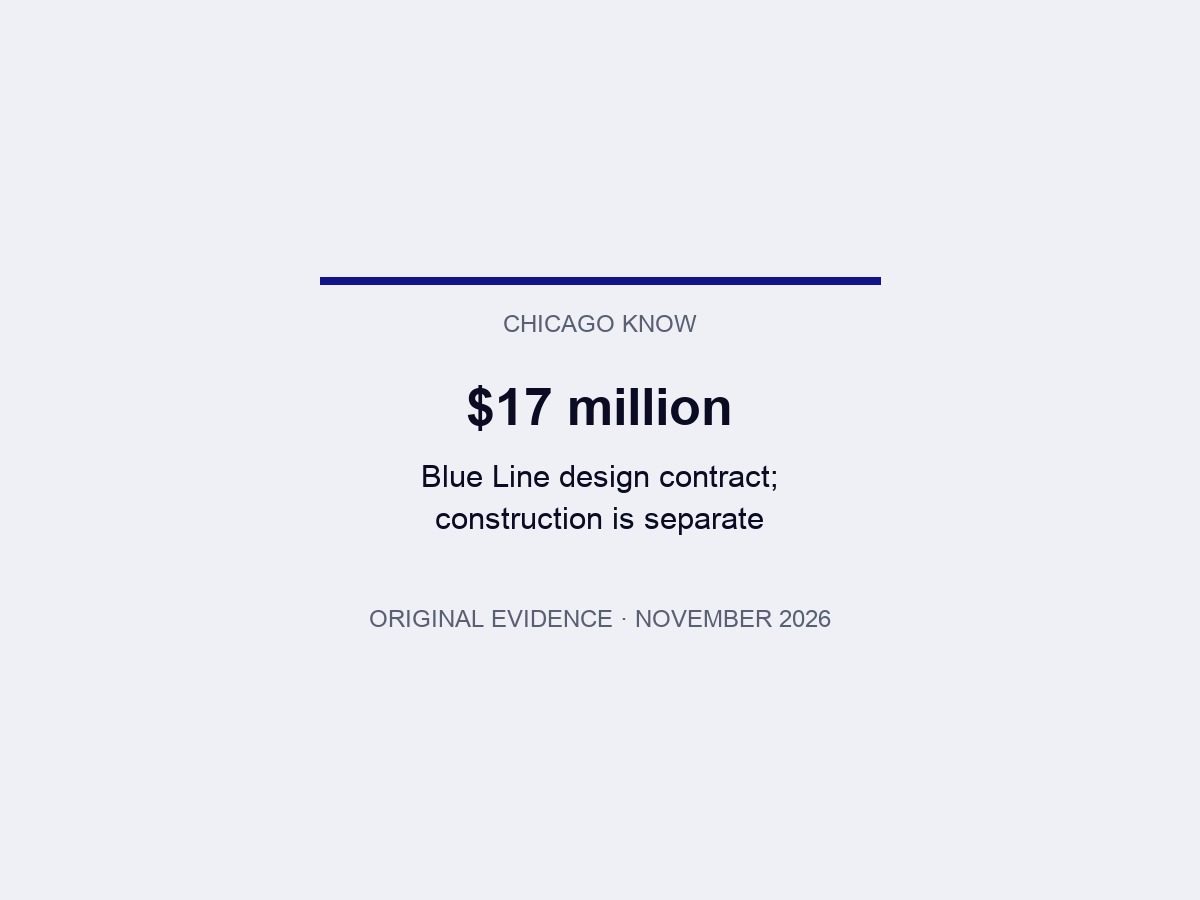
The Forest Park branch of the Blue Line has moved another step toward rebuilding, with a roughly $17 million design contract approved for AECOM Technical Services. For anyone planning a trip west from downtown, the important distinction is what comes next: this award pays for engineering work. A separate stretch around Kedzie and Pulaski is the one CTA expects to begin constructing in 2027.
CTA announced the award on November 2, 2026, following the board’s October 27 vote. The scope runs from Illinois Medical District, or IMD, toward the I-290 bridge just east of River Road and the Forest Park terminal. It excludes the already-designed Kedzie Avenue–Keeler Avenue stretch. CTA’s contract announcement
Read the corridor in travel order
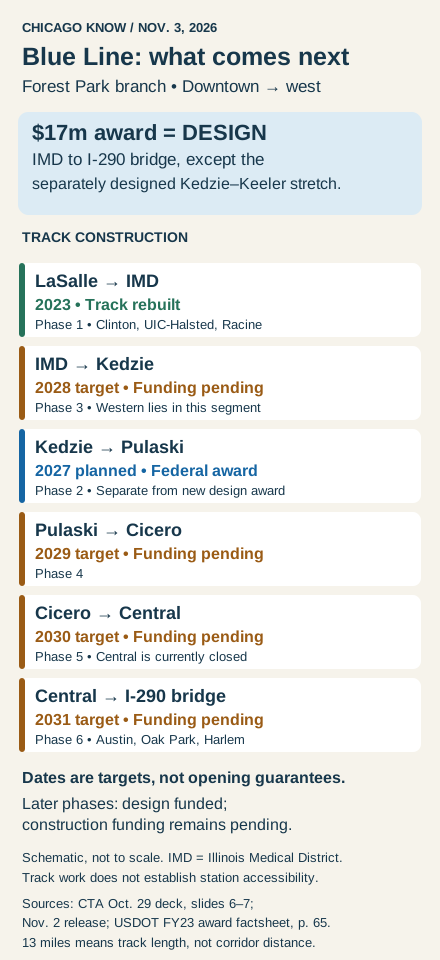
The graphic below follows the branch outward from downtown. Phase numbers are not geographic order: Phase 3 sits between the completed downtown work and Phase 2. That matters when a headline says the “next phase” is starting—it does not mean every intervening track segment is being rebuilt at once.
Open the diagram · Download phase and funding data · Download station-work data
This original schematic is not to scale. It combines CTA’s October 29 community presentation with the November 2 announcement and the federal construction-award record. Years are agency targets, not guaranteed opening dates; station names locate the corridor rather than promise station reconstruction.
What the design money buys
The new contract includes corridor investigation and designs for track, drainage, signals, electrical power and utilities. CTA also wants the designers to examine how drainage along the expressway shoulders affects rail service. A $15.8 million federal Carbon Reduction grant, transferred through IDOT, supports the award in part. That grant is part of the design funding; adding it to the contract amount would double-count money. CTA’s scope and funding explanation
The often-repeated “13 miles” is a track-length figure—CTA describes approximately 70,000 track feet. It should not be read as 13 miles of geographic distance on a route map, or used to turn a design award into a construction cost per mile.
The start language is not fully aligned: CTA’s project page says design is expected in late 2026, while slide 5 of its October 29 presentation says the first quarter of 2027. Neither provides a reason to promise riders an immediate journey-time reduction.
The construction award is a different pot
The federal government’s award record identifies $111 million for construction between Kedzie Avenue and Pulaski Station. It describes replacement of the old track structure and installation of track and signals in East and West Garfield Park. The money belongs to the Neighborhood Access and Equity funding stream in the Reconnecting Communities and Neighborhoods awards. USDOT factsheet, printed page 65
CTA’s March 2024 grant announcement originally put that work in summer 2027. Its latest presentation still shows 2027. The 2024 documents name Pulaski; the new design announcement defines its exclusion using Keeler Avenue. Our data preserves those different boundary descriptions rather than treating station names as precise engineering limits.
For the rest of the track corridor, slide 7 explicitly makes the later construction phases conditional on funding: IMD–Kedzie in 2028, Pulaski–Cicero in 2029, Cicero–Central in 2030, and Central–I-290 bridge in 2031. Those dates are useful for understanding the proposed sequence. They are not evidence that construction money for each segment has arrived. CTA phase schedule
Station work has its own schedule
The station program does not advance on exactly the same calendar as the tracks. CTA’s presentation lists Pulaski for 2028–2030; Central, Kedzie-Homan, Cicero, Forest Park and Western have separate target windows and are explicitly listed as pending funding. Austin, Oak Park and Harlem are assigned to IDOT without dates on that slide. The downloadable station table keeps these distinctions visible, including where funding status is unspecified. CTA station schedule, slide 7
Racine shows why “Phase 1 complete” needs context. Downtown track reconstruction was finished in 2023, but the accessible main station entrance opened October 10, 2025. The October 29, 2026 presentation reports Racine and its Loomis entrance reopened. The earlier $268 million Phase 1 budget included station and power work as well as tracks, so it is not a track-only price benchmark. CTA project page · Original Phase 1 scope
Planning a trip now
Use the Blue Line route and alerts page for your travel date. The rebuild schedule is a capital-project plan, not a notice that your station is closing. Check the station’s accessibility information and elevator alerts separately if you need step-free access.
Also check which branch your outing uses. Our Old Irving Park architecture walk uses the O’Hare side of the Blue Line; this design award concerns the Forest Park side. A shared line color does not make every Blue Line construction announcement relevant to the same part of your trip.
Sources checked November 3, 2026. No travel-time savings or construction-cost-per-mile estimates are calculated here. The dataset records announced awards and published targets, not expenditures, a complete capital budget or live service conditions.