Skip to content
Chicago Know

18 min read ·

How to Decide Whether This Warm Beige Italian Marble Fits Your Project

Daltile permits its polished Botticino Fiorito on properly sealed and maintained interior wet walls but does not recommend that product for shower floors.

Share X in f
Priya Sethi · Updated · 18 min read

How to decide whether this warm beige Italian marble fits your project

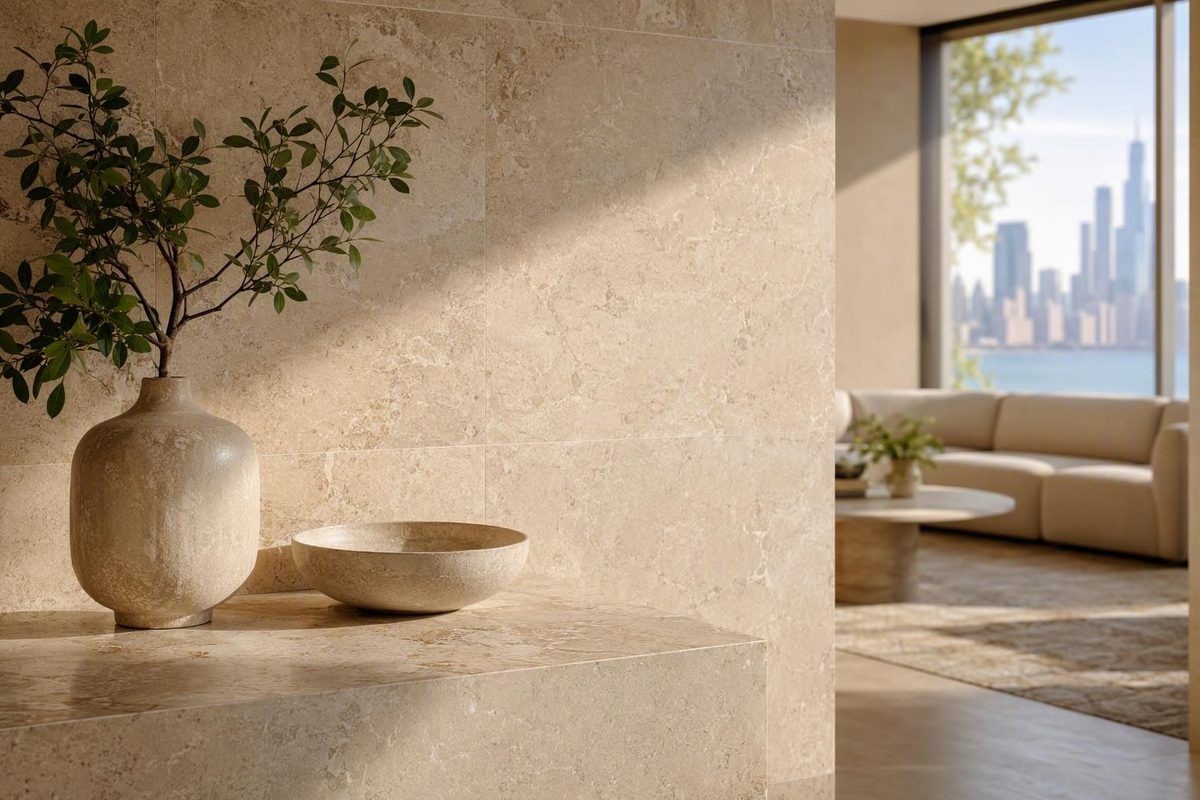
Botticino marble is not one standardized product. It is a family of commercially named natural-stone products that may share a warm cream-to-beige appearance while differing in finish, dimensions, soundness, frost resistance, installation instructions, and approved uses.

That distinction matters. A Botticino tile approved for an interior wall may not be suitable for a shower floor. One supplier’s tested material may resist frost, while another retailer may identify its Botticino product as not frost resistant. Products with similar photographs can also differ in thickness, grout-joint recommendations, filling, lead times, and price.

The safest approach is to evaluate the exact SKU and available lot—not the name alone. Before ordering, review representative samples, written application approvals, current technical data, installation requirements, natural variation, care expectations, and total project cost.

What Botticino marble is—and what the name does not guarantee

Botticino is generally sold as a warm Italian marble. TINO Natural Stone describes its material more specifically as a calcite cream marble with a beige base, light golden veins, and white shading. The supplier places its source broadly near the boundary between Lombardy and Veneto. Daltile identifies its Botticino Fiorito as quarried and manufactured in Italy, while TileBar describes its Botticino Extra Light product as made in Italy.

Those statements support an Italian origin for the cited products, but they do not establish one quarry source or identical geological provenance for everything sold as Botticino.

Names such as Botticino Fiorito, Botticino Extra Light, Semi-Classico, Classico, and Botticino Beige should not be treated as interchangeable specifications. The available evidence does not establish universal definitions for these terms or prove consistent distinctions in quarry, grade, pattern, composition, or performance. Treat each name as a commercial identifier that requires its own documentation.

Broadly expected natural variation may include:

  • Changes in background color and shade
  • Fine or pronounced veining
  • Fossils and other mineral markings
  • Small pits or surface openings
  • Dry seams or separation lines
  • Differences in texture and sheen

More extensive features—such as open voids, structural separation, glass-like veins, reinforcement, filling, and repaired areas—should be tied to the disclosure for the exact product. Daltile, for example, makes those disclosures for its Group C Botticino Fiorito; they should not automatically be attributed to every Botticino product.

Natural characteristics are not necessarily shipping damage. Conversely, the word “natural” does not excuse every broken edge, crack, open repair, dimensional problem, or product that falls outside an approved sample, stated tolerance, or warranty.

A handheld sample can help with basic color and finish, but it may represent only a narrow part of the stone’s visual range. For a large floor, wall, fireplace, or slab installation, request current lot photographs or approval samples. After delivery, inspect the material under the project’s lighting and dry-lay representative pieces before installation. This is the best opportunity to identify a lot that is too light, too dark, too heavily veined, or too visibly repaired for the design.

Formats and finishes: from mosaics and trim to large slabs

Botticino is documented in formats ranging from small mosaics to slab-scale pieces. Availability is product-specific, so the practical question is not simply whether Botticino comes in a particular size. It is whether the exact SKU is available in the required size, thickness, finish, edge treatment, and quantity.

Documented categories include:

  • Mosaics: Small square, rectangular, hexagonal, and patterned pieces, often mounted on sheets
  • Small field tile: Formats such as 3 by 6 inches and 4 by 4 inches
  • Standard and large field tile: Examples include 12 by 12, 12 by 24, 18 by 18, and 24 by 24 inches
  • Decorative components: Pencil liners, chair rails, moldings, and other trim
  • Slabs and custom pieces: Material for larger cladding, fabrication, or project-specific cutting

One retailer collection lists 1-by-1-inch mosaics, 3-by-6-inch tiles, 12-by-12-inch, 12-by-24-inch, 18-by-18-inch, and 24-by-24-inch field tiles, as well as patterned mosaics and pencil trim. It documents honed, polished, tumbled, and micro-beveled polished products. These are representative listings rather than a guarantee that every combination remains available. Tile & Mosaic Depot’s Botticino Beige collection documents the listed formats and finishes.

For slab-scale work, TINO lists a standard thickness of 2 centimeters and a maximum size of 240 by 140 centimeters at that thickness. The supplier instructs buyers to check maximum dimensions by finish and to verify availability for other thicknesses. That figure is a supplier limit for its material, not a universal Botticino slab dimension. TINO provides the slab dimensions and finish qualifications.

Documented finish choices include:

  • Sandblasted: A textured treatment listed by TINO
  • Micro-beveled polished: A polished tile with a small edge treatment

These descriptions concern appearance and processing. The supplied evidence does not establish universal slip ratings, maintenance schedules, or durability rankings for the finishes. A textured-looking product should not be assumed safe for a wet floor without product-specific traction information.

Not every size is made in every finish. A collection might pair tumbled field tile with honed trim, while another offers polished rectangular tile. Before combining field tile, mosaics, base pieces, liners, or chair rails, confirm their:

  • Shade and lot range
  • Thickness
  • Finish and sheen
  • Edge treatment
  • Nominal and actual dimensions
  • Setting depth
  • Grout-joint recommendation

Components can all carry the Botticino name yet look or sit differently when installed together. Review them as a group rather than relying on the trade name to create a match.

Where Botticino can be used: supported, conditional, and product-specific applications

Application claims must remain tied to the exact product. The matrix below separates recurring uses from conditional, negatively qualified, or unverified applications.

Application Classification What to verify
Interior wall cladding Commonly listed Finish, thickness, substrate, setting material, filling, and attachment requirements
Interior residential flooring Commonly listed Traffic, finish, substrate, joint layout, maintenance, and traction
Backsplashes and other interior walls Conditionally suitable Product approval, acid exposure, setting materials, sealing instructions, and cleaning expectations
Foyers, kitchen floors, and bathroom floors Conditionally suitable Traffic, moisture, finish, traction, and written product approval
Fireplace surrounds Conditionally suitable Position relative to the heat source, substrate, setting system, and local requirements
Shower walls Conditionally suitable Written wet-wall approval, waterproofing, setting materials, sealing, and maintenance
Shower floors Not recommended for a cited product Daltile does not recommend polished Botticino Fiorito; verify wet traction and approval for any alternative
Countertops and worktops Conditionally suitable Slab or tile approval, support, fabrication, staining and etching expectations, and warranty
Heavy-commercial floors Conditionally suitable Product-specific traffic rating, finish, maintenance plan, and selected SKU
Exterior walls or floors Conditionally suitable Frost resistance, climate, drainage, substrate, movement joints, finish, and traction
Pool surrounds and persistently wet exterior floors Unverified Written approval plus wet-slip, chemical-exposure, drainage, and freeze-thaw data

Interior floors and wall cladding recur most consistently across the supplied product information. Architessa also lists backsplashes, foyers, kitchen and bathroom floors, fireplace surrounds, shower walls, and shower floors for its represented collection. These are retailer claims for those products, not universal approval for every Botticino tile. Architessa’s listing documents its stated applications.

Wet areas require greater discrimination. Daltile permits its polished Botticino Fiorito on interior wet walls when properly sealed and maintained but does not recommend it for shower floors. It also cautions against polished stone where floor slip resistance is a concern. The same product documentation lists a 1/16-inch grout joint and requires medium-bed mortar when at least one tile side exceeds 15 inches. Daltile’s Botticino Fiorito page contains the usage and installation qualifications.

The evidence does not provide qualifying wet coefficient-of-friction results for these Botticino products. A polished finish, exterior-use statement, or broad retailer application list is therefore not enough to establish safe wet-floor traction.

Countertop use is also conditional. Some listings use broad countertop or worktop language, but TINO’s detailed use information directs buyers to check suitability. A tile being natural marble does not automatically make it appropriate for a countertop. Confirm the selected material, thickness, reinforcement, support, edge fabrication, seams, staining and etching expectations, and warranty.

Commercial approval cannot be generalized. Daltile gives its Botticino Fiorito a heavy-commercial durability rating, but that rating belongs to that product. It does not establish equivalent performance for a different mosaic, tumbled tile, decorative component, slab, or product from another supplier.

Exterior evidence is conflicting. TINO reports frost resistance for its tested material, and Daltile permits specified exterior uses for Botticino Fiorito in freezing and non-freezing climates. TileBar, by contrast, marks its Botticino Extra Light 12-by-24-inch tile as not frost resistant even though the retailer lists some outdoor applications. TileBar’s Extra Light specifications show this product-level conflict.

Exterior durability and exterior safety are separate questions. Frost resistance does not prove adequate wet traction, and exterior approval does not resolve drainage, deicing exposure, substrate movement, or installation-system design. For shower floors, countertops, exterior paving, freezing climates, and other demanding settings, obtain written approval for the exact SKU and have a qualified professional review the proposed assembly.

Technical specifications and natural-stone soundness

Technical figures can help compare materials only when their scope is clear. TINO reports the following laboratory results for its tested Botticino material:

Property Reported result Cited test standard
Water absorption 0.30% UNE EN 13755
Open porosity 0.90% UNE EN 1936
Flexural strength 9.4 MPa UNE EN 12372
Compressive strength 98 MPa UNE EN 1926
Abrasion resistance 20 mm UNE EN 14157
Bulk density 2.69 g/cm³ UNE EN 1936
Impact resistance 25 cm UNE EN 14158
Breaking load at a dowel hole 1,550 N UNE EN 13364

These are supplier-reported results for the tested material, as shown in TINO’s Botticino technical information. They are not guaranteed values for every quarry source, commercial variety, finish, thickness, tile, or slab sold under the Botticino name.

Soundness is a separate issue. Daltile classifies its Botticino Fiorito as Group C. Its product disclosure says the stone may contain holes, voids, separation lines, structural flaws, dry seams, pits, fossils, or glass veins and may require filling, reinforcement, fabrication, repair, or additional maintenance. Fillings can be lost over the life of an installation and may need replacement.

That classification does not mean every visible feature is damage. Factory filling, reinforcement, fossils, or natural seams may be expected for the selected product. It also does not mean every crack, broken edge, open void, or failed repair must be accepted. The agreed sample, stated tolerances, product warranty, and condition on delivery still matter.

A practical receiving procedure is to:

  1. Match labels and packing documents to the ordered SKU and lot.
  2. Confirm dimensions, thickness, edge treatment, and finish.
  3. Inspect boxes or crates for impact and moisture damage.
  4. Examine material from multiple packages under consistent lighting.
  5. Separate questionable pieces before installation.
  6. Photograph cracks, excessive breakage, open repairs, shade concerns, or dimensional differences.
  7. Ask the seller or supplier to evaluate disputed material in writing.
  8. Preserve labels and packaging until the material has been reviewed.

Request current technical information rather than relying on an old catalog, dealer summary, or figures copied from another Botticino variety. Confirm applicable tolerances and the expected degree of filling or reinforcement before ordering, particularly for polished floors, visually prominent walls, book-matched work, and slab fabrication.

How to compare Botticino prices without misleading yourself

Botticino is sold under at least four pricing bases:

  • Per square foot, usually for field tile
  • Per sheet, often for mosaics
  • Per piece, commonly for trim or small tile
  • Per box, with the box covering a stated area

These headline prices are not directly comparable. A mosaic sheet may cover less than one square foot. A liner priced per piece covers length rather than floor area. A box price means little without its stated coverage. Format, thickness, finish, grade, stock status, freight, returns, and order quantity can also affect the offer.

The supplied evidence does not include a reliable observation date for the captured retail prices. Treat every figure below as an undated listing example—not a current quote or market average—and verify it immediately before publication or purchase.

Tile & Mosaic Depot displayed selected field tiles at $9.45 to $11.95 per square foot, mosaics at $10.45 to $11.45 per sheet, and a polished pencil liner at $5.99 per piece. Those figures apply to particular products and selling units. The retailer collection provides the associated price examples.

Architessa displayed a selected 12-by-12-inch tumbled tile at $44.28 per square foot and identified it as special order with a one-to-two-week lead time. These terms apply to the selected configuration rather than the collection as a whole. Architessa supplies the price and lead-time context.

TileBar displayed a 12-by-24-inch polished Extra Light tile at $244.59 per box, or $19.95 per square foot, with six pieces and 12.26 square feet per box. Floor & Decor used another model: $1.49 per 3-by-6-inch honed piece covering 0.13 square feet, with the displayed price and inventory tied specifically to Manassas. Floor & Decor’s listing illustrates location-specific piece pricing.

Use this process to compare quotations:

  1. Calculate covered-area cost. Divide box or piece prices by the stated square-foot coverage.
  2. Confirm whether coverage is nominal or usable. Cuts, pattern requirements, breakage, and rejected visual features can reduce practical yield.
  3. Apply a project-specific overage. Do not compare a waste-inclusive quote with one based only on exact room area.
  4. Add freight and handling. Stone weight, crates, residential delivery, lift-gate service, and destination can materially change the total.
  5. Include installation materials. Mortar, grout, membranes, waterproofing, movement-joint materials, sealers, and cleaning supplies belong in the budget.
  6. Add preparation and labor. Demolition, disposal, substrate flattening, reinforcement, layout, cutting, edge finishing, and polishing may exceed the material cost.
  7. Include fabrication where needed. Slabs, stairs, fireplaces, countertops, miters, cutouts, and finished edges require separate pricing.
  8. Budget for retained spares. Store labeled pieces from the installed lot for future repairs.

The cited retailers provide planning examples of 10% or 15% extra material, but neither is a universal rule. A straight-laid rectangular room may need less contingency than a diagonal floor, patterned mosaic, heavily veined layout, irregular room, or installation that requires selective blending. The difficulty of matching a future natural-stone lot may justify retaining additional pieces.

Because the supplied sources do not provide geographically scoped labor, freight, preparation, or fabrication rates, these examples should not be presented as installed-cost estimates. Obtain a dated written quote that identifies the SKU, lot if known, finish, thickness, package coverage, order quantity, freight, tax, lead time, and return restrictions.

Pre-installation planning for natural Botticino stone

Product and layout questions should be resolved before the first piece is set. Once stone has been installed, it is harder to inspect, return, replace, or rearrange.

Use this pre-installation checklist:

  • Exact trade name and SKU
  • Intended application and written approval
  • Country of origin, if relevant to the specification
  • Finish and sheen
  • Nominal and actual dimensions
  • Thickness and allowable variation
  • Edge treatment
  • Shade range and expected veining
  • Product-specific soundness classification
  • Expected factory filling or reinforcement
  • Lot, batch, or crate numbers
  • Coverage per sheet, piece, or box
  • Ordered overage
  • Available replacement stock
  • Special-order status and lead time
  • Return and claim deadlines
  • Setting-material requirements
  • Grout-joint recommendation
  • Sealing instructions
  • Quantity to retain as spare material

Inspect the shipment before installation rather than checking only the top tile in each box. Dry-lay enough pieces to understand the range, then blend packages or crates to distribute color and veining. This also allows highly marked or repaired pieces to be placed in less prominent positions—or disputed before they become part of the work.

Document cracks, broken corners, significant filling loss, dimensional differences, and unacceptable shade variation promptly. Keep disputed pieces uninstalled while the seller or supplier reviews them.

Light-colored marble may require compatible white setting materials where the product manufacturer directs. Do not choose mortar solely because it worked with another beige marble; verify compatibility with the tile, substrate, membrane, location, and environmental conditions.

Large-format instructions also vary by product. Daltile requires medium-bed mortar for its Botticino Fiorito when at least one side exceeds 15 inches. That is a product-specific instruction, not the sole rule for all large Botticino tile. Follow the current product documentation and the setting-material manufacturer’s requirements.

Grout guidance demonstrates the same variability. Daltile lists a 1/16-inch joint for Botticino Fiorito, while TileBar lists 1/8 inch for its Extra Light 12-by-24-inch product.

For showers and exterior work, treat the following as planning questions for the qualified designer or installer—not as a complete assembly specification:

  • Is the substrate suitable and sufficiently flat?
  • Has structural movement or deflection been addressed?
  • How will waterproofing remain continuous?
  • Are drainage and slope appropriate?
  • What mortar coverage is required?
  • Where are flexible sealant and movement joints needed?
  • Is the product approved for the expected freeze-thaw exposure?
  • How will the assembly manage moisture?
  • Is there product-specific wet-traction evidence?
  • What cure time is required before use?

After completion, retain labeled spare pieces in a protected location. Record the product name, SKU, finish, and lot information. A later order may differ enough in color, thickness, or veining to make even a small repair conspicuous.

Cleaning, sealing, and protecting Botticino marble

The following is conservative care guidance for calcareous marble and natural stone generally. The cited care sources do not provide finish-specific testing for every Botticino product.

TINO describes its Botticino as calcitic. The Natural Stone Institute explains that calcareous stone consists mainly of calcium carbonate and is sensitive to acidic solutions. It recommends mild, non-acidic cleaning, frequent grit removal, prompt spill blotting, and soft drying. The Natural Stone Institute provides the general care basis.

A low-risk routine is straightforward:

  1. Remove sand, dust, and grit frequently with a clean, soft, untreated dust mop.
  2. Blot spills promptly rather than wiping them across a larger area.
  3. Use a pH-neutral cleaner identified as suitable for natural stone.
  4. Follow the cleaner’s dilution and dwell-time instructions.
  5. Rinse when the cleaner or stone-care instructions require it.
  6. Dry with a soft cloth or untreated microfiber pad.
  7. Use entrance mats and area rugs with slip-resistant backings.
  8. Check vacuum wheels and attachments for worn plastic or exposed metal.

Avoid routine use of vinegar, lemon, citrus-based cleaners, and other acidic products. Abrasive scouring products, harsh brushes, and unsuitable powered vacuum brushes can also damage the surface. Bona’s general marble-floor guide similarly recommends pH-neutral cleaning, prompt spill attention, gentle tools, and drying.

It helps to distinguish among common problems:

  • Etching is a chemical change caused by acid reacting with marble. It often appears as a dull or lightened area, especially on polished stone.
  • A stain is discoloration caused by a substance absorbed into the stone or filling.
  • A scratch is physical damage caused by grit, tools, furniture, or abrasive cleaning.
  • Moisture discoloration can occur when stone darkens after exposure and does not dry as expected.
  • Filling loss occurs when material used to close a pit, seam, or void becomes dislodged.

These conditions need different responses.

Whether sealing is needed—and how often—depends on the product, finish, location, existing treatment, exposure, and sealer instructions. Although Bona gives a broad three-to-six-month suggestion for marble floors, that should not be treated as a universal Botticino schedule. Product-specific and condition-based guidance is more reliable.

Seek professional evaluation for deep scratches, persistent stains, widespread etching, damaged filling, moisture problems, or restoration of a worn polished floor. Do not improvise with bleach, ammonia, solvents, blades, or steel wool unless a qualified stone professional has diagnosed the issue and specified a safe procedure.

A final Botticino buying checklist

The decision should be made at product and lot level. “Botticino” narrows the visual category, but it does not settle application, performance, installation, or care requirements.

Before approving an order:

  • Obtain a current sample rather than relying only on a website image.
  • For visually sensitive work, request photographs or approval samples representing the available lot.
  • Confirm the complete trade name and SKU.
  • Record the stated country of origin without assuming it identifies one universal quarry.
  • Verify dimensions, thickness, finish, edge treatment, and package coverage.
  • Ask how much shade and vein variation to expect.
  • Confirm the soundness classification and expected pits, seams, voids, filling, reinforcement, or repairs.
  • Obtain written approval for the intended floor, wall, wet-area, commercial, countertop, exterior, or freeze-thaw use.
  • Request product-specific wet-slip data for wet or slip-sensitive floors.
  • Do not infer traction from a finish name or exterior-use statement.
  • Review the complete installation system with a qualified installer.
  • Confirm substrate, mortar, grout, waterproofing, drainage, movement joints, sealing, and cure requirements.
  • Convert every material offer to cost per covered square foot.
  • Add realistic overage, freight, labor, fabrication, installation materials, and retained spare stock.
  • Review return terms, special-order restrictions, lead time, claim deadlines, warranty language, and responsibility for natural variation or filling loss.
  • Inspect and approve the received lot before installation.

Is Botticino marble suitable for a shower floor?

Not by default. Daltile permits its polished Botticino Fiorito on properly sealed and maintained interior wet walls but does not recommend that product for shower floors. It also cautions against polished stone where slip resistance is a concern. These limitations apply specifically to Daltile’s Botticino Fiorito.

For any proposed shower floor, obtain written approval and relevant wet-traction information for the exact SKU. If those are unavailable, choose a product verified for the application.

Can Botticino marble be installed outdoors in a freezing climate?

Some products may be suitable, but the evidence conflicts. TINO reports frost resistance for its tested material, and Daltile allows specified exterior uses for Botticino Fiorito. TileBar, however, identifies its Botticino Extra Light product as not frost resistant. TileBar’s specification illustrates why the exact SKU must be checked.

Obtain written freeze-thaw and exterior approval for the selected product. Separately verify drainage, substrate, movement accommodation, installation materials, and wet traction.

Does Botticino marble need to be sealed?

Possibly, but there is no reliable universal schedule. An impregnating sealer may reduce absorption and improve stain resistance, but it cannot make marble waterproof, stain-proof, or resistant to acid etching.

Follow the stone supplier’s and sealer manufacturer’s instructions for the exact product and finish. The Natural Stone Institute advises consulting those parties about whether sealing is required and how often it should be performed. Its care guidance supports a product-specific rather than automatic schedule.

What is the difference between polished, honed, and tumbled Botticino?

Polished Botticino has a glossy, reflective surface that tends to emphasize color, veins, and repaired areas. Honed Botticino has a lower-sheen appearance. Tumbled Botticino is processed for a softer, more weathered visual character, often with less-crisp edges.

These are visual and processing distinctions, not universal performance ratings. Suitability, traction, care, and available dimensions depend on the exact product.

How much extra Botticino tile should I order?

The retailer examples in the supplied evidence recommend either 10% or 15%, but neither amount suits every project. The appropriate allowance depends on room shape, cuts, pattern, tile size, breakage risk, selective vein placement, natural variation, and the quantity to be retained for repairs.

Ask the installer to calculate the actual layout and compare more than one overage scenario. Keeping labeled pieces from the original lot can be especially valuable because later natural-stone shipments may not match.

Botticino is a plausible choice when its warm cream-to-beige coloring suits the design and the exact product’s limits suit the project. Approve it only when the available lot, documented applications, technical properties, natural variation, installation system, care obligations, and complete project cost all align.

Get the next article first

One email when we publish, covering evergreen Chicago discovery through neighborhoods, architecture, lakefront walks, and practical routing.

We respect your privacy. Unsubscribe anytime.