
16 min read ·
Best Playgrounds in Chicago by Age, Features, and Outing Type
Maggie Daley is the best-supported destination inside city limits, with age-specific zones, accessible surfacing and seasonal water play.
Overview
If you want one destination playground inside Chicago city limits, go to the Maggie Daley Play Garden at 337 E. Randolph St., because it is the only option with official, detailed evidence for age-specific zones, accessible surfacing, and seasonal water play. If you want a neighborhood playground instead, the right pick depends on your children’s ages and how far you will travel.
This guide covers playgrounds within the city of Chicago only. That boundary matters because search results for this exact phrase routinely mix in other geographies: My Kid List’s “10 Best Playgrounds” page covers Chicago’s suburbs, O The Places We Go covers the Northwest suburbs, and Chicago North Shore Moms covers North Shore parks. None of those help you if you are staying near the Loop without a car or planning a day inside the city.
There is also no consensus winner across the sources this guide draws on. The Chicago Playgrounds guide calls Brighton Park Community Campus “the best in Chicago,” while No Place Like Anywhere singles out Maggie Daley’s climbing walls and slides as “a one-of-a-kind play experience in the heart of downtown Chicago.” Rather than manufacture a single ranking, this guide compares the supported contenders by what each does well, flags where the evidence is thin, and tells you exactly what to verify on the Chicago Park District’s official pages before you leave.
How this guide defines “best”
This guide treats “best” as a fit question, not a trophy. The Chicago Park District lists 515 playground facilities on its official playgrounds directory, so any short list is a judgment call, and the honest move is to disclose how the judging works.
Every playground here had to clear one hard filter and then earn its place on at least one supported strength. The hard filter is geography: the site must sit within Chicago city limits, confirmed against the Park District directory or an official facility page. Beyond that, inclusion rests on the following criteria, applied to what the sources actually document:
- Age fit: evidence of distinct spaces for younger children, older children, or both, such as Maggie Daley’s officially posted rule that the Play Garden is for children under 12, with large slides restricted to ages 5-12 only
- Distinctive play: concrete equipment worth a trip, named specifically (slides, climbing nets, spray features, sand, musical elements) rather than generic praise
- Practical conditions: shade, seating, water play, and documented tradeoffs like crowding
- Accessibility evidence: official surfacing and route details where they exist, clearly separated from editorial “accessible” labels
- Location value: whether the playground pairs naturally with another stop, such as the lakefront or Lincoln Park Zoo
Two limits are worth stating plainly. First, this is an evidence synthesis, not a claim that every site was recently field-tested; where a description comes from one editor’s favorites list, such as the Chicago Playgrounds guide’s stated purpose of listing “my favorite playgrounds in the city of Chicago,” the article says so. Second, the available sources document downtown, North Side, and South Side options in usable detail, but they do not establish a comparably detailed West Side finalist, so this guide does not pretend to balanced coverage it cannot support. If your outing starts on the West Side, the Park District directory is the right tool for finding your nearest facility.
Chicago playgrounds worth the trip
The shortlist below is deliberately non-ordinal, because each entry earns its place for a different supported reason. Maggie Daley Play Garden has the deepest official documentation and the clearest case as a destination. Brighton Park Community Campus, at 4830 S. Western Ave. in the Park District directory, carries the corpus’s only explicit number-one claim. Adams, Mount Greenwood, and Jonquil are neighborhood picks distinguished by concrete features: shade, sand, spray areas, musical elements, and varied play zones, as described by the Chicago Playgrounds guide. A final group earns inclusion for setting, where zoo proximity, a lakefront café, or downtown context turns a playground stop into a fuller route.
The shortlist also skews where the evidence skews: downtown and the North Side are documented in the most detail, while Brighton Park and Mount Greenwood give the South and Southwest Sides genuine representation. Read each profile for the “best for” case, the supporting evidence, and the tradeoff you should plan around.
Maggie Daley Play Garden: the best-supported destination playground
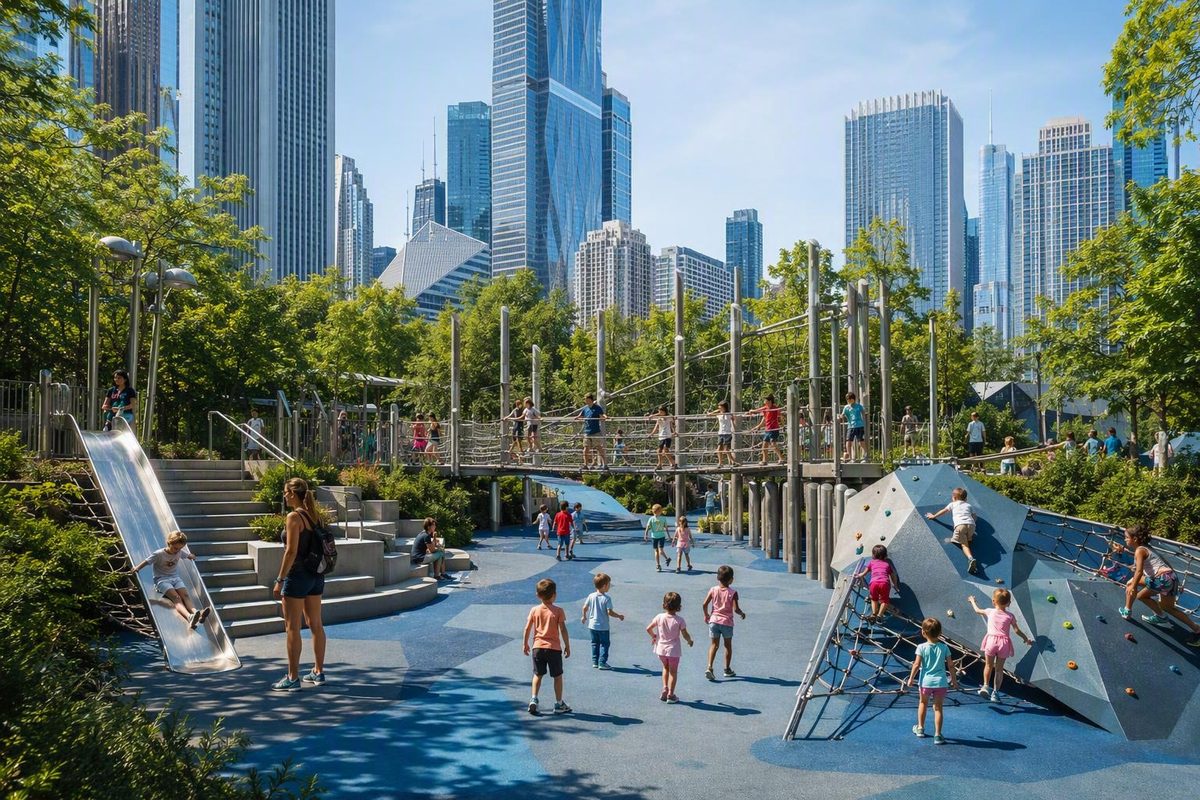
Choose the Play Garden when you need one playground that works for siblings of different ages, or when your day already includes downtown. The official Maggie Daley Park page describes a 3-acre Play Garden anchoring the southeast section of the park, divided into named zones, with an official rule restricting the large slides to children ages 5-12, which is exactly the structure that keeps a toddler and a nine-year-old both occupied without one of them being bored or overwhelmed, which is exactly the structure that keeps a toddler and a nine-year-old both occupied without one of them being bored or overwhelmed.
The zone detail is unusually specific. The Harbor’s graded blue play surface allows direct accessible access from the entry boardwalk, with an additional ramp down to “water” level. The Sea is an 8,500 square foot play loop built around a custom metal play ship with ladders, nets, and a captain’s wheel, and the Slide Crater offers wide slides, rail slides, and slides that emerge from a Play Pyramid; the official page restricts the large slides to children ages 5-12 only. My Kid List, which added Maggie Daley as an “unofficial” city entry to its suburban top ten, calls the two soaring towers and suspension bridge “an awe-inspiring moment for older kiddos” and notes they make great photos against the Chicago skyline. Two more areas round it out: the Enchanted Forest, a 3,590 square foot network of pathways and play zones dedicated to imaginative outdoor play and sensory exploration, and the Wave Lawn, with steeply graded lawn slopes and an accessible pathway network connecting its high and low points.
Plan around three practical facts from the official page: the official pages conflict on current hours, with the Play Garden page listing 6:00 am to 9:00 pm seven days a week and the main Maggie Daley Park page listing open daily 10am-7pm, so verify the day’s schedule before visiting; water features operate Memorial Day weekend through Labor Day weekend, daily 9am-7pm; and the large slides are restricted to children 5-12 only. My Kid List adds one logistics warning worth taking seriously: be prepared to walk, because the Play Garden sits at the southeast corner of the park itself. Budget that walk into your timing, especially with a stroller and a tired toddler on the return leg.
Brighton Park Community Campus: the clearest editorial number-one claim
Consider Brighton Park Community Campus if you are on the Southwest Side or want the newest headline build in the city. The Chicago Playgrounds guide describes it as “brand new in 2023” and calls it flatly “the best in Chicago,” which is the strongest single endorsement anywhere in this guide’s source set. The Chicago Park District directory confirms the location: Brighton Park Community Campus (Park No. 596) Playground, 4830 S. Western Ave., Chicago, 60609.
The honest caveat is that the supplied evidence stops there. The sources do not document Brighton Park’s specific equipment, age zones, water features, or accessibility components in the way the official Maggie Daley page does, so this guide cannot validate a universal top ranking from one editor’s verdict. Treat Brighton Park as a strong contender backed by a credible city-focused reviewer, and check its Park District facility page for current details before building a cross-town trip around it. The tradeoff is straightforward: you get a 2023-vintage playground and South Side convenience, but with less independent documentation than the downtown option.
Feature-rich picks for shade, water, and varied play
These three neighborhood playgrounds earn their places on concrete features rather than fame, all as described by the Chicago Playgrounds guide’s city favorites list. None has the official documentation Maggie Daley has, so treat each description as an experienced editor’s account and verify current conditions on the Park District’s facility pages.
Pick Adams Playground Park when your priority is a comfortable long visit with a younger child on a hot day. The Chicago Playgrounds guide describes it as “a wonderful playground with shade, picnic tables, a big water spray area, and a shaded sandbox.” That combination solves a specific problem: sand play and spray play usually mean full sun and no seating, and Adams is described as offering both with shade and picnic tables in one footprint. The tradeoff is that the description is editorial, so confirm spray operation for your date before promising water play to a four-year-old.
Pick Mount Greenwood Park when you need one Southwest Side site that can absorb a group of mixed-age kids for hours. The same guide calls it “a huge, sprawling and highly accessible site with several distinct play areas, interactive musical elements, a water spray feature, and tons of amenities” and closes with “highly recommend.” Several distinct play areas is the key phrase for families with a wide age spread, and interactive musical elements are a genuinely uncommon feature in the city set. The “highly accessible” label is promising but unverified at the component level; the accessibility section below explains what that gap means in practice.
Pick Jonquil Playlot Park for an interesting North Side stop with water, with your eyes open about crowds. The Chicago Playgrounds guide describes “an accessible play structure, a weird set of traversing elements, and a water spray feature,” and it is the one entry where the source names a real tradeoff: “it can be crowded (and day camp groups can take over the water spray area during the summer) but this is a wonderful playground.” That caveat is useful routing information. If the spray feature is the whole point of your visit, aim for earlier in the day in summer, or hold Jonquil for a non-camp-season visit and pick Adams or Mount Greenwood when spray access is non-negotiable.
Across all three, the pattern to notice is that specific features, not superlatives, are what separate a good visit from a wasted trip: shaded sand at Adams, musical elements and multiple zones at Mount Greenwood, unusual traversing equipment at Jonquil.
Playground-plus-outing combinations
Choose from this group when the playground is one stop in a longer day rather than the whole destination. The supported pairings run north to downtown.
For a Lincoln Park day, sequence the zoo first and the playground second. The Chicago Playgrounds guide places one of its picks “right by the Lincoln Park Zoo,” featuring Kompan equipment and animal sculptures, which makes it a natural decompression stop after zoo crowds. The source supports proximity, not a specific walking time, so leave slack in your schedule.
For a lakefront afternoon where the adults also get to sit down, No Place Like Anywhere describes a lakefront park where “parents can eat lunch at the cafe while their children play in full view on the playground.” The same source notes the playground “is not massive but does provide structures for both littles and bigger kids.” That sightline-plus-café arrangement is rare, and it changes the calculus: you are trading playground scale for a genuinely restful stop, which is often the right trade late in a full day.
For a downtown itinerary, Maggie Daley is the obvious anchor. My Kid List highlights that the Slide Crater’s towers frame “great photos against the Chicago skyline,” and the Play Garden’s position at the southeast corner of Maggie Daley Park means the walk in can flow naturally from the Randolph Street side rather than requiring a doubled-back route. The Chicago Playgrounds guide also notes that one large park playground in the city offers “some of the best skyline views and some of the best places to watch trains in the whole city,” a reminder that setting is a legitimate selection criterion, not just a bonus.
The general principle: pair the playground with the adjacent attraction and put the higher-stamina activity first, so the playground works as the reward at the end of the sequence rather than the thing kids get pulled away from.
Choose the right playground for your outing
Use this matrix to match your family’s actual constraint to the option with the strongest supporting evidence. Every “supported reason” traces to a named source; every caveat tells you what remains unverified so you know what to check before committing to a trip.
| Family need | Option to consider | Supported reason | Caveat or what to verify |
|---|---|---|---|
| Toddler (ages 2-5) with gentle water play | Maggie Daley Play Garden | Official page states the Play Garden is for children under 12 and documents seasonal water features | Water features run only Memorial Day weekend through Labor Day weekend, 9am-7pm, per the official page |
| Older child (5-12) seeking thrills | Maggie Daley Play Garden | Official page documents the Slide Crater’s wide slides and rail slides, plus The Sea’s play ship with ladders and nets; My Kid List describes the suspension bridge and towers | Large slides are restricted to ages 5-12 only; expect a walk to the southeast corner of the park, per My Kid List |
| Siblings across a wide age range | Maggie Daley Play Garden or Mount Greenwood Park | Maggie Daley’s official page documents multiple named zones with a 5-12 restriction on large slides; Chicago Playgrounds describes Mount Greenwood as huge with several distinct play areas | Mount Greenwood’s description is editorial; no official zone or age documentation in this guide’s sources |
| Shade, sand, and spray in one visit | Adams Playground Park | Chicago Playgrounds describes shade, picnic tables, a big water spray area, and a shaded sandbox | Editorial description only; confirm spray operation on the Park District facility page |
| Verified accessible surfacing and routes | Maggie Daley Play Garden | Official page states a poured-in-place soft surface base and play elements that meet or exceed ADA minimum standards, plus accessible pathways in the Wave Lawn and Harbor | Component-level fit for a specific child (swings, transfers, sensory load) still needs confirmation for your situation |
| Newest build / strongest editorial pick | Brighton Park Community Campus, 4830 S. Western Ave. | Chicago Playgrounds calls it brand new in 2023 and “the best in Chicago”; address confirmed in the Park District directory | Sources provide no comparable equipment, water, or accessibility detail; check the facility page first |
| Playground after Lincoln Park Zoo | The playground beside the zoo (per Chicago Playgrounds) | Described as right by the Lincoln Park Zoo with Kompan equipment and animal sculptures | Proximity is supported; walking time and current conditions are not documented |
| Lunch for adults while kids play | Lakefront park with café (per No Place Like Anywhere) | Parents can eat at the café with children in full view on the playground; structures for both littles and bigger kids | Playground is described as not massive; café hours and seasonality not documented |
Two reading notes on the table. First, Maggie Daley appears in multiple rows not because it wins a ranking but because it is the only site where official documentation covers ages, water, and accessibility together; a well-documented option is easier to recommend confidently than a possibly better but thinly documented one. Second, where the caveat column says “editorial,” that is not a knock on the source, only a signal that you should treat the detail as one visitor’s account and spend two minutes on the Park District directory confirming the facility’s current status before you drive across the city.
What “accessible” means—and what is actually verified
Start with the official definition, because it is narrower than most families assume. The Chicago Park District states that “a playground is considered accessible if it has a rubberized surface (poured in place) or EWF (engineered wood fiber) surface and ADA swing(s).” That is a facility-level label about surfacing and swings. It does not, by itself, tell you whether a child using a mobility device can reach every play structure, whether transfer platforms exist, how sensory-intense the environment is, or whether the route from parking to the playground is manageable.
Maggie Daley Play Garden is the one shortlisted site where the sources go deeper than the label. The official Play Garden page states that it “features a poured in place soft surface base and play elements that meet or exceed ADA minimum standards.” The zone descriptions add route-level detail that is genuinely useful for planning: The Sea’s play ship has “multiple points of accessible entry and exit”; the Harbor’s graded blue play surface “allows for direct accessible access from the entry boardwalk,” with an additional ramp down to the marina’s “water” level; and the Wave Lawn has “an accessible pathway network that connects high and low points.” For a caregiver evaluating whether a child can participate rather than watch, those are the details that matter, and Maggie Daley is the only city option in this guide’s evidence where they are published.
For the rest of the shortlist, the evidence is thinner and you should treat it accordingly. The Chicago Playgrounds guide calls Mount Greenwood “highly accessible” and describes Jonquil as having “an accessible play structure.” Those labels come from a city-focused editor and are worth something, but they do not verify surfacing type, ADA swings, accessible routes between zones, or transfer access at either site. Brighton Park Community Campus and the other shortlisted playgrounds have no accessibility documentation at all in this guide’s sources. Absence of documentation is not evidence of inaccessibility, but it does mean the burden of verification falls on you.
A practical way to close that gap: look up the specific facility on the Park District directory and check whether it carries the district’s accessible designation, then translate the label into your child’s actual needs. Surfacing and ADA swings, the two components in the district’s definition, cover some families’ requirements completely and others’ barely at all. If your child needs a wheelchair-navigable route to elevated structures, quiet zones for sensory regulation, or caregiver access alongside the child, the label alone does not answer the question, and this guide will not pretend it does. For Maggie Daley, the published zone descriptions let you plan at that level. For everywhere else on this shortlist, plan to confirm the specific component your family depends on before making the playground the centerpiece of your day.
Plan your visit before you leave
Two sets of rules govern these visits, and they come from different sources, so keep them separate. The Chicago Park District’s general playground rules state that playgrounds are open during daylight hours only, are for children under 12 years, and that dogs, bicycles, bottles, and glass are not permitted. The district also states that beginning June 1, 2024, unattended toys or personal items in the playground will be removed and discarded, so do not stash a scooter by the fence and walk away.
Maggie Daley Play Garden publishes its own site-specific schedule on the official park page: 6:00 am to 9:00 pm, seven days a week. The sources do not explain how that fixed schedule relates to the district’s general daylight-only rule, so treat them as two separate published statements and rely on the official page for Maggie Daley specifically. The Play Garden adds its own rules beyond the district baseline: ball playing is not permitted, dogs and bikes are not permitted, children should sit rather than stand in swings, and the large slides are restricted to children 5-12 only.
Before you leave, run through a short verification pass. It takes five minutes and prevents the most common outing failures:
- Confirm the facility’s current status on the Chicago Park District directory, which lists all 515 playground facilities with addresses, especially for editorially described sites like Adams, Mount Greenwood, Jonquil, and Brighton Park where this guide has no current-conditions evidence
- Check water operation dates and hours if spray play is the point; Maggie Daley’s water features run Memorial Day weekend through Labor Day weekend, daily 9am-7pm, and other sites’ spray schedules are not documented in this guide’s sources
- Confirm bathrooms, parking, and transit access for your specific site, because none of the sources here document those amenities for any shortlisted playground
- Match posted age rules to your kids, including the under-12 rule at district playgrounds and the 5-12 restriction on Maggie Daley’s large slides
Then plan for conditions the sources do document. Crowding is real at popular water features: the Chicago Playgrounds guide notes that day camp groups can take over Jonquil’s spray area during the summer, so a weekday morning start beats an afternoon arrival if water play is essential. Walking distance matters at Maggie Daley, where My Kid List warns the Play Garden sits at the southeast corner of the park; approach from Randolph Street and build the walk into your schedule rather than discovering it with an impatient toddler. For packing, My Kid List’s advice for splash-pad visits transfers directly to the city sites: changes of clothes or sandals for the water features, plus extra water, sunscreen, and snacks.
The overall workflow is simple. Pick your playground from the matrix based on your family’s constraint, verify its facility page the morning of the visit, sequence it with any paired attraction so the playground comes last, and pack for water and sun in season. Do that, and “best playground in Chicago” stops being an abstract ranking question and becomes what it should be: the right park, on the right day, for your particular kids.