
17 min read ·
Best Parks in Chicago by Activity: Sightseeing, Family Play, Nature, and Views
Millennium Park wins for first-visit sightseeing, Maggie Daley Park for kids and Montrose Point for birding, with three more picks matched to the day.
Overview
The best park in Chicago depends on what you want from the day, not on a single citywide winner. Choose Millennium Park for first-visit sightseeing, Grant Park for a museum-centered day, Maggie Daley Park for destination play with kids, Montrose Point for birding, Promontory Point for a skyline view across the water, and Jackson Park for designed landscapes near a major museum.
That answer reflects how the sources that cover Chicago parks actually disagree. Visitor guides such as Choose Chicago lead with Millennium Park, calling it the city’s iconic urban oasis, while a playground specialist like Chicago Playgrounds judges parks by equipment, shade, and water features instead of landmarks. Neither is wrong. They are answering different questions, so this guide names a winner per use case rather than forcing one park to carry every outing.
It also helps to compare like with like. Some of the recommendations below are landscaped downtown campuses with several attractions inside them, one is primarily a playground, one is a fenced nature sanctuary, and one is a stone peninsula inside a much larger lakefront park. The table labels each park’s primary experience so you can see what you are actually choosing between.
| Park | Area | Best for | Primary experience | Why it stands out |
|---|---|---|---|---|
| Millennium Park | Downtown (Loop) | First-visit sightseeing | Public art and lawn programming | Cloud Gate, interactive fountains, free live music, and seasonal ice skating, per Choose Chicago |
| Grant Park | Downtown (Loop) | A museum-centered day | Large formal green space | Connects directly with Museum Campus (Field Museum, Shedd Aquarium, Adler Planetarium), per Chicago’s Property Shop |
| Maggie Daley Park | Downtown (Loop) | Family destination play | Playground campus | Climbing walls and signature slides, with a cafe overlooking the play areas, per No Place Like Anywhere |
| Montrose Point Bird Sanctuary | North Side (Lincoln Park) | Birding and quiet | Fenced nature sanctuary | Over 300 recorded bird species, per Chicago’s Property Shop, and an accessible 1/3-mile loop installed in 2021, per the Chicago Park District |
| Promontory Point | South Side (Burnham Park) | Skyline views over water | Lakefront peninsula | A naturalistic point designed by Alfred Caldwell, per the Chicago Park District, with an unbeatable view of the Chicago skyline, per Chicago’s Property Shop |
| Jackson Park | South Side | Landscapes plus a museum | Historic parkland with paths and waterways | Walking paths and green space surrounding the Museum of Science and Industry, per Chicago’s Property Shop |
Use the table to pick your category first, then read the matching section below. Each one explains the tradeoff you accept by choosing that park, and the final section covers what to verify on official pages before you commit part of a day to any of them.
Best downtown parks for a first Chicago visit
If you are downtown with limited time, the practical question is not which park is famous but which one anchors the rest of your day. The three strongest options sit close together along Michigan Avenue and the lakefront, and each pulls your route in a different direction. Millennium Park is the sightseeing anchor, with Cloud Gate and its lawn programming at the center. Grant Park is the green corridor that connects you south toward Museum Campus, which Chicago’s Property Shop notes integrates seamlessly with the Field Museum, Shedd Aquarium, and Adler Planetarium. Maggie Daley Park is the family answer, a playground campus rather than a strolling park. Because all three are within walking distance of each other, the real decision is sequencing: start where your main goal is, and treat the others as what you pass through on the way, not as separate trips.
Millennium Park for iconic sightseeing
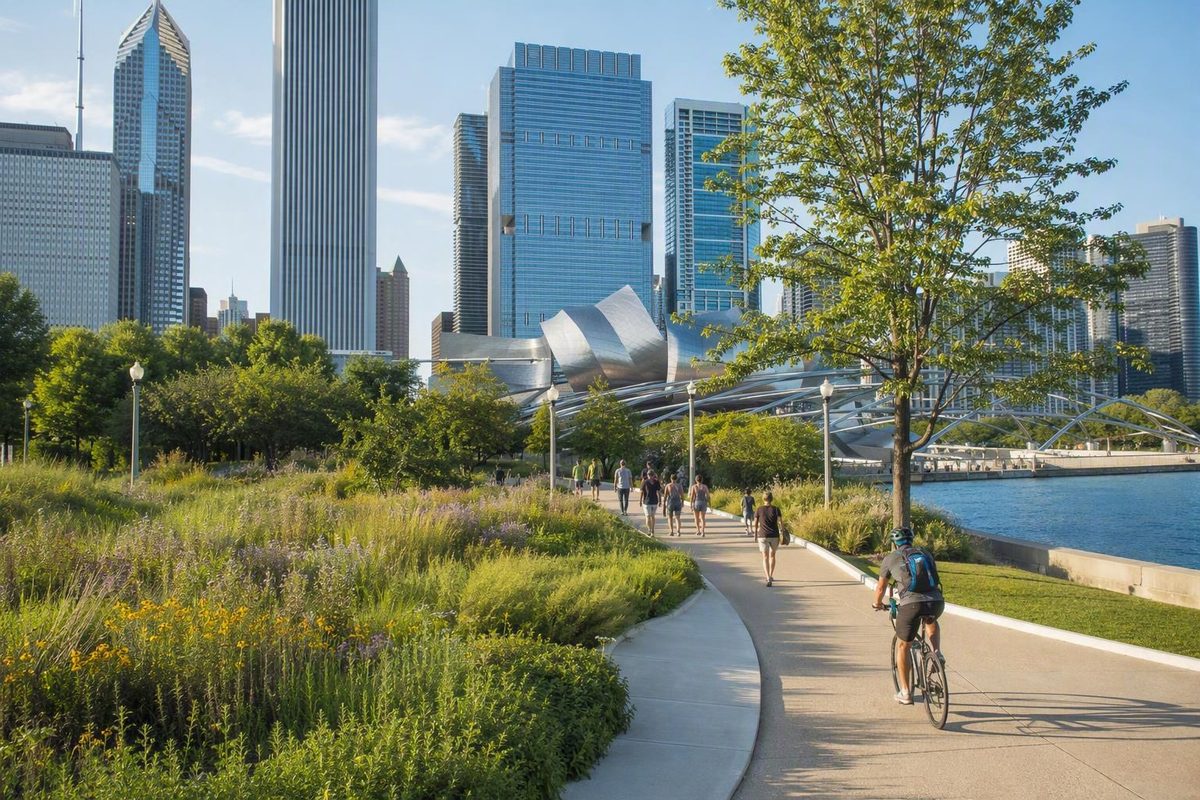
Choose Millennium Park when your goal is to see the Chicago that appears in photographs, and to do it in one compact stop. Choose Chicago describes it as the city’s iconic urban oasis, and its core draws sit close together: Cloud Gate, the reflective Anish Kapoor sculpture locals call The Bean, interactive fountains where kids can splash, and free live music on the lawn in season. Chicago’s Property Shop adds that Cloud Gate’s mirrored surface gives you skyline views and photo angles you cannot get elsewhere downtown, which is why the sculpture works as a route anchor at 201 E Randolph St.
The park is also not only a summer stop. Choose Chicago notes seasonal ice skating rinks and holiday events keep it active year round, which matters if you are visiting in winter and most lakefront options are less appealing. The tradeoff is predictable: this is the single most recommended park in the visitor-oriented sources, including a Tripadvisor reviewer who calls it a landmark for locals and tourists alike, so you should expect company. If you want quiet, this is the wrong pick; Montrose Point, covered below, is the better answer for that.
Grant Park for a museum-centered day
Choose Grant Park when the park is the connective tissue of your day rather than the destination itself. Its defining advantage, per Chicago’s Property Shop, is that it integrates directly with Museum Campus, home to the Field Museum, Shedd Aquarium, and Adler Planetarium. That makes it the natural choice for a day built around one or more of those institutions: you walk through formal green space to reach them, take breaks on the lawns between visits, and end the day back at the lakefront without ever needing transit between stops.
The tradeoff against Millennium Park is focus. Grant Park does not have a single signature attraction on the scale of Cloud Gate, so if your goal is landmark sightseeing in an hour, Millennium Park serves you better. Grant Park rewards a longer, museum-paired day instead. One note on scope: the supplied sources support the Museum Campus pairing but do not establish current admission prices, hours, or reservation rules for the museums themselves, so check each institution’s official site before building your day around a specific entry time.
Maggie Daley Park for destination play
Choose Maggie Daley Park when children are the deciding vote. No Place Like Anywhere describes its playground as a one-of-a-kind play experience in the heart of downtown, built around modern structures including climbing walls and its well-known slides. This is not a conventional neighborhood playground scaled up; it is a destination in its own right, which is why families sometimes plan a downtown day around it rather than adding it as a stop.
One practical detail from the same source matters for parents: there is a cafe where adults can eat lunch while keeping children in full view on the playground. That sightline arrangement is rare among the parks in this shortlist and makes a longer stay workable. The tradeoff is that Maggie Daley Park does little for adults without kids; if you are choosing a downtown park for scenery or strolling, Millennium Park or Grant Park is the better use of the same time. It sits adjacent to both, so a family route can reasonably start here and let the adults trade off short walks to Cloud Gate.
Best Chicago parks and playgrounds for families
For families, the right park depends less on fame and more on how a specific playground handles shade, water, sightlines, and crowds. The specialist sources in this shortlist are useful precisely because they judge on those terms. Chicago Playgrounds builds its list around playgrounds that stand out for interesting equipment or setting, and its individual entries show what those criteria look like in practice: one favorite has shade, picnic tables, a big water spray area, and a shaded sandbox; another is a huge, sprawling, highly accessible site with several distinct play areas, interactive musical elements, a water spray feature, and extensive amenities; a third is a large playground with some of the strongest skyline views in the city and one of its better trainspotting positions.
Those entries translate into a short checklist you can apply to any Chicago playground before you commit to it:
- Shade and seating. A shaded sandbox and picnic tables, as Chicago Playgrounds highlights at one of its favorites, decide whether a summer visit lasts twenty minutes or two hours.
- Water play. Spray features are a repeated marker of standout playgrounds in the specialist coverage, but they are seasonal and can be dominated by groups.
- Distinct play areas. A site with several separated areas, as in the sprawling accessible example above, lets children of different ages play without colliding.
- Accessibility. Chicago Playgrounds explicitly flags one large site as highly accessible; if that matters for your family, look for that language rather than assuming it.
- Supervision sightlines. Maggie Daley Park’s cafe-with-full-view arrangement, noted by No Place Like Anywhere, is the clearest supported example of a layout that makes supervision easy.
- Crowding. Chicago Playgrounds is candid that one of its favorites can be crowded and that day camp groups can take over the water spray area during the summer, a warning worth generalizing to any popular water feature on a July weekday.
Where does that leave the actual pick? For a downtown family outing, Maggie Daley Park remains the clearest supported choice because its climbing structures and slides are a destination experience rather than routine equipment, per No Place Like Anywhere. For an outing built around a beach day, the same source notes that Montrose Beach, Chicago’s largest public beach, adds volleyball, jet ski rentals, and a bar and restaurant, which pairs a swim with the Montrose Point sanctuary next door if older kids want a nature walk.
Two honest limits on this section. First, the supplied evidence does not map every standout playground to a named park, so treat the checklist as the transferable part and use a park-by-park resource such as Kidlist, which documents individual playgrounds including the bathroom and parking situation, to fill in specifics for your neighborhood. Second, none of the sources establish uniform age-suitability ratings, so match the equipment description to your own children rather than trusting a blanket kid-friendly label.
Best parks for lakefront views, gardens, trails, and birding
Scenery in Chicago parks is not one experience, and choosing well means knowing which kind of view you are actually after. A downtown landmark view is what you get at Millennium Park, where Cloud Gate reflects the skyline back at you, per Chicago’s Property Shop. A skyline view across open water is a different thing entirely, and the strongest supported example is Promontory Point, a peninsula reaching into Lake Michigan on the South Side. A sanctuary outlook is quieter again: a Tripadvisor reviewer describes Montrose Point as a bird sanctuary with amazing views of the city and spots for quiet moments, which is a fair summary of its dual appeal. Even playgrounds enter this category, since Chicago Playgrounds singles out one large playground for some of the best skyline views in the city. The three sections below take the strongest supported examples in turn: Montrose Point for birding, Promontory Point for the over-water skyline, and Jackson Park for designed landscapes with a museum attached.
Montrose Point Bird Sanctuary for birding and quiet
Montrose Point is the clear birding choice in this shortlist, and the evidence behind it is stronger than for any other nature claim in the corpus. The Chicago Park District states that the sanctuary, located within Lincoln Park on the North Side lakefront, attracts tens of thousands of migratory birds to rest, eat, and shelter each spring and fall. Chicago’s Property Shop adds that more than 300 species have been recorded there, including warblers, thrushes, sparrows, purple martins, woodpeckers, and owls, and that the site has gained international recognition as a birding location.
Access has also measurably improved. The Park District installed an accessible one-third-mile loop in 2021, funded in part by a grant from the Illinois Department of Natural Resources, that travels near several popular birding locations within the site. The district describes this ADA-accessible trail as opening one of the most important birding destinations in Illinois to a wider range of visitors, and it implements part of the sanctuary’s 2015 master plan.
The tradeoff is purpose. Montrose Point is a sanctuary, not a recreation park; you go there to walk quietly and look, and the Tripadvisor description of quiet moments with city views captures the pace. If your group wants activity, the adjacent Montrose Beach, which No Place Like Anywhere identifies as Chicago’s largest public beach with volleyball and jet ski rentals, is the natural pairing. Time your visit for spring or fall migration if birds are the point of the trip.
Promontory Point for a peninsula skyline view
Choose Promontory Point when the view itself is the outing. Chicago’s Property Shop describes it as a peninsula reaching into Lake Michigan with an unbeatable view of the Chicago skyline, popular with locals and visitors alike, and the geometry explains why: because you stand out over the water south of downtown, you see the skyline across open lake rather than from inside it, an angle no downtown park can offer.
The setting has pedigree as well. The Chicago Park District identifies the Point as a naturalistic landscape designed by Alfred Caldwell, sitting within Burnham Park, which totals about 600 acres of lakefront just south of Grant Park. That parent park matters for planning a longer route: the district notes Burnham Park also holds a popular skate park at 31st Street, beaches at 12th Street, 31st Street, Oakwood, and 57th Street, plus bird sanctuaries and natural areas, so the Point can be one stop on a southbound lakefront day rather than an isolated destination.
The tradeoff is amenities. The Point is a scenic landscape, not an attraction campus, and access details there have changed over time, so hold the practical questions for the planning section below and verify current conditions on the Park District’s page before you go.
Jackson Park for landscapes and museum proximity
Jackson Park is the pick when you want designed parkland with a cultural anchor inside it. Chicago’s Property Shop highlights the Museum of Science and Industry as the park’s striking focal point, its classical architecture surrounded by walking paths and green space, and Choose Chicago includes Jackson Park among the city’s principal parks and gardens. That combination gives Jackson Park a different logic from the two lakefront points above: rather than one view, you get a walking landscape where paths, waterways, and a major museum sit within the same South Side park.
The practical routing case is similar to Grant Park’s, applied to the South Side. If the Museum of Science and Industry is on your itinerary, Jackson Park lets you extend the visit outdoors on foot instead of treating the museum as an isolated stop. The difference from Promontory Point, a short distance north along the lakefront, is the primary experience: the Point is a single scenic destination, while Jackson Park is a landscape you move through. The supplied sources do not document Jackson Park’s specific facilities, hours, or garden features, so treat this as a landscape-and-museum recommendation and confirm current details on official pages before building a full day around it.
Looking beyond downtown and the North Side
The strongest coverage in the sources clusters downtown and along the North Side lakefront, but the supported shortlist does extend west and south, and those options deserve equal footing in your decision. On the West Side, Chicago’s Property Shop describes Humboldt Park, spanning 207 acres on the city’s northwest side, as blending scenic beauty with cultural vibrancy, and Choose Chicago includes it in its list of principal city parks. On the South Side, two of this guide’s category winners already sit there: Promontory Point within Burnham Park’s roughly 600 lakefront acres, per the Chicago Park District, and Jackson Park with the Museum of Science and Industry at its center.
For a reader deliberately choosing outside the downtown core, the supported options group like this:
- West Side: Humboldt Park, a 207-acre landscape combining scenery with cultural life, per Chicago’s Property Shop.
- South Side lakefront: Promontory Point and the rest of Burnham Park, including beaches at 12th, 31st, Oakwood, and 57th Streets and a skate park at 31st Street, per the Chicago Park District.
- South Side parkland: Jackson Park’s paths and museum setting, plus Washington Park, which Choose Chicago names among the city’s parks and gardens.
One scope limit should be stated plainly. The sources behind this guide are curated editorial lists and two official park pages, not a systematic community-area survey, so this section shows that credible choices exist beyond downtown and the North Side rather than proving the shortlist is geographically balanced across all of Chicago. Choose Chicago’s own list, which also names Lincoln Park, North Avenue Beach, and the Lakefront Trail, skews toward the lakefront for the same reason most visitor coverage does: that is where the marquee landscapes sit.
The practical takeaway is directional. If you are staying south or west, or you have already done the downtown circuit on a previous trip, you do not need to default back to Millennium Park. A day built around Jackson Park and Promontory Point covers a museum, historic landscape design, and the strongest over-water skyline view in this shortlist without entering the Loop at all, and Humboldt Park gives the West Side a large-scale landscape of its own. What the evidence cannot do is rank every neighborhood park citywide, so treat these as the supported anchors and check the Chicago Park District directly for parks nearer to where you are.
Plan your park visit before you go
A good park choice can still produce a bad outing if the practical details have changed since a list was written, and the evidence behind this guide shows exactly how that happens. The Montrose Point master plan of 2015 recorded that the site lacked an accessible trail; the Chicago Park District’s current page documents the accessible loop installed in 2021. A six-year-old planning document and a current official page describe two different parks, which is why the verification habit matters more than any single listed detail.
The same evidence also shows how uneven practical information is across sources. The Park District’s Promontory Point page notes metered parking in nearby lots; the playground sources flag summer crowding at water features; the family resource Kidlist documents bathroom and parking situations playground by playground precisely because that information is not standardized anywhere else. The two subsections below split the verification work into operations, which change seasonally, and access, which changes with construction and infrastructure.
Verify hours, closures, reservations, and seasonal operations
Before you commit part of a day to any park on this shortlist, check its official page for the details that editorial lists cannot keep current. The supplied sources, candidly, do not establish comparable hours, closure status, or reservation rules across these parks, so this guide will not invent them. What the evidence does establish is which categories change and why they matter.
Run through this sequence on the park’s official page, and the official pages of any paired attraction:
- Current hours and temporary closures. Park landscapes near active lakefront infrastructure can change access with little notice; verify rather than assume.
- Reservations and admission conditions for paired attractions. The Grant Park and Jackson Park recommendations lean on Museum Campus and the Museum of Science and Industry, per Chicago’s Property Shop, and museum entry rules are outside what park lists track.
- Seasonal amenities. Choose Chicago notes Millennium Park’s ice rinks and holiday events are seasonal, and water spray features at playgrounds run only part of the year, per Chicago Playgrounds.
- Likely crowd pressure. Chicago Playgrounds warns that day camp groups can take over a water spray area during summer, so a weekday morning in July behaves differently from a September afternoon.
Five minutes on the Chicago Park District site before leaving protects the two or three hours you are about to spend, which is the whole point of choosing carefully in the first place.
Check transit, parking, restrooms, and accessibility
Access details decide whether a park works for your specific group, and the two official examples in this evidence set show how location-specific those details are. At Promontory Point, the Chicago Park District’s page notes that metered parking is available in nearby lots, which is the kind of concrete fact worth confirming for any park you plan to drive to, since the sources do not establish parking conditions for the rest of the shortlist.
Montrose Point is the more instructive case. The sanctuary’s 2015 master plan documented informal entrances on all sides with primary access from the south and west, two accessible parking areas (one on Montrose Drive to the south, one near the beach house to the west, the latter limited by drainage problems), and additional parking along Montrose Drive. It also recorded a real restroom gap: the nearest public restrooms sat in the beach house west of the Point, many birders visit in the early morning and off-season when those restrooms are closed, and summer port-a-johns stood over half a mile from the far end of the Point. If you plan an early-morning migration walk, that seasonality is the difference between a comfortable visit and a short one.
At the same time, treat older planning documents as history, not current fact. The same plan stated that Montrose Point lacked an accessible trail; the Park District’s current page confirms the accessible one-third-mile loop has been in place since 2021. The current official page always wins. For any park in this guide, check its Park District page for accessibility, parking, and restroom status, and for playground-level specifics, a resource like Kidlist documents bathrooms and parking site by site. The supplied evidence does not cover CTA routes or transit frequency for these parks, so confirm your transit approach with official transit information rather than an editorial list. Do that, pick the park whose primary experience matches your day, and the choice largely makes itself.