
20 min read ·
How to Recognize Deco-Era Geometry and Choose the Right Window Approach
An Art Deco style description does not establish period origin. That requires documentary or physical evidence, not visual resemblance alone.
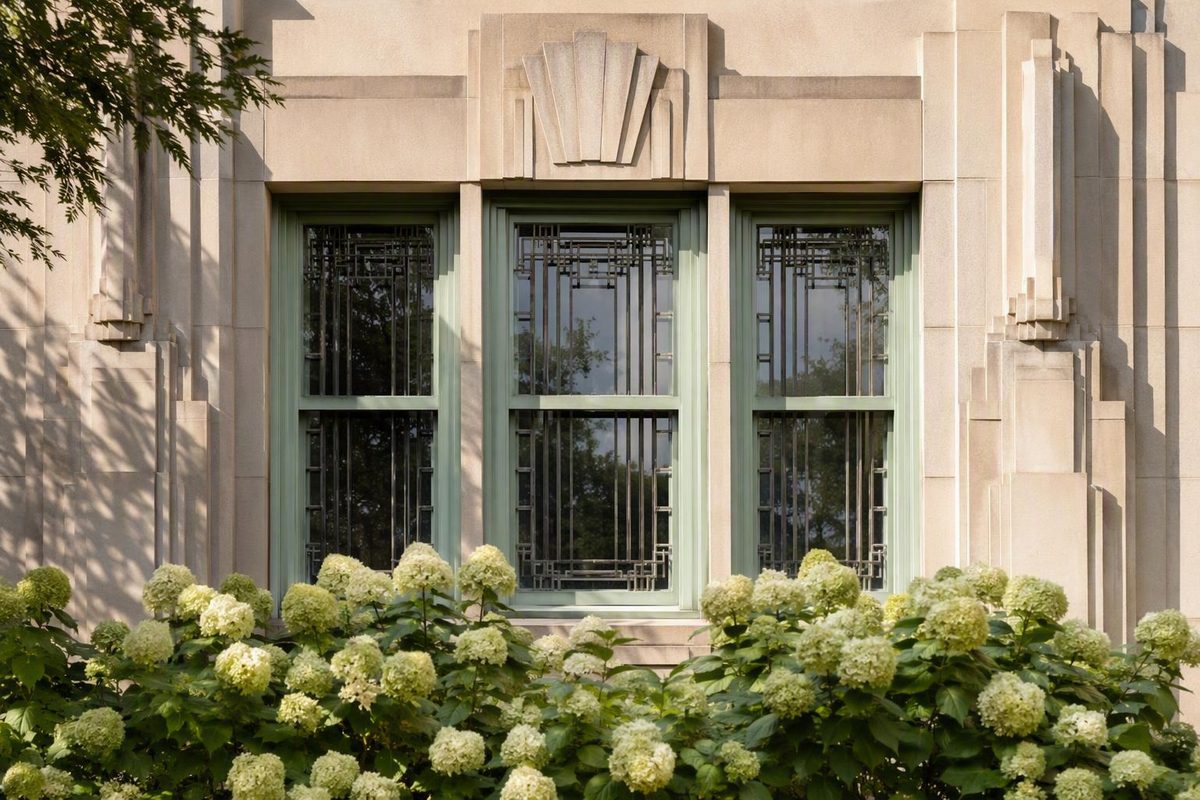
Art Deco windows are united less by one material than by a visual system: disciplined geometry, symmetry, streamlined lines, and repeated rectilinear or radiating patterns. Those qualities can appear in stained glass, clear glazing, metal casements, entrance doors, transoms, grilles, and modern steel-look systems.
This guide is an identification and due-diligence framework—not an authentication, conservation, engineering, regulatory, or comparative product report. The available evidence is strongest for visual traits, commercial formats, and supplier-described options. Decisions involving historic fabric, exterior glazing, safety, performance, or permissions require project-specific documents and qualified advice.
What the Term “Art Deco Windows” Actually Covers
A centered sunburst, stepped border, vertical grid, or sequence of chevrons may give a window an Art Deco character, but the overall composition matters more than any isolated motif. Common traits include:
- Bilateral or radial symmetry
- Sharp angles and controlled curves
- Stepped or radiating forms
- Slim, repeated lines
- Rectangular grids
- Strong vertical or horizontal emphasis
- Streamlined rather than botanical composition
The term does not refer only to colorful stained glass. It can cover:
- Leaded or stained-glass panels
- Mostly clear geometric glazing
- Steel casement windows
- Modern steel-look replacement systems
- Transoms and sidelights
- Glazed entrance doors
- Decorative grilles
- Coordinated interior doors and glazed partitions
It is equally important to distinguish decorative glass from the complete window assembly. Glass is only one component. A geometric panel installed in a later frame may have a different history from the assembly around it.
Art Deco belongs to an early-20th-century context, but no single date range safely authenticates every window. Sources variously emphasize the 1920s and 1930s or extend the style’s popularity into the 1940s. A broad art-market overview associates Art Deco’s emergence with the period around 1920 and the 1925 Paris exhibition while defining it primarily through sharp geometry and streamlined form rather than a rigid boundary date. Rise Art provides this general historical and stylistic context.
Stained glass is prominent in the supplied examples and current commercial coverage, but it is not required. A clear rectilinear grid, narrow metal sections, repeated horizontal divisions, or a carefully proportioned arrangement of fixed and opening lights can also express Art Deco design. Conversely, a brightly colored stained-glass window is not automatically Art Deco.
That distinction leads to the central caution: “Art Deco style” is a visual description unless documentary or physical evidence establishes period origin. Recognizing the design language and proving when an object was made are separate tasks.
A Visual Identification Checklist
Begin with the composition as a whole and then move toward materials and construction. The strongest identification comes from several related features working together—not from finding one triangle or sunray.
1. Read the dominant structure
Look first for a clear organizing system:
- Bilateral symmetry: The left and right sides mirror or balance each other around a central axis.
- Radial symmetry: Lines spread from a center or base point like a fan or sunrise.
- Stepped outlines: Borders rise or recede in controlled increments.
- Vertical emphasis: Tall central panels, upward-pointing forms, or repeated narrow divisions draw the eye upward.
- Rectilinear grids: Squares, rectangles, and narrow bands create a measured architectural rhythm.
- Geometrically controlled arches: Curved openings are subdivided by repeated lines rather than loose botanical tracery.
The useful question is not simply, “Does it contain geometry?” Almost every window does. Ask whether geometry governs the entire design.
2. Identify the motif family
Commonly reported Art Deco-associated motifs include:
- Chevrons
- Zigzags
- Triangles
- Sunbursts and sunrays
- Stepped corners
- Concentric arches
- Fans
- Strong horizontal bands
- Repeated vertical bars
- Bold, contained blocks of color
One chevron in an otherwise floral and asymmetric panel is weak evidence. A centered chevron sequence echoed in the border, glazing bars, and adjacent door grille is much stronger.
Motifs should not be assigned fixed universal meanings. Their evidential value lies in how they structure the composition and relate to the rest of the building.
3. Examine the frame and glazing-bar rhythm
Slim frames and narrow glazing bars can reinforce a streamlined effect, particularly in steel or steel-look windows. Repeated horizontal bars may give a broad opening a measured, machine-like rhythm, while closely spaced vertical sections can emphasize height.
Thin metal framing is not automatically Art Deco. Similar grids appear in industrial buildings, modernist architecture, later renovations, and contemporary interiors. Read the frame together with:
- Façade composition
- Opening proportions
- Bar spacing
- Fixed and opening sections
- Glass treatment
- Hardware
- Building history
A frame may support an Art Deco attribution, but it cannot establish one by itself.
4. Look at glass, color, and texture
Reported Art Deco stained-glass examples combine clear and colored glass, bevels, and textured varieties. Textures described in the supplied commercial sources include stippled, ribbed, hammered, waterglass, glue-chip, and iced-granite effects.
Beveled pieces can create bright prismatic accents. Ribbed, hammered, or irregular glass can make a simple geometric field more visually active and may obscure views while admitting light. Neither bevels nor texture proves an Art Deco origin, because both appear in other styles and periods.
Emerald green, red, cobalt blue, and amber are frequently cited examples, often contrasted with clear glass. A panel can nevertheless be recognizably Art Deco with little or no strong color. Mostly clear glass divided by dark, silver-colored, or black lines may express the style through proportion alone. This commercial overview illustrates the commonly reported palette, textures, and geometric motifs.
5. Use a confidence ladder
A practical attribution can be expressed at four levels:
- Geometric resemblance: The window contains forms commonly associated with Art Deco.
- Coherent Art Deco composition: Symmetry, motif, line, frame rhythm, and glass treatment work together.
- Period-consistent construction: The glass, frame, hardware, fabrication, and relationship to the building are compatible with the suspected date.
- Documented period origin: Records, photographs, maker information, or other reliable evidence establish when and where it was made or installed.
That can support a style description, but not a claim that the window is an original.
Stock-image tags, retailer categories, and seller titles are search aids rather than authentication. Image results can combine historic photographs with vectors, illustrations, generated images, and loosely related styles. Retailers may also use “Art Deco” because a design looks geometric even when no date, maker, or provenance is supplied.
Art Deco vs. Art Nouveau Windows
The quickest distinction is to trace the dominant line.
Art Deco generally favors straight or sharply turning lines, symmetry, stepped forms, and controlled radiating patterns. Art Nouveau generally favors long curves, vines, stems, flowers, and flowing asymmetry. One tends to feel constructed and architectural; the other often appears to grow.
| Feature | Art Deco | Art Nouveau |
|---|---|---|
| Dominant line | Straight, angular, stepped, radiating | Curving, sinuous, whiplash-like |
| Structure | Often symmetrical or strongly balanced | Often asymmetric and flowing |
| Typical motifs | Chevrons, sunbursts, zigzags, triangles | Vines, flowers, leaves, stems |
| Color arrangement | Bold blocks or sharp contrasts | Layered or painterly transitions |
| Visual rhythm | Streamlined and repetitive | Organic and continuous |
| Possible daylight impression | Crisp patterns and bright accents | Softer, more diffuse effects |
The daylight differences are tendencies, not rules. A Deco composition using clear textures and bevels may produce crisp patterns or small prismatic highlights. An Art Nouveau composition using layered or opalescent glass may appear softer and more diffuse. Orientation, interior brightness, glass selection, and surrounding finishes can alter either effect.
Fabrication method does not settle the classification. Lead came and copper foil can be used for either style. A contemporary workshop may select zinc came to produce straight, narrow sightlines in a geometric panel, but that is a present-day fabricator’s practice rather than a universal historical rule. Profile shape, joint treatment, panel scale, and repair history must also be considered. Scottish Stained Glass describes these methods and daylight effects from a contemporary fabricator’s perspective.
Try this four-step diagnostic exercise:
- Trace the dominant line. Does it turn sharply or flow continuously?
- Test the symmetry. Is there a central axis, radial center, or repeated grid?
- Identify the motif family. Are you seeing chevrons and sunrays, or stems and blossoms?
- Inspect materials and construction. Do the glass, joints, frame, and hardware support the suspected attribution?
Not every window fits neatly into one category. A design may combine a geometric border with a floral center or simplify organic forms into angular patterns. “Hybrid,” “transitional,” or “later interpretation” may be more accurate than forcing a definitive label.
Original, Reproduction, or Merely “Art Deco Style”?
A visual match cannot prove manufacture date, maker, or provenance. It can support an attribution, but authentication requires documentary and physical investigation.
Use this four-level authenticity scale:
- Documented period original: Reliable records connect the window to a period installation, maker, or commission.
- Probable period example: Several documentary and physical clues agree, but evidence remains incomplete.
- Later faithful reproduction: The window intentionally follows period proportions, motifs, or construction but was made later.
- Loosely Art Deco-inspired product: Selected geometric features evoke the style without closely reproducing a historical design or assembly.
Documentary evidence to seek
Useful records may include:
- Original building plans and specifications
- Building permits, where available
- Invoices and contracts
- Maker marks or studio labels
- Studio order books or correspondence
- Repair and restoration records
- Dated interior or exterior photographs
- Newspaper reports and advertisements
- Historical-society files
- Library and archival collections
- Previous ownership or sale records
Search the building and the window separately. A studio invoice might identify a panel that architectural drawings describe only as decorative glazing. A dated photograph may show whether the present glazing pattern matches an earlier façade.
Physical evidence to record
Photograph and describe:
- Glass color, texture, thickness, and irregularities
- Beveled elements
- Came or glazing-bar profiles
- Solder joints and assembly methods
- Frame material and profile
- Hinges, catches, stays, and handles
- Paint layers and corrosion
- Tool marks
- Cracks, patches, and replacement pieces
- Bowing or movement in leaded panels
- The fit between the frame and surrounding opening
The building’s construction date supplies context, not proof. Windows may be replaced, relocated, altered during renovation, or assembled from older glass in a newer frame.
Cumberland Stained Glass suggests that a geometric Art Deco design might indicate approximately the late 1920s or 1930s, while also recommending investigation of records, glass type, leading, beveling, repairs, and local archives. That estimate is a commercial source’s approximate stylistic clue—not a definitive dating rule. Its window-age guide outlines that broader investigative approach.
Commercial labels show why caution matters. A retailer may title an object “Art Deco Style” without providing a manufacture date, maker, provenance, detailed material description, or condition report. In that situation, the title supports only the seller’s style description.
Use language that reflects the evidence:
- Documented when records establish the origin
- Attributed to when evidence suggests a maker or period but remains incomplete
- Consistent with when construction and style fit a suspected date
- Reproduction when later work intentionally copies a historical type
- Inspired by when it borrows selected visual features
Accurate uncertainty is more useful than false precision.
Restore, Reuse, Reproduce, or Replace?
These approaches solve different problems. They should not be treated as interchangeable versions of the same product.
Retain and repair an existing original
This route prioritizes existing fabric and may preserve glass, framing, hardware, and evidence of earlier construction. After inspection, a stained-glass specialist may consider cleaning, re-soldering, re-leading, or selective replacement of damaged bevels or textured pieces. The surrounding frame may require separate assessment.
These are possible workshop interventions, not a prescription for any particular window. Scottish Stained Glass identifies cleaning, re-soldering, re-leading, and selective glass replacement among its restoration practices, but the appropriate treatment depends on condition, exposure, construction, significance, and the cause of deterioration. The company describes those repair options here.
Variation in old glass, minor wear, and stable earlier work may be relevant to its history. Document the window before dismantling, cleaning, stripping finishes, or replacing components.
Install reclaimed glass or a complete reclaimed window
Reclaimed material provides an existing design rather than a new interpretation. It may be attractive where older glass, workmanship, or patina is desired.
Potential uncertainties include:
- Incorrect dimensions or frame depth
- Unknown provenance
- Cracked or fragile glass
- Bowing panels
- Fatigued cames or loose joints
- Decayed timber or corroded metal
- Incompatible previous repairs
- Missing hardware
- Packing, insurance, and freight requirements
Do not assume a reclaimed panel can safely become an exterior window—or even an interior screen—without assessment. Its condition, support, location, glazing requirements, and installation design should be reviewed by a qualified glazier or other appropriate specialist.
Commission custom decorative glass
Custom work can adapt the size, shape, colors, textures, bevels, and pattern to a particular opening. Applications described by custom-glass suppliers include:
- Doors
- Sidelights
- Transoms
- Stairwells
- Kitchens
- Bathrooms
- Internal partitions
A designer can vary the balance of clear and colored glass to address the desired visual effect and degree of screening.
Custom glass does not automatically reproduce a period window. The frame, hardware, bar widths, opening sections, and relationship to the building also need deliberate design. A geometric panel placed in a visually heavy contemporary frame may differ substantially from a complete period assembly.
Reproduce a slim metal-window appearance
Modern suppliers offer steel or aluminium systems intended to evoke older steel-window proportions. These products may suit projects requiring a complete operable assembly rather than a decorative panel alone.
Steel-look aluminium remains aluminium. Do not assume visual resemblance establishes material authenticity, equivalent detailing, equivalent repairability, or suitability for a conservation project. Confirm the proposed material, section profiles, finishes, glass build-up, hardware, and installation details.
Add decorative film
Film can add a geometric pattern, colored effect, house number, or privacy layer to modern glazing. It may offer a way to test a design or decorate glazing that is not historically significant.
A window-film supplier describes made-to-measure Art Deco patterns and privacy treatments, but its claims about cost and ease of application are commercial claims rather than independent comparisons. Purlfrost presents the film approach from a vendor’s perspective.
Film is not equivalent to stained or leaded glass. It does not reproduce separate glass pieces, came joints, bevel depth, historic frames, or hand fabrication. Treat it as a decorative surface treatment rather than an artifact with the same material or heritage value.
Replace the complete assembly
Complete replacement may be considered when a project faces extensive deterioration, operational problems, incompatible previous work, or defined performance requirements. It also removes existing material and may alter the proportions and detailing of the opening.
Do not choose repair or replacement solely from photographs or a product brochure. Work through the decision in order:
- What is the window’s historical or architectural significance?
- What is its present condition, and why has it deteriorated?
- How much material authenticity is required?
- What ventilation, security, thermal, acoustic, or operational goals apply?
- What budget covers survey, design, work, delivery, and installation?
- Can the intervention be reversed without major loss?
- Are the panel, frame, opening, and surrounding construction compatible?
- What approvals or supporting documents might be required?
An on-site assessment is particularly important for exterior glazing, damaged assemblies, and potentially significant historic fabric.
Keeping the Period Look While Adding Modern Performance
If frames become too deep or glazing bars too wide, the narrow sightlines associated with older metal windows may disappear.
Jennyfields describes replacement steel or aluminium windows using double glazing, polyamide thermal breaks, and putty-line angled glazing bars intended to retain the appearance of traditional single glazing. It also says replacements can be phased one window at a time. These are supplier descriptions, not independent comparative test results. Jennyfields explains its stated slimline replacement approach.
IDSystems describes a different route: thermally broken aluminium frames designed to resemble traditional steel windows. Its product page lists security-laminate and solar-control glass options, multipoint locking, internal locking handles, and coordinated doors and glazed partitions.
IDSystems also states that its specified theHERITAGE windows have been independently tested to PAS 24:2022. Buyers should request the certificate, tested specimen details, hardware schedule, and scope of applicability rather than assuming the claim covers every size, glass specification, opening type, or heritage-style product. IDSystems sets out the product options and PAS 24:2022 claim.
Appearance and demonstrated performance are separate. A supplier may reproduce slim proportions convincingly, but thermal, air, water, acoustic, and security performance should be evaluated using specifications and applicable documentation for the proposed configuration.
Ask each supplier for:
- Frame material and construction
- Visible face widths and profile depths
- Sectional drawings
- Glass build-up and cavity arrangement
- Applied, integral, or structural glazing-bar details
- Thermal data for the specified configuration
- Safety-glass locations and specification
- Security test documents and tested hardware
- Ventilation, drainage, and weather-sealing details
- Finish system and available colors
- Hinges, handles, catches, locks, and restrictors
- Warranty scope and exclusions
- Maintenance instructions
- Replacement-part availability
- Future glass and frame repair options
The supplied evidence does not provide a reliable independent comparison of U-values, air leakage, acoustic performance, condensation behavior, or service life between steel and aluminium systems. Do not infer those outcomes from words such as “heritage,” “thermally broken,” “secure,” or “steel look.”
If work is phased one opening at a time, establish a project standard before the first order. Record profile dimensions, color reference, sheen, hardware, bar spacing, glass specification, and opening arrangement so later phases can be checked for consistency.
Buying and Commissioning Checklist
Measurement errors can turn an attractive window into an expensive object that does not fit. Record the architectural opening and proposed product separately.
Measure and note:
- Opening width and height at several points
- Opening depth
- Existing frame width and depth
- Whether quoted dimensions include the frame
- Diagonal measurements to assess squareness
- Sill slope and projections
- Interior and exterior trim
- Hinge and opening clearances
- Wall construction around the opening
- Access constraints for delivery and installation
Do not rely on one nominal measurement. Clarify whether the seller is quoting the glass panel, movable sash, outer frame, or maximum overall dimensions. For a custom exterior assembly, establish who is contractually responsible for the final survey and fit.
Inspecting reclaimed pieces
Request photographs from both sides, including close-ups of:
- Cracks and missing glass
- Bowing or bulging
- Loose joints
- Came condition
- Solder repairs
- Timber decay
- Metal corrosion
- Hardware
- Paint loss and accumulated layers
- Putty or sealant
- Previous patches and replacement glass
Ask for the date, maker, provenance, material description, condition report, restoration history, and basis for the Art Deco attribution. Missing information creates uncertainty; it does not independently prove either authenticity or a defect.
Establishing the complete price
Confirm whether the quotation includes:
- Frame and glass
- Design work and drawings
- Samples or prototypes
- Finishing and paint
- Hardware
- Tax
- Packing and crating
- Insurance
- Freight or collection
- Restoration
- Installation
- Removal of the old window
- Disposal
- Scaffolding or lifting
- Making good around the opening
- Approval drawings or supporting documents
Retail evidence demonstrates why broad price claims are unreliable. Art Deco-labeled windows may be sold as individual pieces, pairs, larger sets, loose panes, or made-to-size products, while availability and commercial terms vary. Richard Cann’s product category illustrates this range of formats.
One retailer’s “Art Deco Style” panel was listed at $715 before tax, with standard shipping excluded and all sales final at the time captured. That dated seller snapshot does not establish the current price or typical cost of a restored original, custom commission, complete replacement, delivery, or installation. The retailer’s listing provides the price and sale terms.
Custom schedules also require caution. Scottish Stained Glass reports a typical residential process of two to four weeks for design and four to eight weeks for fabrication. Those are one company’s stated timeframes, not an industry-wide promise, and complex design, specialty materials, revisions, frame fabrication, site work, or shipping may change the schedule.
If a property may be subject to heritage, landmark, listing, conservation-area, or other planning controls, ask the relevant local authority which permissions and documents apply before ordering or altering the window. A commercial window-film article notes that permission may be required depending on the property and local council, but that is general vendor guidance rather than jurisdiction-specific legal advice. Purlfrost makes that limited permissions point.
Before payment, verify:
- Attribution and the evidence behind it
- Exact panel, frame, and opening dimensions
- Condition and disclosed repairs
- Materials and technical specifications
- Required permissions
- Total delivered and installed cost
- Responsibility for measurement and fit
- Installer scope
- Warranty terms
- Return or final-sale conditions
- Future repairability and replacement-part access
How to Read Art Deco Windows on an Architecture Walk
Street observation can identify plausible design language, but it rarely authenticates a window. Begin with the complete building rather than immediately zooming in on one decorative panel.
Use this sequence:
- Read the façade. Look at massing, entrances, vertical or horizontal emphasis, and repeated ornament.
- Study the opening shape. Is it rectangular, curved, stepped, or grouped into bays?
- Read the frame rhythm. Note repeated bars, narrow sections, opening lights, and mullion spacing.
- Trace the glazing pattern. Look for symmetry, grids, chevrons, fans, sunrays, or stepped borders.
- Check the motif family. Decide whether the design is predominantly geometric, organic, or hybrid.
- Observe glass texture and color. Change your viewing angle only where it is safe and lawful.
- Look for visible hardware. Handles, hinges, stays, and catches may indicate which sections open or have been changed.
Repetition across several bays is more informative than one isolated detail. Even then, the complete group may be a later replacement.
Check whether the pattern continues into transoms, sidelights, entrance doors, grilles, vestibules, or visible internal screens.
Daylight can change what you see. Bevels and textures may become more legible from an oblique angle, while a dark interior can conceal colored or leaded details. If practical, return under different lighting rather than forcing a conclusion from one view.
Where photography is permitted, use photographs as field notes rather than proof. Capture:
- The building in context
- The complete façade
- The window’s position within it
- The full opening
- Glazing and frame details
- Nearby doors, grilles, or repeated motifs
After the walk, compare your observations with building records, archival photographs, library collections, historical societies, permit files, and reliable architectural documentation. Do not assign a date or claim that a window is original from street appearance alone.
This sequence complements Chicago Know’s visitor-focused emphasis on architecture and practical walking plans: observe deliberately, record where each detail appears, and verify it later rather than collecting disconnected impressions. The supplied Chicago Know material does not identify or authenticate any particular Art Deco window, building, or route.
Frequently Asked Questions
Can Art Deco windows be double glazed without losing the slim period look?
They can be designed with double glazing while aiming to retain narrow sightlines, but success depends on the complete profile, glass build-up, seals, and glazing-bar construction. Supplier examples include thermally broken steel or aluminium systems with angled bars intended to resemble older single-glazed windows.
Request actual face dimensions, sectional drawings, corner samples, and photographs of comparable installations. Ask for thermal and security documentation covering the exact proposed configuration. Terms such as “slim,” “heritage,” and “traditional appearance” remain subjective unless supported by measurements and project details.
How can I tell whether an Art Deco window is original?
Treat visual style as the beginning of the investigation. Search for plans, permits, invoices, studio records, dated photographs, maker marks, repair files, and ownership history. Then compare the glass, cames or glazing bars, frame profile, hardware, paint layers, tool marks, repairs, and fit within the opening.
A building date alone is insufficient because windows can be replaced, relocated, or altered. If the evidence remains incomplete, describe the window as “attributed,” “consistent with the period,” or “Art Deco style” rather than calling it a documented original.
Are steel-look or Crittall-style windows automatically Art Deco?
No. Slim metal windows are associated with many Art Deco-era designs, but the window type is not inherently or exclusively Art Deco. Similar grids appear in industrial architecture, modernism, later renovations, and contemporary interiors.
Evaluate the complete composition: proportions, symmetry, bar spacing, opening shape, surrounding façade, glass treatment, hardware, and documentary context. A current aluminium product can reproduce a steel-window appearance without being an original steel window or a faithful Art Deco design.
How much do Art Deco windows cost?
There is no defensible single typical price in the supplied evidence. Costs vary according to whether the purchase is a loose reclaimed panel, framed window, matching pair, restored original, custom stained-glass commission, new steel assembly, steel-look aluminium replacement, or decorative film treatment.
Budget separately for survey, design, glass, frame, hardware, restoration, finishing, packing, insurance, freight, removal, installation, access equipment, making good, and approvals. Compare total delivered project costs rather than isolated listing prices.
Is decorative window film equivalent to Art Deco stained glass?
No. Film can add pattern, color, privacy, or a period-inspired appearance to modern glazing. It may suit a decorative update where no significant historic fabric is being imitated or removed.
It does not reproduce separate glass pieces, bevels, came joints, hand-painted details, historic frames, physical depth, or hand fabrication. Treat it as a surface layer rather than an equivalent replacement for stained or leaded glass.
Recognition Is Not Authentication
Geometry, symmetry, frame rhythm, and glass treatment can identify a plausible Art Deco composition. They cannot, on their own, prove age, maker, provenance, or originality.
Before changing an existing window, document the complete assembly and its architectural setting. Obtain project-specific dimensions, specifications, performance documents, condition information, costs, and approval requirements. Where historic fabric, exterior glazing, structural condition, or safety is involved, consult qualified glass, frame, conservation, installation, and local-authority specialists as appropriate.
For architecture walkers, the same principle applies: observe carefully from the street, photograph context where permitted, and verify impressions against reliable records later. A confident visual description is useful; an unsupported claim of authenticity is not.