
21 min read ·
How to Make Sense of Chicagoland—and Choose Where to Go
Published totals range from 24 communities in a property search to 406 suburbs in a ranking. A useful shortlist reflects purpose, route and address-level costs.
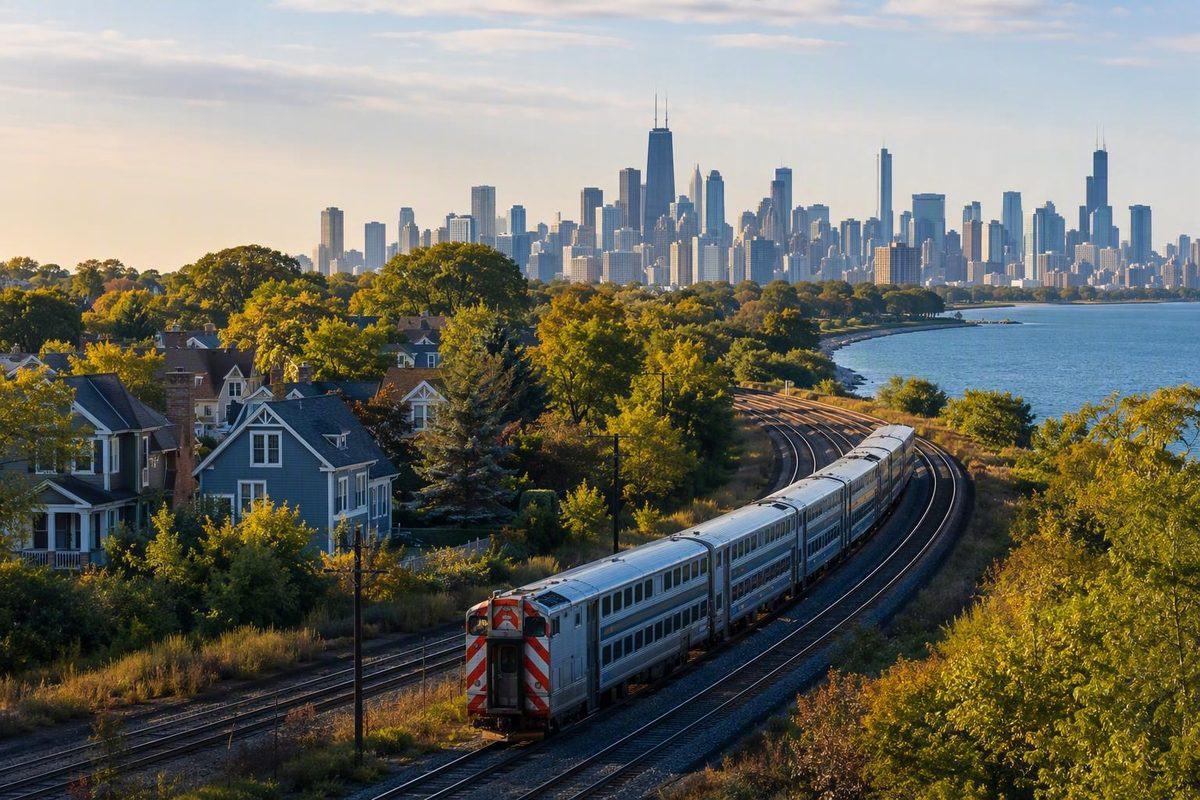
“Chicago suburbs” sounds precise, but the phrase can describe several different geographies. Depending on the speaker, it may mean a municipality immediately outside Chicago, a farther-out Illinois community linked to the city, or part of a broader Chicagoland region extending into Indiana and Wisconsin.
That ambiguity matters. A visitor seeking a car-free day trip needs a different shortlist from a household comparing school assignments, property taxes, housing costs, and weekday commutes. A commercial “best suburbs” ranking cannot answer all those questions equally well.
The practical approach is to define the region for your purpose, use directional groupings only as a browsing tool, and compare communities by actual routes, station access, destinations, and address-level costs. This guide offers a representative overview rather than an official or exhaustive list of every Chicago suburb.
What Counts as a Chicago Suburb?
The directories, rankings, and editorial guides reviewed here do not use one consistent geographic definition. Each source answers a different question:
- A crowdsourced category identifies places its editors classify as Chicago suburbs.
- A rankings publisher defines a Chicago-area pool for comparison.
- A brokerage lists communities covered by its local pages or property searches.
- A relocation company selects places it considers relevant to prospective customers.
- A travel writer chooses destinations suitable for a particular type of outing.
These are useful perspectives, but none independently establishes a universal metropolitan boundary or an official list of suburbs.
The first distinction is straightforward: Similar density, architecture, or transit access does not erase that distinction.
“Chicagoland” may be used more broadly. For example, the Simple English Wikipedia category for Chicago suburbs reports 211 entries and includes places in Illinois, Indiana, and Wisconsin. That shows how broad colloquial usage can be; the category page itself does not state an inclusion criterion.
Counts differ sharply among other publishers. Niche’s 2026 Chicago-area ranking contains 406 results. Dream Town’s commercial suburban directory links to 53 communities, while Chicago’s Property Shop provides searches for 24 communities. These figures reflect different ranking pools, editorial decisions, and commercial coverage—not a disagreement that can be solved by choosing one “correct” total.
It helps to distinguish four possible meanings:
- Municipal meaning: incorporated communities outside Chicago.
- Close-in suburban meaning: municipalities immediately outside or near the city.
- Commuter-region meaning: places connected to Chicago through employment or travel patterns.
- Broad Chicagoland meaning: a looser regional identity that may cross state lines.
A community can plausibly fit one meaning but not another. Rail access alone does not make a place a suburb, and inclusion in a brokerage directory does not establish membership in a formal statistical region.
This guide therefore uses a representative, Illinois-centered framework, with Indiana and Wisconsin discussed separately as part of broader regional usage. It does not endorse any exact suburb count as definitive.
A Practical Map of the Suburban Landscape
Terms such as “North Shore,” “near west,” and “southwest suburbs” may overlap or vary by speaker.
The following table is deliberately non-exhaustive. It organizes communities found in the reviewed directories and category pages without implying that every place in a row shares the same transit, housing, or physical characteristics.
| Practical area | Representative communities |
|---|---|
| North and North Shore | Evanston, Wilmette, Glenview, Northbrook, Highland Park, Winnetka |
| Northwest | Arlington Heights, Buffalo Grove, Schaumburg, Barrington |
| West and near west | Oak Park, Riverside, Elmhurst, La Grange, Western Springs, Hinsdale, Clarendon Hills, Naperville, Geneva |
| Southwest and south | Downers Grove, Tinley Park, Joliet, Blue Island |
| Broader Indiana region | Hammond, Munster, East Chicago, Portage |
| Broader Wisconsin region | Kenosha, Lake Geneva |
North and North Shore
Evanston, Wilmette, Glenview, Northbrook, Highland Park, and Winnetka provide useful northern reference points. “North Shore” is itself a flexible regional label, so it should not replace checking a map or researching a specific address.
These communities should not be treated as interchangeable merely because they appear in the same directional group. For a visit or move, compare the exact station, destination, home address, and route rather than relying on the regional label.
Northwest
Arlington Heights, Buffalo Grove, Schaumburg, and Barrington are common reference points northwest of Chicago. The label does not imply that they share a train line, commute pattern, or level of station access.
This distinction matters especially when evaluating car-free living. Rail or bus service somewhere within a municipality does not mean every home, workplace, or attraction is convenient to that service.
West and near west
Oak Park, Riverside, Elmhurst, La Grange, Western Springs, Hinsdale, Clarendon Hills, Naperville, and Geneva illustrate how broad the western grouping can become.
“Near west” and “west” are useful shorthand, but they conceal large practical differences. A route from Oak Park to a Chicago destination is not equivalent to one from Naperville or Geneva. Compare the complete journey rather than the compass direction.
Southwest and south
Downers Grove, Tinley Park, Joliet, and Blue Island illustrate the range of communities that may be grouped south or southwest of Chicago. They should not be treated as one visitor corridor, housing market, or commute zone.
Classifications can also be debatable at the margins. That uncertainty does not prevent comparison; it shows why the labels should remain flexible.
Indiana and Wisconsin in broader usage
Some broad uses of Chicagoland include communities beyond Illinois. The crowdsourced category cited above includes Hammond, Munster, East Chicago, and Portage in Indiana, as well as Kenosha and Lake Geneva in Wisconsin.
Include these places only when that wider frame serves the question. Someone examining a cross-state regional economy may need them. A household limiting its search to Illinois school and tax systems may not. A traveler seeking a straightforward Metra outing may also need a different shortlist.
Directional groupings help readers browse. They do not determine whether every named place belongs within a formal metropolitan definition.
Start With Your Purpose, Not a Universal Ranking
Before comparing suburbs, identify which question you are asking:
- Where might I live?
- Which suburb should I visit?
- Which place works as a rail-connected base or commute?
These questions overlap, but they are not interchangeable. A historic district can make a pleasant afternoon without making an entire municipality practical for car-free daily life. A community with housing options may offer little for a short visit. A direct train can simplify one part of a commute while leaving a difficult trip between the station and home.
If you are considering a move
Build a shortlist around the constraints that shape everyday life:
- Workplace or other regular destination
- Acceptable peak, off-peak, evening, and weekend travel patterns
- Purchase or rental budget
- Property taxes, insurance, transportation, and other recurring costs
- Required amount and type of space
- Exact school assignment, if relevant
- Walking, cycling, driving, or bus distance to a useful station
- Grocery stores, healthcare, parks, and other routine amenities
- Desired density, downtown activity, nightlife, or quiet
- Parking needs and household car requirements
Do not substitute a municipality’s reputation for address-level research. A suburb-wide commute estimate may be irrelevant to a home several miles from the station.
Terms such as “safe,” “affordable,” “walkable,” and “family-friendly” require defined benchmarks and current, comparable evidence. Conditions can also differ within the same municipality. Decide what each term means for your household before using it as a filter.
Attractions are similarly limited as relocation evidence. A riverwalk, museum, theater, or historic district may add recreational value, but it does not demonstrate affordability, school quality, safety, or the convenience of routine errands.
If you are planning a day trip
Start with the rail route and work outward:
- Which downtown terminal or station does the service use?
- How frequent is service in both directions?
- How far is the first destination from the arrival station?
- Are two or three worthwhile stops clustered together?
- Is the route suitable and accessible for everyone in the group?
- What is the final practical return train?
- Will attractions be open when you arrive?
- Are reservations required?
A suburb is not automatically a good car-free outing because a train stops there. The station may be far from the destination, crossings may be inconvenient, or return service may be sparse when you need it.
If you are choosing a commute or rail-connected base
Specify both ends of the journey. “Downtown Chicago” could mean a particular rail terminal, an office elsewhere in the Loop, a medical campus, or another destination requiring a transfer.
The useful measure is door to door:
- Reach the origin station.
- Allow for waiting time.
- Ride the train or bus.
- Transfer if necessary.
- Complete the final walk or connection.
The recurring trade-off is not simply “near is expensive, far is cheap.” A more careful framework is:
- Closer-in places may provide shorter journeys, additional urban-transit options, or more amenities near certain stations.
- Farther-out places may offer different housing types or more space.
- Neither pattern guarantees lower total costs, a preferred school assignment, or a better quality of life.
Published rankings can generate ideas, but their conclusions depend on the eligible places and methodology. Niche says its ranking considers crime, public schools, cost of living, jobs, and amenities and draws on several public datasets. The evidence reviewed here does not reproduce its complete calculations, so the resulting order should be treated as Niche’s ranking rather than a universal answer.
Before choosing a home, verify the school boundary for the exact address, recent closed-sale or rental information, parcel-level property taxes, station access, and real schedules for the days and hours you expect to travel.
Getting Between Downtown Chicago and the Suburbs
The basic roles of the region’s principal transit systems are:
- Metra connects downtown Chicago with many outlying suburbs.
- CTA primarily serves Chicago but also reaches selected close-in suburbs.
- Pace provides regional bus service and may be useful for first- and last-mile connections.
Choose Chicago’s tourism guide describes Metra as operating 11 routes across more than 200 stations and offering one-way tickets, day passes, and monthly passes. Because routes, schedules, fares, and ticket products can change, verify current details with the transit operator before traveling. (Choose Chicago)
Examples reported by the reviewed travel sources include:
| Suburb | Reported rail service |
|---|---|
| Evanston | Metra Union Pacific North; CTA Purple Line |
| Wilmette | Metra Union Pacific North; CTA access at Linden |
| Oak Park | Metra Union Pacific West; CTA Green Line |
| Naperville | Metra BNSF |
| Geneva | Metra Union Pacific West |
The service examples above are reported in Jen Ottolino’s 2026 suburban travel itinerary; they should be checked against current operator information before departure. (Islands)
Evanston and Oak Park are notable within this shortlist because the travel sources identify both CTA and Metra options. That does not make the services interchangeable. Select the system that fits the specific origin and destination.
For itineraries involving several systems, the RTA’s regional transit guide directs travelers to its Trip Planner for personalized directions and describes a Regional Day Pass for unlimited same-day travel on CTA, Metra, and Pace. Check current pricing, eligibility, purchase instructions, and terms before depending on the pass.
Treat all quoted travel times as estimates rather than promises. Results depend on:
- Origin station
- Downtown terminal
- Express or local service
- Weekday, weekend, or holiday schedules
- Time of day
- Transfers
- Construction and service disruptions
- The walking, bus, driving, or parking segment at either end
Before leaving, confirm the outbound service and the final return that you would actually be willing to take—not merely the last scheduled train. Also check fares, station accessibility, elevator or platform constraints, construction notices, and attraction hours.
Five Rail-Friendly Suburbs for a Day Trip
Travel writer Jen Ottolino recommends Evanston, Wilmette, Oak Park, Naperville, and Geneva as transit-accessible suburban visits. This is one writer’s selection, not an objective top-five ranking.
| Suburb | Reported rail service | Principal draw | Travel writer’s approximate walk | Planning caveat |
|---|---|---|---|---|
| Evanston | Metra Union Pacific North; CTA Purple Line | Northwestern University and lakefront surroundings | About 10 minutes from Davis station to campus | Metra and CTA use different service patterns |
| Wilmette | Metra Union Pacific North; CTA access at Linden | Baháʼí House of Worship near Lake Michigan | About 25 minutes from Northwestern’s campus to the temple, then about 20 minutes to Linden | Combining it with Evanston creates a longer walking day |
| Oak Park | Metra Union Pacific West; CTA Green Line | Frank Lloyd Wright Home and Studio and nearby Wright-designed houses | No consistent estimate provided | Select a station and architecture route in advance |
| Naperville | Metra BNSF | Downtown and Riverwalk | About 30 minutes from the station to the Riverwalk | The writer also estimates roughly an hour on the train |
| Geneva | Metra Union Pacific West | History museum and Fox River recreation | No estimate provided | Outdoor activities require separate weather and operating checks |
These services, attractions, and approximate walking times are attributed to the five-suburb travel itinerary. Walking and journey times may vary with schedules, pace, route, station exit, construction, and mobility.
Evanston
The travel article identifies two rail choices for Evanston: Metra’s Union Pacific North line and CTA’s Purple Line. Northwestern University provides a clear visitor anchor, and the writer estimates a walk of roughly 10 minutes from Davis station to campus.
A manageable itinerary could combine part of the campus, nearby lakefront space, and downtown Evanston. Choose a turnaround point in advance, because the campus and shoreline cover more ground than a single destination pin suggests.
Wilmette
Wilmette’s central visitor destination in this itinerary is the Baháʼí House of Worship near Lake Michigan. The writer proposes pairing it with Evanston and estimates approximately 25 minutes on foot from Northwestern’s campus to the temple, followed by about 20 minutes from the temple to Linden station.
That creates a logical one-direction route: Evanston, campus, lakefront area, temple, Linden, and return. It may still involve more walking than some travelers want. Check the route, weather, accessibility, visitor hours, and current service before committing to the pairing.
Oak Park
Oak Park provides a clear architecture theme through the Frank Lloyd Wright Home and Studio and multiple Wright-designed houses. The travel article reports Union Pacific West Metra and CTA Green Line access.
Rather than trying to visit every marked building, choose the Home and Studio, a limited neighborhood circuit, and perhaps one meal or coffee stop. Then identify the most convenient return station. This leaves more time for the architecture and less for navigating between scattered pins.
Naperville
The itinerary identifies BNSF service, downtown Naperville, and the Riverwalk. It estimates approximately one hour on the train and a further 30-minute walk from the station to the Riverwalk.
That walk does not rule out a car-free visit, but it changes the day’s scale. Allow enough time and energy for the return to the station, or investigate a current local connection. A compact outing should remain focused on downtown and the Riverwalk rather than adding destinations that require separate cross-town travel.
Geneva
The writer identifies Geneva as a Union Pacific West destination and names the Geneva History Museum, Fox River Bike Trail, and Fabulous Fox Water Trail as possible visitor anchors.
Treat the trail and water references as ideas rather than assurances that access, equipment, or conditions will suit a particular date. Check seasonal operations, weather, trail conditions, and rental requirements. A simpler outing can focus on the historic center, museum, and river area.
Across all five destinations, use a route-first approach: choose one station-area sequence, decide where it ends, and select a return in advance. This adapts Chicago Know’s route-first Chicago itinerary example to suburban day trips without assuming that every municipality is uniformly walkable.
Frequently Mentioned Suburbs and Their Distinctive Fit
Repeated appearance in rankings, relocation pages, travel stories, and real-estate directories shows that a suburb is prominent in the available coverage. It does not prove that it is better than less frequently mentioned alternatives.
Evanston: lakefront, university, and two reported rail options
Evanston is a candidate for visitors and prospective residents interested in a city-adjacent municipality, Northwestern University, lakefront surroundings, and both CTA and Metra service as reported by the travel and relocation sources.
For a visit, campus, downtown, and part of the lakefront can form one itinerary. For a move, those attractions are not enough: compare the exact address with the nearest useful station, school assignment, housing costs, daily services, and the Chicago destination you need to reach.
Oak Park: close-in and architecture-oriented
Oak Park’s Frank Lloyd Wright connections give visitors an obvious itinerary theme. The reviewed sources report CTA Green Line and Union Pacific West Metra access.
For residential research, municipal-level transit availability does not establish convenience for every address. Measure the walk to the relevant station and test the entire trip during the hours you expect to travel.
Naperville: a large suburban center
The reviewed sources identify Naperville’s BNSF service, downtown, Riverwalk, Centennial Beach, and DuPage Children’s Museum. Those attractions can help a visitor organize a day, but they do not establish residential suitability.
Prospective residents still need to compare neighborhoods, school boundaries, road access, housing expenses, and distance to the station. The presence of a downtown does not mean every Naperville address is within a practical walk of it.
Glenview: Metra access and several named attractions
Extra Space Storage’s relocation guide reports that Glenview has a Metra station and highlights The Grove, Historic Wagner Farm, Kohl Children’s Museum, and Oil Lamp Theater. These are examples of local attractions, not evidence about school quality, affordability, safety, or car dependence. (Extra Space Storage)
For a move, determine which station is practical, which school district serves the address, and how many routine trips would require driving.
Buffalo Grove: quieter positioning with a different reported rail pattern
Commercial relocation guides frame Buffalo Grove as a quieter, family-oriented option. Ace Relocation reports highway access and service on Metra’s North Central Service. Because that information comes from a relocation company and schedules can change, confirm current service and station usefulness before relying on it. (Ace Relocation)
“Quiet” and “family-oriented” are subjective descriptions, not standardized comparisons. Evaluate Buffalo Grove at the address and route level rather than assuming it functions like Evanston or Oak Park.
Clarendon Hills: highly ranked, but not universally “best”
Clarendon Hills appears first in the visible portion of Niche’s 2026 Chicago-area ranking. Ace Relocation also associates it with the BNSF corridor.
Those mentions make Clarendon Hills a possible research candidate if its location and route fit your needs. They do not prove that it is objectively the best suburb. The full calculations behind the ranking are not reproduced in the evidence reviewed here, and different priorities can produce a different shortlist.
Alternatives worth researching
A responsible shortlist should extend beyond the communities mentioned most often:
- Elmhurst: a possible western-suburban candidate for further station-area research.
- Downers Grove: another community to compare with Naperville and smaller western suburbs.
- Skokie: a close-in northern alternative that appears in commercial directories and personal recommendations.
- Geneva: a rail-served visitor option in the travel writer’s shortlist.
- Wilmette: a northern alternative with reported rail access and the Baháʼí House of Worship.
The available evidence is not standardized enough to support a credible head-to-head residential ranking of these places. Use the names to widen the field, then compare current information under consistent definitions.
How to Read Rankings, Housing Numbers, and Commute Claims
Published comparisons become more useful when you ask four questions:
- What exactly is being measured?
- Which places were eligible?
- How were the results calculated?
- Is the publisher selling a related product or service?
A “best” list is conditional on those choices. A relocation company, a storage company’s city guide, a rankings platform, and a travel writer can produce different lists without any one of them settling the question.
Read only as much into a ranking as it supports
The Niche excerpt reviewed for this guide shows the first 10 of 406 results. Clarendon Hills is first and Naperville second, followed by Riverside, Buffalo Grove, Kildeer, Lincolnshire, Western Springs, Long Grove, La Grange, and Hinsdale. Every entry in that visible top 10 has an A+ overall grade and an A+ public-schools grade. (Niche)
That describes the displayed ranking; it does not independently prove that every listed community has superior schools or quality of life. Niche says it considers crime, schools, living costs, jobs, and amenities and uses several public datasets, but the excerpt does not reproduce the full calculations.
Resident reviews require additional caution. Visible review counts vary substantially, so the ratings do not represent equal volumes of feedback. Reviews may reveal what individual residents value, but they are not independently verified evidence about safety, school performance, affordability, or municipality-wide conditions.
Separate asking prices from sale prices
Chicago’s Property Shop reported 309 newly listed suburban properties, four average days on market, an average asking price of $302.97 per square foot, and a median list price of $549,000 for the seven days ending August 21, 2026. These are dated active-listing measures, not completed sales, appraised values, or a durable affordability benchmark. (Chicago’s Property Shop)
The same page’s results section showed 314 properties without clearly explaining how that total differed from the 309 newly listed properties. That discrepancy is another reason not to treat either number as a definitive market total.
Even an internally consistent regional listing summary would combine multiple communities and property types. It cannot show what a particular house, condo, or rental should cost, or the total monthly cost after taxes, insurance, assessments, maintenance, parking, and transportation.
Treat relocation statistics as publisher-reported until verified
Extra Space Storage publishes home-price, rent, unemployment, and relative-safety figures for Buffalo Grove, Evanston, Glenview, Naperville, and Oak Park. The material reviewed here does not clearly identify consistent dates, methods, or geographic definitions for those figures.
Do not use those numbers to declare one suburb safer or more affordable than another. Before making a consequential comparison, replace promotional summaries with current, documented figures measured over the same period and under the same definitions.
Commute claims need endpoints and schedules
“Twenty minutes to Chicago” is not a complete commute claim. Ask:
- From which station?
- On which train?
- Express or local?
- To which downtown terminal?
- At what time and on what day?
- How long does it take to reach the origin station?
- How long is the final walk or transfer?
- Is the return schedule equally practical?
A quoted train time can provide an initial orientation, but it should never be treated as a door-to-door guarantee.
A verification checklist for a move
For each finalist, document:
- Recent closed-sale prices by property type and small geographic area
- Current rents and lease terms
- Property-tax history for the actual parcel
- Homeowners or renters insurance estimates
- HOA or condo assessments, where applicable
- Expected transportation and parking costs
- Recent standardized crime data with clear definitions
- Exact elementary, middle, and high school assignments
- Possible enrollment or boundary changes
- Peak, evening, and weekend transit schedules
- Station and vehicle accessibility
- Walking, cycling, driving, or bus time from the address to the station
- Grocery, healthcare, childcare, and other routine trips
- Flood, maintenance, and other property-specific due diligence where appropriate
Attach a date and source to every changeable figure. If you cannot determine when a price, fare, schedule, review, or safety measure was produced, do not treat it as current.
A verification checklist for a visit
Before a suburban day trip, confirm:
- The correct downtown departure point
- Outbound and return schedules
- Fare and ticket rules
- Planned station exits
- Accessibility requirements
- Construction or service alerts
- Attraction hours and reservation policies
- Total walking distance, not merely the first station walk
- Weather exposure and backup options
- A predetermined point at which to turn back
Frequently Asked Questions
How many Chicago suburbs are there?
There is no single definitive number. Different publishers use different boundaries and coverage rules. The crowdsourced Wikipedia category reports 211 entries, Niche ranks 406 Chicago-area suburbs, Dream Town links to 53 communities, and Chicago’s Property Shop offers searches for 24.
Those totals describe a category, ranking pool, directory, or commercial market. They do not establish an official suburb count.
Are any Chicago suburbs in Indiana or Wisconsin?
Under broad colloquial uses of Chicagoland, yes. The cited crowdsourced category includes Hammond, Munster, East Chicago, and Portage in Indiana, as well as Kenosha and Lake Geneva in Wisconsin.
Whether those communities belong in your search depends on the purpose. If you need an Illinois-specific school, tax, transit, or housing comparison, keep them separate. If you are studying a broader regional economy or travel area, cross-state communities may be relevant.
Which Chicago suburbs can you reach by CTA as well as Metra?
The travel sources identify Evanston and Oak Park as clear examples in this guide. Evanston is reported as having CTA Purple Line and Metra Union Pacific North service, while Oak Park is reported as having CTA Green Line and Metra Union Pacific West service.
The same travel itinerary reports Metra Union Pacific North service in Wilmette and CTA access at Linden. In every case, verify the exact stations and current schedules because CTA and Metra may serve different parts of a municipality and arrive at different downtown locations.
Which suburbs make practical car-free day trips from downtown Chicago?
Evanston, Wilmette, Oak Park, Naperville, and Geneva form one travel writer’s recommended set. Evanston offers an itinerary around Northwestern and the lakefront; Wilmette around the Baháʼí House of Worship; Oak Park around Frank Lloyd Wright architecture; Naperville around downtown and the Riverwalk; and Geneva around its historic center and Fox River activities.
Practicality depends on the date, schedule, walking distance, mobility needs, weather, and attraction hours. The writer’s Naperville itinerary, for example, estimates roughly an hour on the train and a 30-minute walk from the station to the Riverwalk.
What should I verify before choosing a Chicago suburb to live in?
Verify the exact school assignment, recent closed-sale or rental data, parcel-level property taxes, insurance, assessments, standardized crime data, and total transportation costs. Test the actual route from a prospective address to work during relevant weekday, evening, and weekend periods.
Also visit at different hours, walk the station route, and check routine needs such as groceries, healthcare, parks, childcare, and parking. Use rankings and relocation guides to generate possibilities, not to make the final decision.
The final choice is a two-step process. First, define what “Chicago suburbs” means for your purpose: close-in Illinois municipalities, a wider commuter region, or a broad Chicagoland area that may cross state lines. Second, shortlist communities by route and priority rather than by a universal ranking.
For a visit, choose a rail-served suburb with a compact station-area plan and confirm the return before leaving. For a move, use broad guides only to narrow the field, then verify address-level school assignments, current housing and tax costs, standardized safety data, and actual peak and weekend transit before committing.