
16 min read ·
When Sudden Braking Crosses the Line Into Dangerous Driving
State law and circumstances control. A sudden stop alone does not establish retaliatory intent, and a rear impact is not automatic proof of sole liability.
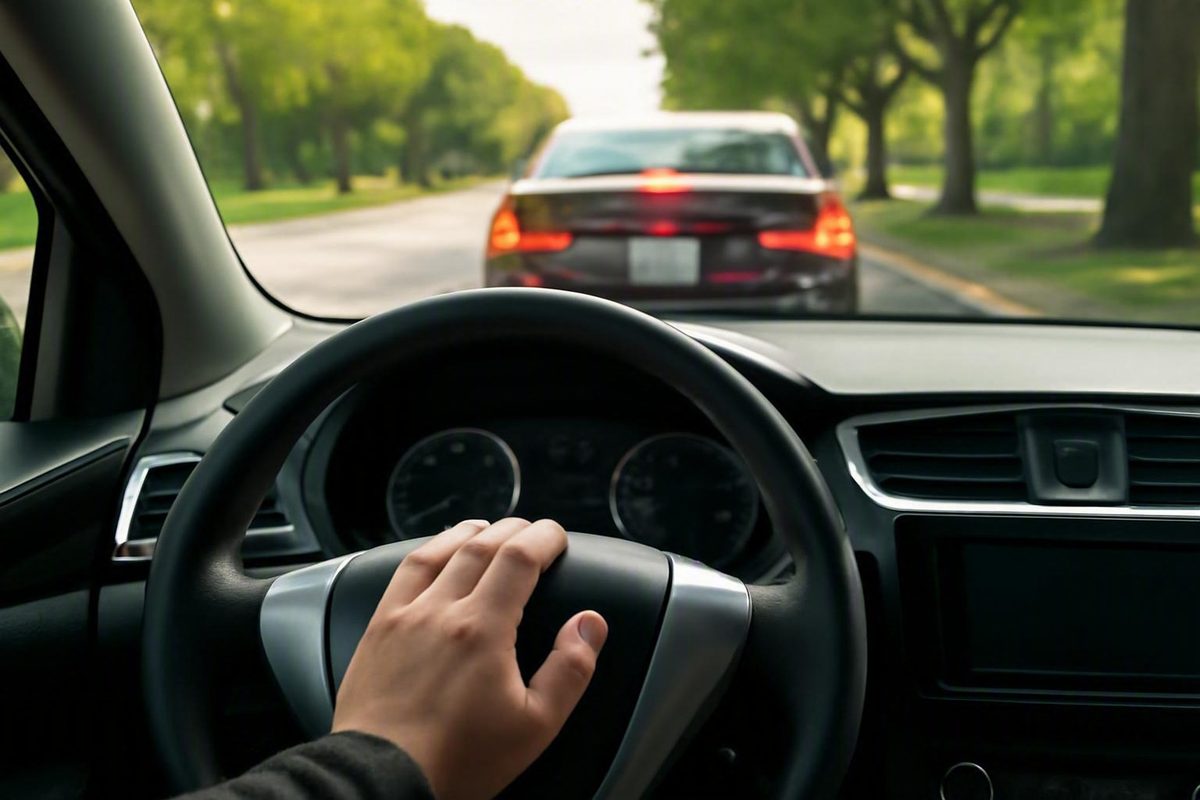
The short answer: intentional brake checking may be illegal
Deliberate, unjustified, and dangerous brake checking may be illegal, but the United States has no single nationwide brake-checking rule. State law and the circumstances control. Authorities may evaluate the maneuver under broader laws governing reckless, aggressive, careless, or otherwise unsafe driving rather than an offense specifically called “brake checking.” The legal treatment varies by state and by the conduct involved.
Several states reviewed for this guide do not use the phrase “brake checking” in the relevant laws identified by the available sources. The practical question is not simply whether a statute contains those two words. It is whether the driver’s proven actions satisfy the elements of an applicable traffic or criminal offense.
Five questions usually shape that analysis:
- Intent: Did the driver brake to punish, frighten, intimidate, or provoke someone?
- Necessity: Was there a legitimate traffic, mechanical, or safety reason to slow down?
- Danger: What risk did the maneuver create given the speed, traffic, road, visibility, and weather conditions?
- Result: Did it cause a collision, swerving, injury, property damage, or another dangerous reaction?
- Evidence: What objective information supports or contradicts the allegation?
State law controls, and statutes and court interpretations can change. Anyone evaluating a real incident should check current official statutes, relevant decisions, and state-specific guidance rather than treating a nationwide summary as a definitive legal answer.
It is also important to separate four questions that may arise from the same event:
- Traffic enforcement: Whether an officer issues a citation.
- Criminal prosecution: Whether the evidence supports an offense under the applicable state law.
- Civil fault: Whether one or more drivers may be legally responsible for a collision and resulting losses.
- Insurance coverage: How the relevant policy language, evidence, and state insurance law affect coverage.
These processes can reach different outcomes.
Research limitation: The state examples below are based primarily on law-firm educational articles and one news report, not a comprehensive review of official codes and appellate decisions. They should be treated as starting points for further research, not as legal advice or verified statements of current law in every circumstance.
What counts as brake checking—and what does not
Brake checking is best defined narrowly: deliberately applying the brakes to startle, punish, intimidate, provoke, or force a following driver to react. It is often connected with tailgating or road rage, but an abrupt reduction in speed is not automatically a brake check.
Intent is the central distinction. A driver who brakes hard because a child enters the road has not done the same thing as someone who moves in front of another vehicle and immediately brakes on a clear road after an angry exchange. The vehicles may slow in a similar way, but the reasons for doing so are fundamentally different.
Legitimate reasons for sudden braking can include:
- Traffic stopping unexpectedly
- A pedestrian or cyclist entering the vehicle’s path
- An animal in the roadway
- Debris, a pothole, or another obstruction
- A collision or disabled vehicle ahead
- Ice, standing water, poor visibility, or another weather-related hazard
- A mechanical problem or genuine emergency
A sudden stop alone does not establish malicious or retaliatory intent. The surrounding sequence matters:
| Scenario | Possible characterization | Central question |
|---|---|---|
| A driver brakes hard to avoid a pedestrian | Justified emergency braking | Was the braking reasonably connected to a genuine hazard? |
| Traffic compresses and the lead vehicle slows quickly | Ordinary traffic response | What were the vehicles, signals, and conditions ahead doing? |
| A distracted driver notices slowing traffic late and brakes abruptly | Potentially careless, but not necessarily retaliatory | Did inattention, rather than an intent to target another driver, cause the maneuver? |
| A driver gestures angrily, moves directly in front of another car, and repeatedly brakes on a clear road | Possible retaliatory brake checking | Does the complete sequence support an inference of intimidation or punishment? |
Investigators, insurers, and courts may examine what was in front of the lead vehicle, whether surrounding traffic was slowing, the timing of a lane change, earlier gestures or lane conflicts, repeated brake applications, following distance, visibility, and road conditions.
A recording that appears to show a clear road may be helpful, but it may not capture everything the driver could see.
Intent does not necessarily have to be established through an admission. It may sometimes be inferred from conduct and circumstances, such as cutting into another vehicle’s lane immediately before braking, repeating the maneuver, or braking after a hostile exchange. But an inference is not the same as conclusive proof, and stronger allegations call for stronger objective evidence.
Which laws can apply when no statute says “brake checking”
There is no universal brake-checking offense that applies identically throughout the country. The sounder approach is to identify what the driver allegedly did and determine whether that conduct meets the language and elements of a particular law.
Reckless driving is one possible framework. The reviewed materials for Texas, Illinois, California, Virginia, and South Carolina discuss standards involving willful or wanton disregard for safety or similar dangerous conduct. A deliberate maneuver intended to create a near-collision might fall within such a standard, but only when the jurisdiction’s actual elements are satisfied. Necessary emergency braking does not become reckless merely because it was abrupt.
Aggressive driving may place greater emphasis on conduct directed at another person. The Georgia language quoted in a local news report covers operating a vehicle with intent to annoy, harass, molest, intimidate, injure, or obstruct another person. The same report distinguishes that concept from Georgia’s reckless-driving language addressing disregard for the safety of people or property. Those provisions may be relevant to intentional braking, but the facts must still satisfy the applicable offense.
Stopping and signaling rules may also enter the analysis. An Illinois secondary source identifies 625 ILCS 5/11-804 as addressing an appropriate signal before stopping or suddenly reducing speed when there is an opportunity to signal a vehicle immediately behind. It separately identifies 625 ILCS 5/11-503 as the state’s reckless-driving provision. Application of either provision depends on the statutory wording and the circumstances.
Aggressive careless driving may require a pattern rather than one isolated action. A Florida law-firm article says the state’s aggressive-careless-driving provision involves multiple dangerous acts during one episode, such as abrupt braking combined with unsafe lane changes, speeding, weaving, or following too closely. The same source identifies reckless driving as another possible framework but notes that Florida does not expressly name brake checking in the cited statutes.
Depending on the jurisdiction and facts, other rules involving unsafe lane changes, traffic obstruction, improper stopping, or following too closely might also be considered. More serious allegations would require additional facts and proof of separate legal elements.
Merely applying a label such as “reckless” or “aggressive” does not establish an offense. The evidence must be connected to the law’s actual requirements. That is why both of these categorical statements are unreliable:
- “Every intentional brake tap is reckless driving.”
- “Brake checking is legal whenever the statute does not use that phrase.”
The correct question is whether the conduct that can be proved violates the current law where the event occurred.
How selected states approach brake checking
These examples illustrate possible differences among states. They are not a complete or authoritative 50-state survey.
Important: The descriptions below come largely from personal-injury law-firm articles. Check current official statutes and relevant case law before relying on any state-specific statement in a real traffic, criminal, insurance, or civil dispute.
Illinois: An Illinois law-firm source identifies 625 ILCS 5/11-503, concerning reckless driving, and 625 ILCS 5/11-804, concerning signaling before stopping or suddenly reducing speed, as provisions that may be relevant to intentional dangerous braking. The source also emphasizes intent, justification, following distance, and available evidence. Its discussion presents those provisions as possible legal frameworks rather than an offense titled “brake checking.”
A recording of the full sequence is more informative than an isolated view of brake lights.
Texas: The reviewed Texas material says state law does not specifically name brake checking. It describes deliberate, dangerous braking as conduct that may instead be examined under the state’s reckless-driving standard or other traffic provisions. The source quotes the reckless-driving standard as operating with willful or wanton disregard for the safety of people or property. That does not mean every abrupt stop satisfies the standard; the reason for braking, risk created, and evidence remain critical.
Georgia: The reviewed Georgia report describes aggressive driving as requiring specified intent directed at another person, while reckless driving focuses on disregard for safety. A targeted road-rage maneuver could raise one or both questions, but the legal label depends on what can be proved.
Florida: The reviewed Florida source points to reckless driving and aggressive careless driving rather than a statute specifically titled “brake checking.” It describes aggressive careless driving as involving multiple dangerous actions during one episode. A single unexplained stop and a sequence involving weaving, tailgating, and retaliatory braking may therefore present different legal questions.
California: A California law-firm article identifies Vehicle Code §23103, concerning willful or wanton disregard for safety, and §22109, concerning stopping or suddenly decreasing speed without an appropriate signal when another vehicle may be affected. It also describes California as using pure comparative fault, under which civil responsibility may be allocated between drivers. Whether either traffic provision applies depends on the evidence and the circumstances of the speed reduction.
Maryland: A Maryland law-firm source describes the state as following contributory-negligence principles, under which an injured person’s own legally relevant negligence may have severe consequences for recovery. The source discusses tailgating and intentional braking as conduct that may affect a collision claim. The exact rule, defenses, and exceptions require current Maryland-specific research.
Virginia: A Virginia law-firm article likewise describes Virginia as a contributory-negligence jurisdiction. It identifies state provisions addressing reckless driving, aggressive driving, and following too closely, while emphasizing that tailgating does not justify retaliatory braking. The source also cautions that liability depends on evidence of both intentional braking and the following driver’s conduct.
These examples intentionally omit exact fines, jail terms, license points, filing deadlines, offense classifications, and enhancements. Such details may change, may depend on the harm caused or a driver’s history, and have not been independently verified here through current primary authority.
Who is at fault in a brake-checking collision?
The following driver is not always solely responsible for a rear-end collision. The lead driver is also not automatically liable whenever the rear driver claims to have been brake checked.
Following drivers ordinarily need enough room and attention to respond when traffic slows or stops. A rear driver’s tailgating, excessive speed, distraction, or failure to maintain control may therefore support an allocation of fault. At the same time, evidence that the lead driver deliberately created an unnecessary emergency can complicate the usual analysis of a rear impact.
Consider a two-driver example:
- Driver A becomes angry, moves directly in front of Driver B, and brakes hard although the lane ahead appears unobstructed.
- Driver B is following too closely and looking away when Driver A brakes.
- Driver B strikes Driver A from behind.
Driver A’s deliberate maneuver may have created the immediate danger. Driver B’s following distance and inattention may have reduced the chance of avoiding it. Both sets of conduct can matter, although their legal effect depends on the state’s negligence rules and the evidence. No responsible percentage can be assigned from a short hypothetical.
Civil negligence systems are often described in three broad categories:
- Pure comparative fault: Responsibility may be divided, and a claimant’s recovery may be reduced according to that person’s assigned share. The reviewed California source describes that state as using this approach. California’s treatment illustrates why a rear impact need not produce an all-or-nothing allocation.
- Modified comparative fault: Responsibility may also be divided, but recovery can be barred at a state-defined level of fault. A reviewed Texas source describes a modified comparative system, although the exact rule should be verified against current authority for any real claim. The source also recognizes that a lead driver’s intentional braking and a rear driver’s following distance may both matter.
- Contributory negligence: A claimant’s own legally sufficient negligence may have much harsher consequences. The reviewed Virginia source describes such a system while noting that the analysis remains fact-specific.
These labels are only practical summaries. States may differ in thresholds, burdens, presumptions, defenses, exceptions, and the claims to which a rule applies.
Brake checking can also cause a driver to swerve, leave the road, or become involved in a multi-vehicle event without first striking the braking vehicle. The possibility of such a no-contact sequence is recognized in the reviewed material. Whether another driver is legally responsible cannot be answered nationally; identification, causation, necessity, foreseeability, and the conduct of all involved drivers would need to be examined under the applicable law.
Finally, police enforcement and civil fault are separate.
How intent and fault can be proved
A rear impact establishes where the vehicles collided, but it does not by itself establish why the lead vehicle slowed. Proof of intentional brake checking usually comes from the sequence before the collision rather than the impact alone.
Potential evidence includes:
- Original front-, rear-, or cabin-facing dashcam footage
- Traffic-camera or surveillance recordings
- Independent eyewitness accounts and contact information
- Police reports and officer observations
- Photographs of the vehicles’ final positions and the wider scene
- Images of damage, debris, tire marks, controls, and sight obstructions
- Electronic vehicle information, when available and lawfully obtained
- Accident-reconstruction analysis
- Relevant statements or admissions by either driver
Useful video may show whether the road ahead appeared open, whether surrounding traffic was slowing, whether the lead vehicle changed lanes immediately before braking, and whether the maneuver happened repeatedly. It may also capture an earlier lane conflict, hostile gestures, the vehicles’ relative positions, or the reactions of nearby drivers. Video, eyewitness accounts, police documentation, damage patterns, and admissions are among the forms of evidence identified in an Arizona law-firm overview.
Video has limits. A short clip beginning immediately before impact may omit the earlier conduct that explains what happened.
Physical evidence may help reconstruct vehicle movement, impact location, and whether an account fits the scene. Damage patterns or tire marks may provide context, but they do not necessarily reveal why someone braked. Such evidence is generally more informative when considered with video, witness accounts, road conditions, and the complete traffic sequence.
Do not rely solely on a clipped or compressed social-media upload. Keep the original photographs and recordings, and identify potential witnesses or nearby cameras promptly without assuming that any recording exists or will remain available.
What to do if someone is tailgating or brake checking you
The immediate goal is to end the interaction safely—not to punish the other driver, prove a point, or obtain a perfect view of the license plate.
Drive predictably and avoid unnecessary speed changes or abrupt lane movements. When possible, create more room ahead of your own vehicle so you can respond gradually if traffic slows. Do not accelerate simply to get away from a tailgater if doing so would increase the danger.
When conditions permit:
- Change lanes safely and allow the aggressive vehicle to pass.
- Avoid competing for position or remaining beside the vehicle.
- If necessary, pull into a public place where you can stop safely.
- Avoid leaving the vehicle to confront the other driver.
- Report an immediate threat from a safe location using the procedure appropriate to the jurisdiction.
Do not chase, block, gesture at, confront, or deliberately brake in front of the other vehicle. Tailgating may itself violate applicable law, but it does not make retaliation safe or automatically lawful.
The driver should not handle a phone, type, or attempt to film while the vehicle is moving. If a passenger can safely and lawfully document the incident, the passenger may note the vehicle description, partial or complete plate, travel direction, location, and observed conduct. The driver’s attention should remain on controlling the vehicle and leaving the conflict.
If the other vehicle leaves, do not follow it solely to obtain identifying information. A partial plate, vehicle description, time, location, direction of travel, witness account, or existing camera recording may be more useful than escalating the encounter.
What to do after a suspected brake-checking crash
Begin with immediate safety. Stop in an appropriate place, check for injuries, and seek emergency assistance when needed. Do not remain in an exposed traffic lane solely to preserve the exact vehicle positions if doing so creates another immediate danger.
Report the collision when required by the applicable jurisdiction. Give law enforcement a factual account that separates observation from inference:
- What each vehicle did
- Where the vehicles were traveling
- Whether a lane change occurred
- What traffic and the road ahead appeared to be doing
- Whether braking was repeated
- Whether you observed gestures or an earlier conflict
- How you responded
- Whether witnesses or recordings exist
“The vehicle moved into my lane and braked three times while the road ahead appeared clear” is more useful than “The driver was crazy and wanted to cause a crash.” You may suspect a motive without being able to prove it from your own observations.
When it can be done safely, document:
- Final vehicle positions
- Damage to all involved vehicles
- Debris, fluid trails, and tire marks
- Lane markings and traffic controls
- Road, weather, lighting, and visibility conditions
- Construction, obstructions, or possible hazards
- Nearby homes, businesses, buses, or traffic cameras
- Witness names and contact information
Save the original dashcam file before the device records over it. Preserve relevant photographs, messages, medical records, towing documents, repair records, and communications about the collision. Keep unedited copies.
Provide prompt, factual notice to the relevant insurer. Avoid guessing about intent or accepting a final fault conclusion before the evidence has been reviewed.
An allegation of intentional conduct can raise insurance-coverage questions in some disputes, but denial is not automatic. The outcome can depend on the exact policy wording, the conduct that can be proved, and applicable state insurance law.
Check the current rules where the incident occurred.
This article provides general information, not legal advice. Consider state-specific legal guidance when a collision involves injuries, significant property damage, disputed fault, criminal allegations, or an insurance-coverage dispute.
Frequently asked questions
Is tapping the brakes to warn a tailgater illegal?
It may be, depending on the driver’s purpose, the danger created, and the applicable law. A necessary and gradual speed adjustment is different from tapping or applying the brakes to frighten a following driver or provoke a reaction.
Do not use the brakes as a punishment or communication tool. Drive predictably, increase the space ahead, change lanes when safe, and allow the other vehicle to pass. The reviewed Georgia material likewise recommends avoiding escalation and letting a tailgater pass safely. Tailgating does not by itself establish a legal justification for retaliatory braking.
Is the rear driver always at fault after a brake-checking crash?
No nationwide rule makes the rear driver solely responsible in every such collision. The following driver’s speed, attention, control, and following distance can matter, but evidence of deliberate and unnecessary braking by the lead driver may also affect the analysis.
The result depends on both drivers’ conduct, the quality of the evidence, and the state’s negligence rules. A rear impact is important evidence, not automatic proof of sole liability.
Can brake checking be illegal if no collision occurs?
Potentially. A collision may not be required if the conduct itself satisfies an applicable reckless-, aggressive-, careless-, signaling-, or unsafe-driving law. Deliberately creating a near-collision to intimidate another driver may therefore attract police attention even when the targeted vehicle avoids impact.
Whether an offense occurred still depends on the law’s elements, the risk created, and the available proof. The absence of a crash does not establish that the maneuver was lawful.
Can dashcam footage prove that someone brake checked me?
Dashcam footage can be powerful evidence, but it may not prove the allegation by itself. A useful recording may show a clear road, an immediate lane change, repeated braking, hostile gestures, surrounding traffic, and the full sequence leading to the event.
Preserve the original, unedited file. The recording should be considered alongside possible hazards outside the camera’s view, witness accounts, physical evidence, and other video. Video is evidence of what the camera captured, not necessarily everything that happened.
Can both a brake-checking driver and a tailgating driver be at fault?
Potentially, depending on the jurisdiction and evidence. One driver may create danger through intentional braking while the other contributes by following too closely, speeding, looking away, or failing to maintain control.
Comparative-fault systems may allocate responsibility between drivers. Contributory-negligence rules can produce different and potentially harsher consequences for a claimant whose own negligence contributed to the collision.
The bottom line
The answer to “is brake checking illegal?” is conditional: deliberate and dangerous brake checking may violate state law even when no statute uses that exact term. Necessary braking for traffic or a genuine hazard is different, and an abrupt stop alone does not prove retaliatory intent.
Fault after a collision may involve both the lead driver’s braking and the following driver’s distance, speed, attention, and control.
Do not retaliate or pursue the other vehicle. De-escalate, preserve the available evidence, report the event when appropriate, and check current law in the state where it occurred.