
15 min read ·
Best Hot Dogs in Chicago: Source-Backed Picks With No Single Consensus Winner
Superdawg has the broadest top-pick support. See when Gene & Jude's, Portillo's or Redhot Ranch better fits your route, timing and preferred style.
Overview
If you have time for one stop, go to Superdawg at 6363 N. Milwaukee Ave. in Norwood Park. It is the closest thing to a cross-source consensus: AmazingRibs ranks it first, Steve Dolinsky ranks it first, and The Infatuation profiles it as an iconic carhop operating since 1948. If your trip revolves around a Cubs game, a flight, or a late-night meal, a different stop fits better, and this guide routes you to it.
No single winner holds across every credible source. Serious Eats leads its ten-best list with Gene & Jude’s and also includes Portillo’s and Redhot Ranch, while Dolinsky and AmazingRibs put Superdawg on top. That disagreement is not a flaw to smooth over. It reflects real differences in what each stand does well: casing and snap, preparation method, topping construction, and the setting around the food.
So instead of an arbitrary universal ranking, this guide works the way you actually decide. First, a shortlist of the strongest-supported stands with the evidence behind each. Then the style and quality knowledge you need to order confidently, followed by picks matched to game day, an O’Hare layover, late hours, and nostalgia, plus the operating details you should confirm before you travel.
The best hot dogs in Chicago: a defensible shortlist
Four stands have the strongest support across the sources reviewed for this guide: Superdawg, Gene & Jude’s, Portillo’s, and Redhot Ranch. One caveat applies to everything below: these recommendations synthesize separate editorial lists and official pages, not a single controlled taste test where every stand received the same order and scoring. Where sources disagree, this guide says so rather than inventing a precise order.
Superdawg carries the broadest top-pick support. AmazingRibs ranks it first among Chicago dog houses and scores it 9/10 for the dog itself and 10/10 for atmosphere, and Steve Dolinsky also puts it at number one in his top five. The Infatuation describes it as an iconic carhop in Norwood Park operating since 1948. Its official Chicago menu describes the signature Superdawg as a pure beef hot dog (no pork, no veal, no cereal, no filler) on a poppy seed bun with golden mustard, tangy piccalilli, kosher dill pickle, chopped Spanish onions, and a hot pepper, served with Superfries for $9.30.
Gene & Jude’s is the pick if you weight the Serious Eats view most heavily; it leads that publication’s list of the ten best Chicago-style hot dogs. Portillo’s appears on the same Serious Eats list and is the finalist with the most verifiable current logistics, since its official Chicago location page lists an address, phone number, and daily hours. Redhot Ranch earns its spot from two independent sources: Serious Eats includes it in its top ten, and The Infatuation describes it as a cash-only fast food spot in Logan Square with good hot dogs and burgers.
The matrix below compares the four by the factors that actually drive your choice.
| Stand | Why choose it | Preparation and experience | Best-fit occasion | Verify before you go |
|---|---|---|---|---|
| Superdawg | Broadest cross-source consensus; #1 for AmazingRibs and Dolinsky, with a 9/10 dog and 10/10 atmosphere from AmazingRibs | Pure beef dog on a poppy seed bun with mustard, piccalilli, pickle, onions, and hot pepper, served carhop-style with Superfries (official menu) | A destination meal where the setting matters as much as the food | Menu prices dated July 2025; confirm current hours and carhop service on superdawg.com |
| Gene & Jude’s | Leads the Serious Eats list of the ten best Chicago-style hot dogs | Serious Eats places it at the top of its ten-best list, though the supplied evidence does not verify which preparation style it serves | A classic-focused stop for diners who prioritize the dog over amenities | Current address, hours, and payment policy are not verified in this evidence set; check official channels |
| Portillo’s | On the Serious Eats top-ten list, and the only finalist with a current official location page in this evidence set | Full-menu, sit-down-capable restaurant rather than a walk-up stand | Late-night dining and groups with mixed orders | Official page lists 100 W. Ontario St. with 10:00 AM to 1:00 AM hours daily; holiday hours may vary |
| Redhot Ranch | Supported by two independent sources: Serious Eats’ top ten and The Infatuation’s stand roundup | The Infatuation describes a cash-only fast food counter in Logan Square | A no-frills neighborhood stop when you want the dog without the production | Cash-only per The Infatuation; confirm current status, hours, and payment before traveling |
Read the matrix as a fit exercise, not a podium. If you want the fullest experience, route to Superdawg. If you trust the Serious Eats palate, route to Gene & Jude’s. If you need late hours or verified logistics, Portillo’s is the safest plan. If you are already near Logan Square, Redhot Ranch saves you a cross-town trip.
What makes a hot dog Chicago-style
A Chicago-style hot dog is an all-beef frankfurter, traditionally from Vienna Beef, served on a poppyseed bun with a specific set of vegetable-forward toppings and no ketchup. Serious Eats defines the classic as an all-beef dog on a poppyseed bun topped with mustard, relish, chopped onion, tomato slices, a pickle spear, sport peppers, and celery salt.
Two points matter before you order. First, the style has a shared backbone: Dolinsky estimates that 98% of the dogs boiled, steamed, char-grilled, and served in Chicago come from the Vienna Beef Company at Damen and Fullerton, so the sausage itself is often the constant rather than the variable. Second, local tradition supports more than one construction. The fully loaded version is the famous one, but a simpler build has real precedent too, and knowing both keeps you from ordering awkwardly at a stand that specializes in one or the other. The next two sections cover each form.
The fully loaded garden-style dog
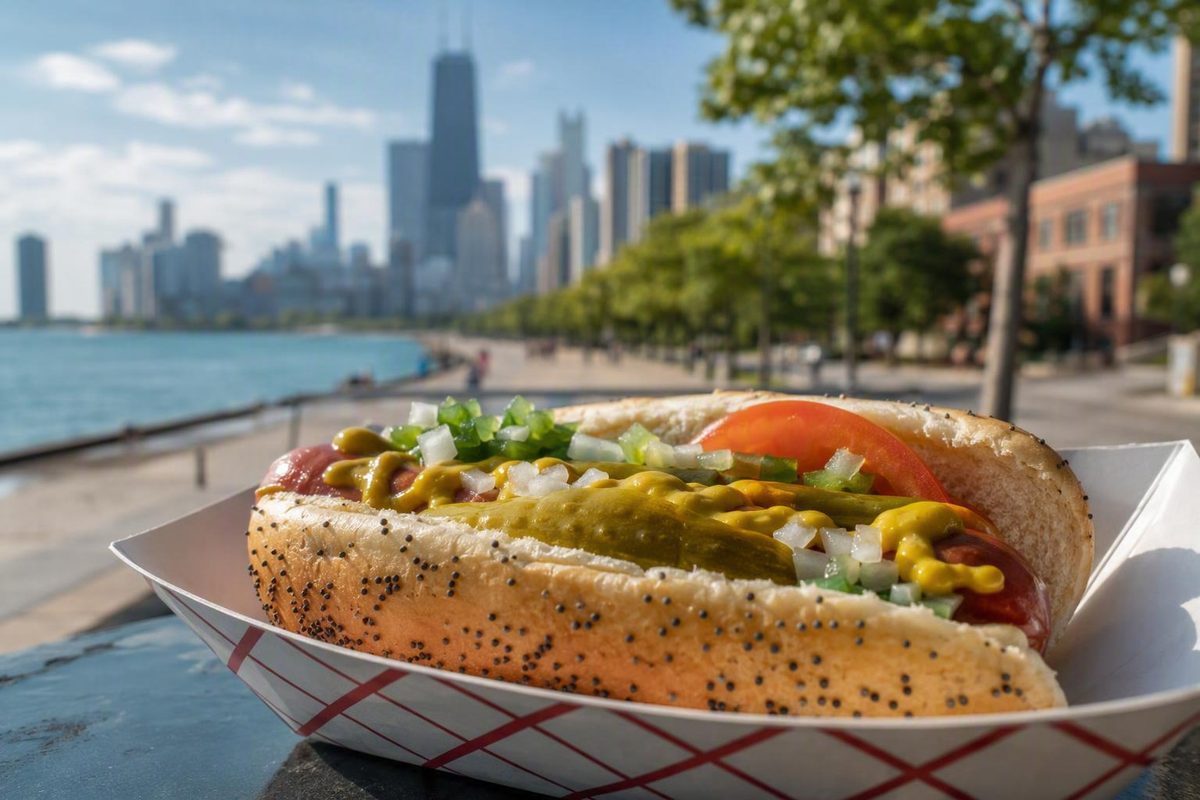
The fully loaded dog is the version most people picture, and Appetites Abroad describes its “drag it through the garden” style: a juicy hot dog topped with mustard (never ketchup), diced white onions, bright green relish, dill pickle, sliced tomatoes, pickled sport peppers, and celery salt, all in a poppyseed bun.
If it is your first Chicago dog, the order is simple: ask for a Chicago-style hot dog with everything. That phrase gets you the full garden build without listing seven toppings at the counter. Serious Eats notes that topping freshness is paramount for pulling off the fully loaded style, so this version rewards stands that move volume and turn over their produce. If the tomatoes and relish look tired, that is a signal about the stand, not the style.
The minimalist West Side version
A simpler dog is still legitimately Chicago-style. Serious Eats states that a stripped-down version featuring just mustard, relish, onions, and sport peppers is just as prevalent as the fully loaded build, especially on the West Side. That precedent matters because food guides sometimes present the seven-topping garden dog as the only authentic order, which the local record does not support.
The minimalist version changes what you taste. Without tomato, pickle, and celery salt, the beef and the casing carry more of the experience, which is why the stands known for this style tend to be judged on the dog itself rather than the produce. Serious Eats also observes that skinless dogs tend to get lost when fully dressed, which cuts the other way here: a minimalist build exposes the sausage, so it favors stands with a crisp natural casing. If you care most about the dog rather than the salad on top, order this way and skip the debate entirely.
How to judge a great Chicago hot dog
Judge a Chicago dog on the sausage, the bun, the toppings, and the assembly, and judge the setting separately. The reason this framework matters is the shared supplier: since Dolinsky reports that roughly 98% of Chicago’s dogs come from the same Vienna Beef plant, he argues that saying one stand’s dogs are better than another’s is usually a condiment, bun, or french fry argument. The stands are not competing on the meat; they are competing on everything around it.
The sources reviewed here converge on five concrete criteria:
- Casing and snap. Serious Eats specifies an all-beef dog with a crisp natural casing from Vienna Beef, noting that skinless dogs lack any snap and get lost under a full dress of toppings.
- Doneness and preparation. Whether the dog is steamed, boiled, or char-grilled changes texture and flavor (covered in the next section), and a stand that executes its chosen method well beats one that does not.
- Bun condition. Appetites Abroad puts it plainly: the bun needs to be fresh, with no dry or stale buns.
- Topping freshness. Serious Eats calls the freshness of toppings paramount, especially for the fully loaded style, where wilted produce ruins the build.
- Proportion and construction. Appetites Abroad lists topping proportion among its judging criteria; a well-built dog keeps every element in each bite rather than dumping condiments at one end.
The second layer of judgment is keeping the food score separate from the experience score. AmazingRibs models this directly for Superdawg, rating the dog 9/10 and the atmosphere 10/10, which tells you the setting slightly outruns the food there. A memorable carhop or a nostalgic dining room is a real reason to choose a stand, but it is a different reason than the dog itself, and conflating the two is how a great outing gets mislabeled as the best bite in the city.
One boundary on all of this: the sources behind this guide scored different stands at different times with different criteria, and they name different winners. No recent apples-to-apples taste test exists in this evidence set where every finalist received the same order and the same rubric. Use the criteria above to run your own comparison; they are the same levers the professional reviewers pull.
Steamed vs. char-grilled: choose by texture and flavor
Neither method is universally better; they produce different dogs, and you should order by preference. Steaming or boiling is the traditional path. Dolinsky states that some places will offer to grill your dog, but steaming and boiling is the classic method. A steamed or boiled dog stays plump and juicy, keeps the casing’s snap clean, and lets the garden toppings share the stage evenly.
Char-grilling trades some of that for browned-meat flavor and a different chew. AmazingRibs describes Gold Coast Dogs’ signature Char Dog: rather than boiling their Vienna Beef hot dogs, they grill them, which gives the slightly sweeter flavor generated by browning meat and a crispier, chewier texture. Spoon University’s North Side guide reaches a similar sensory conclusion from a different kitchen, describing a grilled hot dog as smoky and savory. Char-broiling also extends beyond the standard dog; Superdawg’s official menu lists the Whoopskidawg, a char-broiled take on a Romanian, Hungarian, or Polish sausage, at $12.05.
Here is the practical decision rule. If you want the textbook Chicago dog experience, especially fully loaded, order it steamed or boiled; that is the preparation the classic build was designed around. If you prioritize smokiness, browning, and a firmer bite, order the char version where a stand offers one, and consider the minimalist topping build so the grilled flavor is not buried under tomato and relish. Since preparation can reverse your ranking of two stands that use the same Vienna Beef product, decide your preference before you decide your destination.
Best Chicago hot dogs by occasion
Most hot dog decisions are itinerary decisions: you are near Wrigley, inside O’Hare, out late, or making a deliberate trip. The sections below route each situation to its supported pick and flag what still needs a current check. Be clear about the boundary here: the evidence supports these specific contexts, not a complete neighborhood-by-neighborhood map, and it distinguishes city stops (Wrigleyville, River North, Logan Square, Norwood Park) from the airport terminal. Where a location or access detail is unverified, this guide says so instead of guessing.
For a Wrigley Field game day
Byron’s Hot Dogs is the stronger-supported game-day pick, with Wrigleyville Dogs as the closer backup. The Infatuation’s review places Byron’s at 1017 W. Irving Park Rd., only a few blocks north of the ballpark entrance at Sheffield and Waveland, with a few picnic benches outside. The same review judges the hot dogs and brats there both better and cheaper than at Wrigley Field, which is exactly the game-day tradeoff you are weighing. Note that the review dates to April 2017, so treat its operational details as historical and confirm current hours before you commit the walk.
Wrigleyville Dogs is the proximity play: Spoon University places it a couple hundred feet from the stadium in the heart of Wrigleyville and calls it a game-day fixture for generations of Cubs fans. The route logic is simple. If you have twenty minutes before first pitch, Byron’s short walk north pays off; if you are cutting it close, Wrigleyville Dogs keeps you at the gates.
For an O’Hare stop
You can get a credible Chicago dog inside O’Hare, but treat it as terminal convenience, not a destination. The Infatuation identifies Gold Coast Dogs as a solid O’Hare spot for a quick Chicago dog, and Appetites Abroad directs travelers flying out to Terminal 3 near Gate H14 for a Chicago dog and a drink before departure.
The airport version solves a specific problem: one last local meal without leaving security. It does not replace a trip to Superdawg or Gene & Jude’s, and you should not build an itinerary around it. Confirm current terminal access and hours through O’Hare’s official concession listings before relying on this stop, since neither source verifies present-day operating status and airside access depends on which terminal your flight uses.
For a late-night Chicago dog
Portillo’s is the supported late-night pick because its hours are officially published rather than editorially reported. The official Portillo’s location page lists the Chicago restaurant at 100 W. Ontario St. with restaurant and drive-thru hours of 10:00 AM to 1:00 AM every day of the week, with the caveat that holiday hours may vary. That gives you a verified window past midnight in River North, reachable without a long detour from downtown.
Spoon University’s North Side guide describes a hot dog spot open until 2 a.m. on weekends, but that is older editorial reporting rather than a current official listing, so do not plan a 1:30 a.m. arrival around it. The practical rule for late-night food: an official hours page dated this year outranks a review from several years ago, every time.
For old-school atmosphere and nostalgia
Superdawg is the pick when the experience is the point. The Infatuation describes it as an iconic carhop in Norwood Park that has been around since 1948, meaning you order from your car and the food comes to you, a service format that has mostly vanished from the city. AmazingRibs rates the atmosphere a perfect 10/10.
Keep the two scores separate, though, because the same source rates the dog itself 9/10. That is an excellent dog, and it also means Superdawg’s consensus position rests partly on the setting. If you are choosing between a trip to Norwood Park and a closer stand, decide whether you are buying the carhop experience or purely the sausage. For a first visit or a visitor’s single stop, the combined package justifies the drive up Milwaukee Avenue; for a quick lunch, a nearer pick may serve you better.
For unconventional and alternative sausages
Chicago’s Dog House is the supported stop for a group that wants options beyond the classic dog. Its official site lists wagyu, alligator, and vegan sausages alongside classic Chicago-style dogs and Maxwell St. Polish sausages. Spoon University’s North Side coverage describes a chalkboard menu with alligator sausage, duck confit dogs, and even a rattlesnake and rabbit combo sausage, which matches that adventurous range. One operational note from the official site: the Loop location is now closed due to the permanent closure of the Washington Food Hall, so confirm which location you are routing to before you go.
Superdawg also covers the beyond-the-dog case within a classic setting. Its official menu lists the char-broiled Whoopskidawg sausage at $12.05 and the char-broiled Superchic chicken sandwich at $12.35. For allergen and ingredient questions about the vegan option, see the dietary section below; a menu listing is not the same as dietary documentation.
Check these details before you go
Verify open status, hours, and payment on the stand’s official page before you travel, because this evidence set confirms only scattered details and at least one closure. The Chicago’s Dog House Loop closure notice on its own website is the clearest demonstration of why: an editorial list can name a location that no longer exists, and only the merchant’s current page catches it.
Here is what the evidence does support right now. Portillo’s official page lists 100 W. Ontario St., Chicago, phone (312) 587-8910, with 10:00 AM to 1:00 AM hours daily and a note that holiday hours may vary. Superdawg’s official Chicago menu, dated July 2025, prices the signature Superdawg with Superfries at $9.30 and states that any sandwich without Superfries costs $2.50 less, a useful distinction because the listed prices are effectively small meals, not standalone dogs. The Infatuation reports Byron’s has a few picnic benches outside, which is the only seating detail verified for any finalist, and separately reports that Redhot Ranch is cash-only, so bring cash if Logan Square is your stop.
Before you commit to a trip, run this quick check on the stand’s official site or phone line:
- Current open status and address, especially for multi-location operators
- Today’s hours, including any holiday variance
- Payment methods (Redhot Ranch’s reported cash-only policy shows why this matters)
- Whether posted prices are standalone items or include fries and sides
- Ordering format: counter, drive-thru, or carhop service
Everything not listed above, including parking, transit access, typical waits, takeout packaging, and accessibility, is unverified in this evidence set for every finalist. That is not a reason to skip a stand; it is a reason to spend two minutes on its official page before you drive across the city.
Dietary and allergen questions
The honest answer: this evidence set documents menu variety, not dietary suitability. Chicago’s Dog House lists vegan sausages on its own website alongside wagyu and alligator options, which makes it the one finalist with a merchant-reported vegan item. That is a real signal for mixed-preference groups, but it is a menu listing, not ingredient documentation.
None of the sources reviewed here verify vegan bun availability, gluten-aware options, allergen statements, or cross-contact practices at any stand, including whether plant-based sausages share cooking surfaces with meat. For anyone with a food allergy, celiac disease, or a strict vegan requirement, treat every claim in this guide as a starting point and contact the restaurant directly for current ingredient and preparation information before ordering. A shared flat-top or fryer can matter more than the menu wording, and only the kitchen can answer that question accurately.